USS Strong (DD-758)
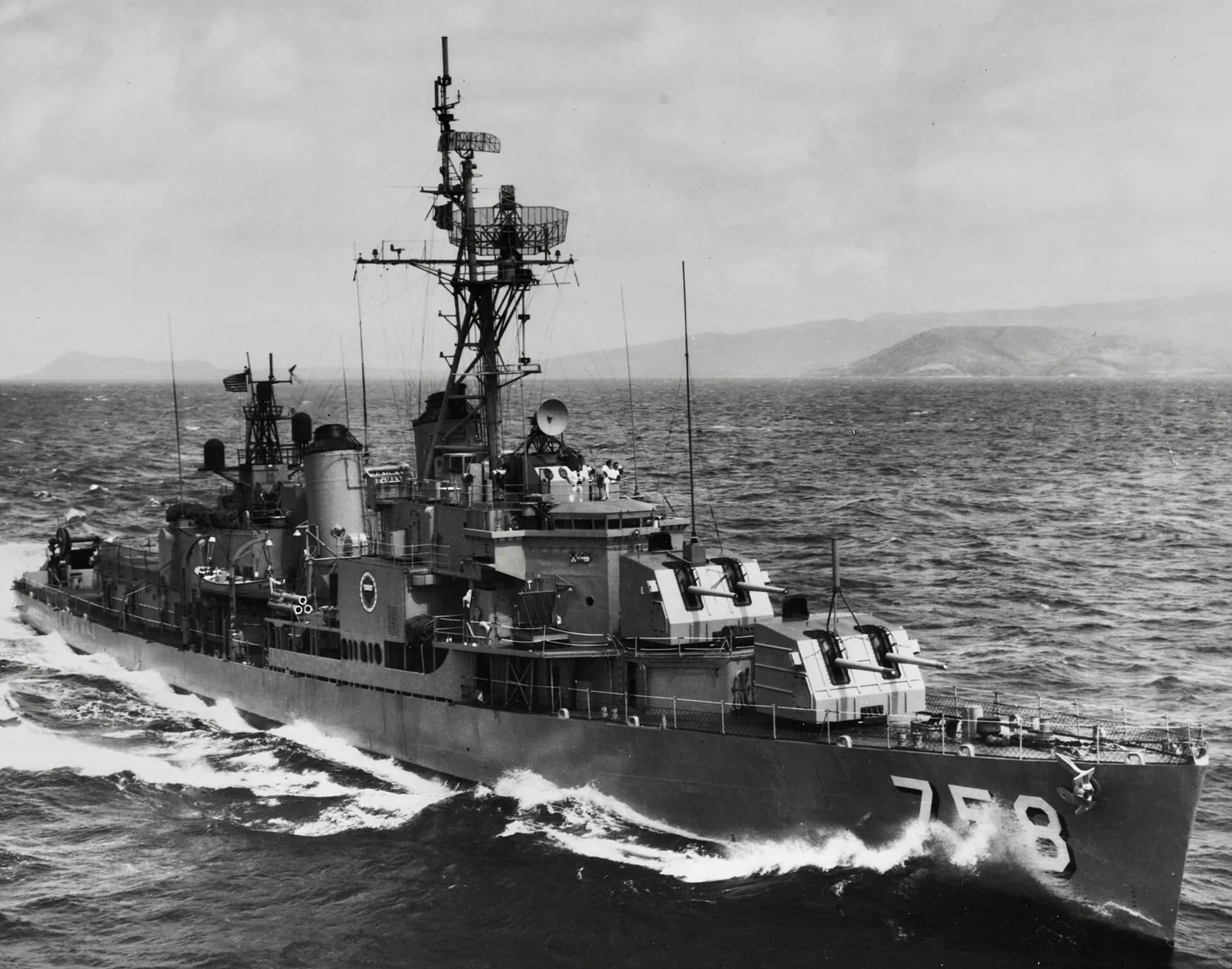
Service
- as Strong8 March 1945 — 31 October 1973178 days of the war
- as Rio Grande do Norte31 October 1973 — 1996
- Name
- USS Strong
- Pennant / hull number
- DD-758
- Namesake
- James H. Strong
- Builder
- Bethlehem Steel, San Francisco
- Laid down
- 25 July 1943
- Launched
- 23 April 1944
- Commissioned
- 8 March 1945
- Decommissioned
- 31 October 1973
- Struck
- 31 October 1973
- Fate
- Reportedly sunk in high seas in 1997 off the coast of Durban, South Africa, while she was under tow from Brazil to India to be scrapped (1997)
- Status
- Scrapped
Specifications
- Displacement, standard
- 2,200 long tons (2,235 t)
- Length
- 114.6 m (376 ft)
- Beam
- 12.19 m (40 ft)
- Draught
- 4.57 m (15 ft)
- Speed
- 34 knots (63 km/h, 39.1 mph)
- Range
- 6,500 nmi (12,038 km)
- Complement
- 336
- Main gun
- 127 mm (5 in)
James H. Strong, born in Canandaigua, N.Y., on 26 April 1814, was appointed a midshipman in the Navy while he was a student in the Polytechnic College at Chittenango, N.Y., on 2 February 1829. He made his first cruise on the Brazil station in Lexington from 1833 to 1835. After various cruises, he commanded the store ship Relief in 1859.
Strong was promoted to commander in April 1861 and commanded Mohawk and Flag in the South Atlantic Blockading Squadron in 1861 and 1862 and Monon gahela in the West Gulf Blockading Squadron from 1863 to 1865. At the Battle of Mobile Bay, he was the first to ram the Confederate ironclad Tennessee and received high commendation for his initiative and valor.
Strong served at the Brooklyn Navy Yard in 1866 and 1867 and later commanded Canandaigua in the Mediterranean Squadron in 1869 and 1870. He was promoted to rear admiral in 1873 and served as Commander-in-Chief of the South Atlantic Squadron from 1873 to 1875. Strong retired on 25 April 1876.
Continue to the full service history About 1,111 words
From the Dictionary of American Naval Fighting Ships, compiled by the Naval History and Heritage Command (Strong II (DD-758)). A work of the United States Government, in the public domain.
Armament and machinery
Armament and machinery
- Propulsion
- 60000 shp
- 2 propellers
- Armament
- 6 × 5 in/38 cal. guns
- 12 × 40 mm AA guns
- 11 × 20 mm AA guns
- 10 × 21 inch (533 mm) torpedo tubes
- 6 × depth charge projectors
- 2 × depth charge tracks
Sister ships
- USS Alfred A. Cunningham
- USS Allen M. Sumner
- USS Ault
- USS Barton (DD-722)
- USS Blue (DD-744)
- USS Borie (DD-704)
- USS Bristol (DD-857)
- USS Brush
- USS Charles S. Sperry
- USS Collett
- USS Compton
- USS Cooper
- USS De Haven (DD-727)
- USS Douglas H. Fox
- USS Drexler
- USS English
- USS Frank E. Evans
- USS Gainard
- USS Hank
- USS Harlan R. Dickson
- USS Harry E. Hubbard
- USS Haynsworth
- USS Hugh Purvis
- USS Hugh W. Hadley
Sources
- Facts harvested from USS Strong (DD-758) on Wikipedia. Figures only — no wording is taken from it.
- Service history reproduced verbatim from Strong II (DD-758) , Dictionary of American Naval Fighting Ships — public domain, a work of the United States Government.
- Photograph: PHCM Louis P. Bodine, U.S. Navy — U.S. Navy photo NH 107152 — Public domain — Wikimedia Commons