USS Walke (DD-723)
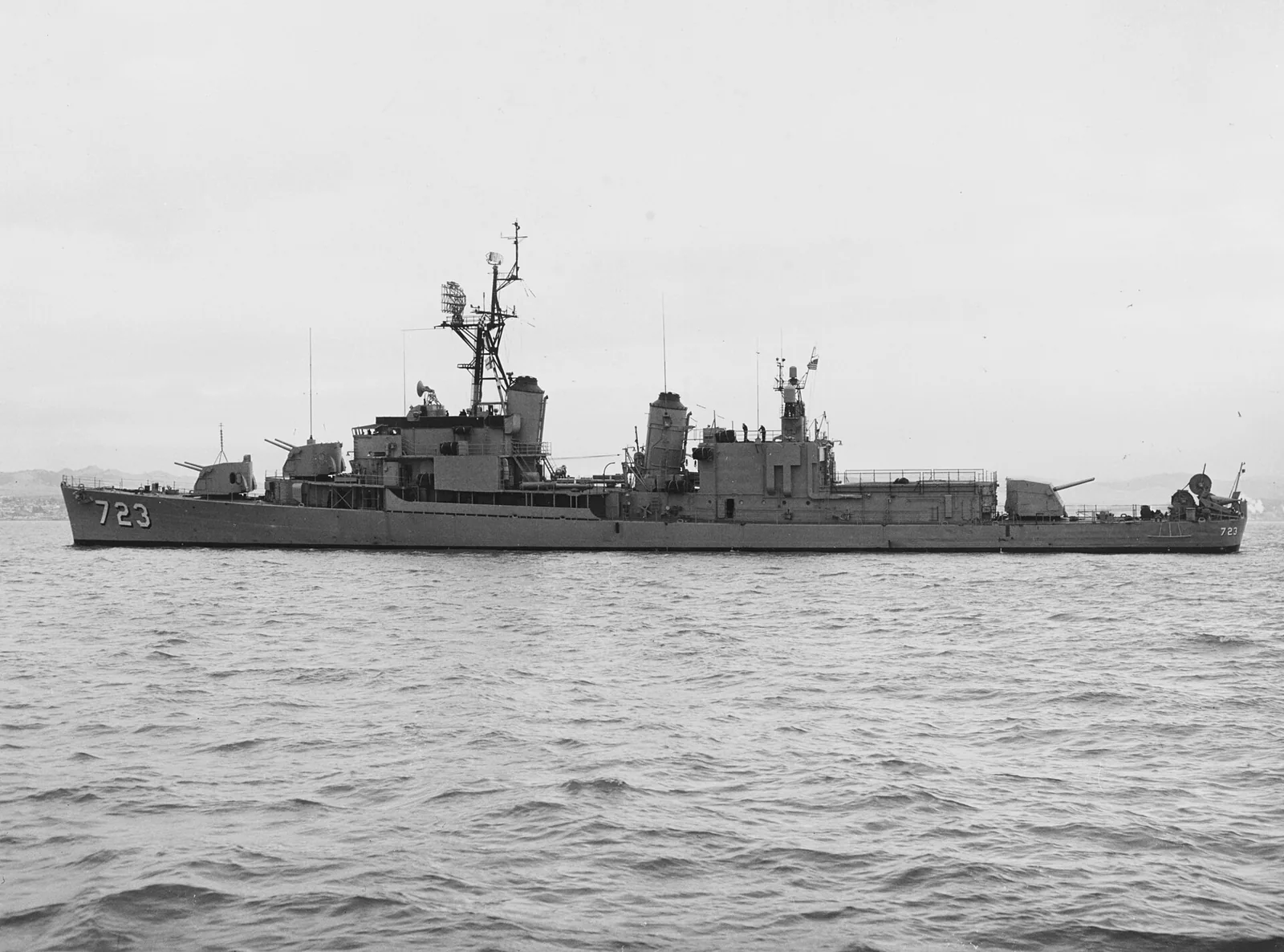
Service
- as Walke21 January 1944 — 30 November 1970590 days of the war
- Name
- USS Walke
- Pennant / hull number
- DD-723
- Namesake
- Henry A. Walke
- Builder
- Bath Iron Works
- Laid down
- 7 June 1943
- Launched
- 27 October 1943
- Commissioned
- 21 January 1944
- Decommissioned
- 30 November 1970
- Struck
- 1 February 1974
- Fate
- Sold 16 April 1975 for scrapping (1975)
- Status
- Scrapped
Specifications
- Displacement, standard
- 2,200 long tons (2,235 t)
- Length
- 114.6 m (376 ft)
- Beam
- 12.19 m (40 ft)
- Draught
- 4.57 m (15 ft)
- Speed
- 34 knots (63 km/h, 39.1 mph)
- Range
- 6,500 nmi (12,038 km)
- Complement
- 336
- Main gun
- 127 mm (5 in)
Henry A. Walke, born on Christmas Eve 1809 in Princess Anne County, Va., was appointed a midshipman on 1 February 1827 and reported for duty at the navy yard at Gosport, Va. (Norfolk). Walke received his initial naval training at Gosport and, from July 1827 to November 1828, cruised the West Indies in sloop Natchez in the campaign against pirates in that area. He made a voyage to the Mediterranean in On tario between August 1829 and November 1831. Walke received his warrant as a passed midshipman on 12 July 1833 and, after several months of post-sea duty leave, transferred to duty ashore at the Philadelphia Navy Yard on 7 March 1834. Between January 1836 and June 1839, he cruised the Pacific Station in the 74-gun ship-of-the-line North Carolina, primarily along the western coast of South America protecting American commerce during a period of unrest caused by strained relations between the United States and Mexico and the war between Peru and Chile.
During service in the receiving ship at New York, Walke was promoted to lieutenant before reporting on board Boston on 5 October 1840. While Lt. Walke was assigned to that sloop of war, she made a cruise to the East Indies. Returning home in 1843, he went ashore for an extended leave before returning to sea in the brig Bainbridge in May 1844 for a cruise along the Brazilian coast.
He returned home early in 1846 and, after a year assigned to the receiving ship at New York, made an eight-month voyage in Vesuvius during which his ship participated in the Mexican War, blockading Laguna and supporting landings at Tuxpan and Tabasco. In October 1847, Lt. Walke went home for another extended leave after which he reported back to the receiving ship at New York on 22 September 1848.
Continue to the full service history About 4,400 words
From the Dictionary of American Naval Fighting Ships, compiled by the Naval History and Heritage Command (Walke III (DD-723)). A work of the United States Government, in the public domain.
Armament and machinery
Armament and machinery
- Propulsion
- 60000 shp
- 2 propellers
- Armament
- 6 × 5 in/38 cal. guns
- 12 × 40 mm AA guns
- 11 × 20 mm AA guns
- 10 × 21 inch (533 mm) torpedo tubes
- 6 × depth charge projectors
- 2 × depth charge tracks
Sister ships
- USS Alfred A. Cunningham
- USS Allen M. Sumner
- USS Ault
- USS Barton (DD-722)
- USS Blue (DD-744)
- USS Borie (DD-704)
- USS Bristol (DD-857)
- USS Brush
- USS Charles S. Sperry
- USS Collett
- USS Compton
- USS Cooper
- USS De Haven (DD-727)
- USS Douglas H. Fox
- USS Drexler
- USS English
- USS Frank E. Evans
- USS Gainard
- USS Hank
- USS Harlan R. Dickson
- USS Harry E. Hubbard
- USS Haynsworth
- USS Hugh Purvis
- USS Hugh W. Hadley
Sources
- Facts harvested from USS Walke (DD-723) on Wikipedia. Figures only — no wording is taken from it.
- Service history reproduced verbatim from Walke III (DD-723) , Dictionary of American Naval Fighting Ships — public domain, a work of the United States Government.
- Photograph: Unknown author — U.S. Navy photo NH 99816 — Public domain — Wikimedia Commons