USS Willard Keith (DD-775)
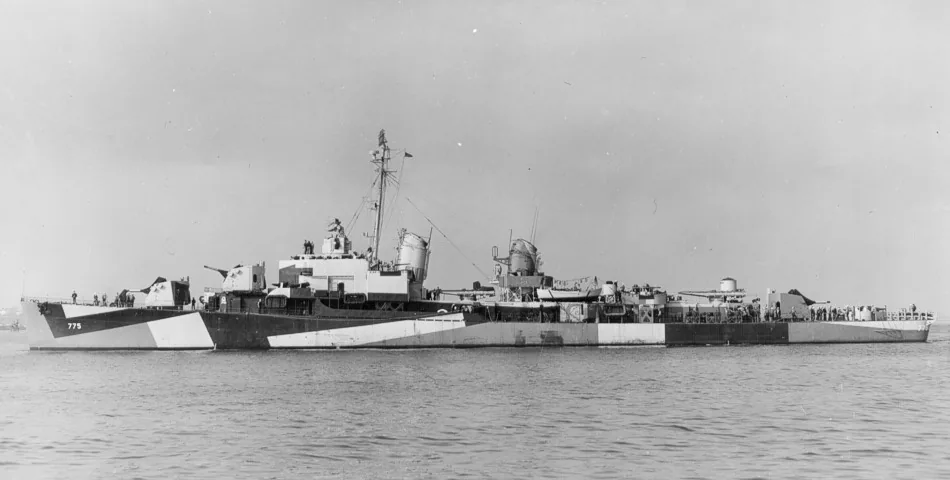
Service
- as Willard Keith27 December 1944 — 1 July 1972249 days of the war
- as Caldas1 July 1972 — 1977
- Name
- USS Willard Keith
- Pennant / hull number
- DD-775
- Namesake
- Willard Keith
- Builder
- Bethlehem Shipbuilding, San Pedro
- Laid down
- 5 March 1944
- Launched
- 29 August 1944
- Commissioned
- 27 December 1944
- Decommissioned
- 1 July 1972
- Struck
- 1 July 1972
- Fate
- Scrapped 1977 (1977)
- Status
- Scrapped
Specifications
- Displacement, standard
- 2,200 long tons (2,235 t)
- Length
- 114.6 m (376 ft)
- Beam
- 12.19 m (40 ft)
- Draught
- 4.57 m (15 ft)
- Speed
- 34 knots (63 km/h, 39.1 mph)
- Range
- 6,500 nmi (12,038 km)
- Complement
- 336
- Main gun
- 127 mm (5 in)
Willard Woodward Keith, Jr., born on 13 June 1920 in Berkeley, Calif., enlisted in the Marine Corps Reserve on 18 April 1939 and served as an enlisted man until he received an honorable discharge on 3 November 1940 to take an appointment as 2d lieutenant in the reserves on the following day. Called to active duty on 20 February 1941, he served "stateside" until his unit was transferred to the South Pacific in the spring of 1942 to build up for the first Allied offensive in that theater: Guadalcanal.
Eventually promoted to captain, Keith led Company "G," 2d Battalion, 5th Marines, from the initial phase of the Guadalcanal campaign. He landed with them at Tulagi on 7 August 1942.
By that autumn, the campaign on Guadalcanal Island was still a hard-fought one. In an offensive aimed against Japanese artillery positions sited beyond the Matanikau River and within range of the important Henderson Field airstrip, the 2d Battalion was assigned the left flank position. Initial elements of the battalion crossed the Matanikau in rubber boats before dawn on 3 November 1942, supported effectively by dive bomber strikes, artillery, and naval gunfire. That afternoon, Capt. Keith led his company against a Japanese strong-point manned by a platoon not only reinforced with heavy machine guns but concealed by heavy jungle growth and entrenched on commanding high ground. Realizing that neither mortar nor artillery fire could reach the Japanese positions, Keith, determined to evict the Japanese, initiated and led successive bayonet and hand grenade charges in the face of heavy fire. Although the Japanese platoon was annihilated,Capt. Keith was struck in the head by a bullet and killed instantly.
Continue to the full service history About 2,358 words
From the Dictionary of American Naval Fighting Ships, compiled by the Naval History and Heritage Command (Willard Keith (DD-775)). A work of the United States Government, in the public domain.
Armament and machinery
Armament and machinery
- Propulsion
- 60000 shp
- 2 propellers
- Armament
- 6 × 5 in/38 cal. guns
- 12 × 40 mm AA guns
- 11 × 20 mm AA guns
- 10 × 21-inch (533 mm) torpedo tubes
- 6 × depth charge projectors
- 2 × depth charge tracks
Sister ships
- USS Alfred A. Cunningham
- USS Allen M. Sumner
- USS Ault
- USS Barton (DD-722)
- USS Blue (DD-744)
- USS Borie (DD-704)
- USS Bristol (DD-857)
- USS Brush
- USS Charles S. Sperry
- USS Collett
- USS Compton
- USS Cooper
- USS De Haven (DD-727)
- USS Douglas H. Fox
- USS Drexler
- USS English
- USS Frank E. Evans
- USS Gainard
- USS Hank
- USS Harlan R. Dickson
- USS Harry E. Hubbard
- USS Haynsworth
- USS Hugh Purvis
- USS Hugh W. Hadley
Sources
- Facts harvested from USS Willard Keith (DD-775) on Wikipedia. Figures only — no wording is taken from it.
- Service history reproduced verbatim from Willard Keith (DD-775) , Dictionary of American Naval Fighting Ships — public domain, a work of the United States Government.
- Photograph: U.S. Navy — Official U.S. Navy Bureau of Ships photo 19-N-76873 available at Destroyerhistory.org — Public domain — Wikimedia Commons