HMS Annan (K297)
Service
- as USS Natchez16 December 1942 — 11 October 1945991 days of the war
- as Juan Pablo Duarte19 March 1948 — 1949
- Name
- HMS Annan
- Pennant / hull number
- K297
- Namesake
- Natchez, Mississippi
- Builder
- Canadian Vickers Ltd., Montreal
- Laid down
- 16 March 1942
- Launched
- 12 September 1942
- Commissioned
- 16 December 1942
- Decommissioned
- 11 October 1945
- Fate
- ran aground, 1949; sold for use as personal yacht, c. 1957; scrapped, 1959 (1949)
- Status
- Scrapped
Specifications
- Displacement, standard
- 2,360 long tons (2,398 t)
- Length
- 91.74 m (301 ft)
- Beam
- 10.97 m (36 ft)
- Draught
- 3.96 m (13 ft)
- Speed
- 20.3 knots (37.6 km/h, 23.4 mph)
- Complement
- 194
- Main gun
- 76 mm (3 in)
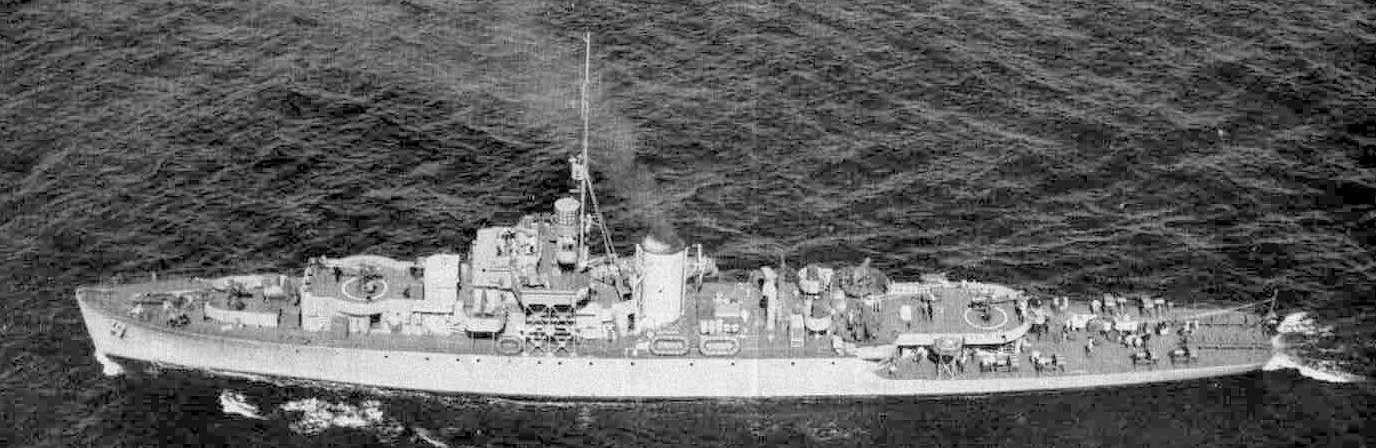
Natchez (PG-102) was laid down 16 March 1942 by Canadian Vickers Ltd., Montreal, Canada as HMS Annan (K-297), later designated as HMCS Annan (K-297); acquired by the U.S. Navy 20 July 1942 and named and classified as Natchez (PG-102) on 8 October 1942; launched 12 September 1942, and commissioned at Ottawa, Canada 16 December 1942.
Natchez sailed under escort to Boston, arriving at the Boston Navy Yard 16 January 1943 for fitting out. On 1 March she reported for duty to Commander Eastern Sea Frontier and was assigned escort duty for merchant convoys between Cuba and New York. Natchez was reclassified as PF-2 on 15 April 1943.
On 4 December, Cuban freighter SS Libertad was reported missing from her convoy off the southern Atlantic coast. Natchez with several other patrol vessels, was dispatched to the scene, guided by homing signals from Navy blimps. Natchez found only three survivors who related that their ship had been torpedoed and sank before they could notify the convoy commander.
Through 1944, Natchez escorted convoys and performed ASW patrol duties. While on convoy duty 29 April 1945, she simultaneously received a sonar contact and sighted the snorkel of a German U-boat, 98 miles east of Cape Henry, Virginia. Launching an immediate attack, she was quickly joined by three destroyer escorts: Coffman (DE-191); Bostwick (DE103); and Thomas (DE-102). Hedgehogs and depth charges erupted large areas of the ocean bottom as the four vessels sought to trap the enemy submarine. Finally contact was lost and a large quantity of oil was seen to rise to the surface, indicating destruction of the U-boat. German sources, at the end of the war, substantiated that U-548 had gone down as a result of this attack.
At the end of the war, Natchez was still patrolling in the Atlantic. She returned to Charleston, S.C., 29 June 1945 for inactivation and disposal.
Natchez decommissioned 11 October 1945, and was delivered to the Maritime Commission on 19 November. On 29 July 1947 she was sold to Louis Moore of Miami, Florida, who resold her to the Dominican Republic 19 March 1948.
From the Dictionary of American Naval Fighting Ships, compiled by the Naval History and Heritage Command (Natchez II (PG-102)). A work of the United States Government, in the public domain.
Armament and machinery
Armament and machinery
- Propulsion
- two 225 psi 3-drum express boilers, two 5500 shp Canadian Vickers vertical triple expansion steam engines, two shaft.
- Armament
- 3 x 3 in/50 cal. dual purpose gun mounts
- 2 x Twin 40 mm gun mounts
- 9 x 20 mm gun mounts
- 2 x Depth charge racks
- 8 x Depth charge projectors
- 1 x Hedgehog depth charge projector
Sister ships
Sources
- Facts harvested from HMS Annan (K297) on Wikipedia. Figures only — no wording is taken from it.
- Service history reproduced verbatim from Natchez II (PG-102) , Dictionary of American Naval Fighting Ships — public domain, a work of the United States Government.
- Photograph: U.S. Navy photo — https://www.navsource.net/archives/12/08002.htm — Public domain — Wikimedia Commons