USS Floyd B. Parks
Service
- as USS Floyd B. Parks31 July 1945 — 2 July 197336 days of the war
- Name
- USS Floyd B. Parks
- Pennant / hull number
- DD-884
- Namesake
- Floyd B. Parks
- Laid down
- 30 October 1944
- Launched
- 31 March 1945
- Commissioned
- 31 July 1945
- Decommissioned
- 2 July 1973
- Struck
- 2 July 1973
- Fate
- Sold for scrap, 1 April 1974 (1974)
- Status
- Scrapped
Specifications
- Displacement, standard
- 2,616 long tons (2,658 t)
- Displacement, full load
- 3,460 long tons (3,516 t)
- Length
- 119.02 m (390.5 ft)
- Beam
- 12.47 m (40.9 ft)
- Draught
- 4.36 m (14.3 ft)
- Speed
- 36.8 knots (68.2 km/h, 42.3 mph)
- Range
- 4,500 nmi (8,334 km)
- Complement
- 336
- Main gun
- 40 mm (1.6 in)
Floyd Bruce Parks, born 16 January 1911 in Salisbury, Mo., was a member of the Naval Academy class of 1934, and was appointed a Second Lieutenant in the Marine Corps 1 June 1934. He commanded Marine Fighting Squadron 221 in the Battle of Midway, in which he was killed, 4 June 1942, while leading his men against a vastly superior force of Japanese bombers and fighters. For his heroism, Major Parks was posthumously awarded the Navy Cross.
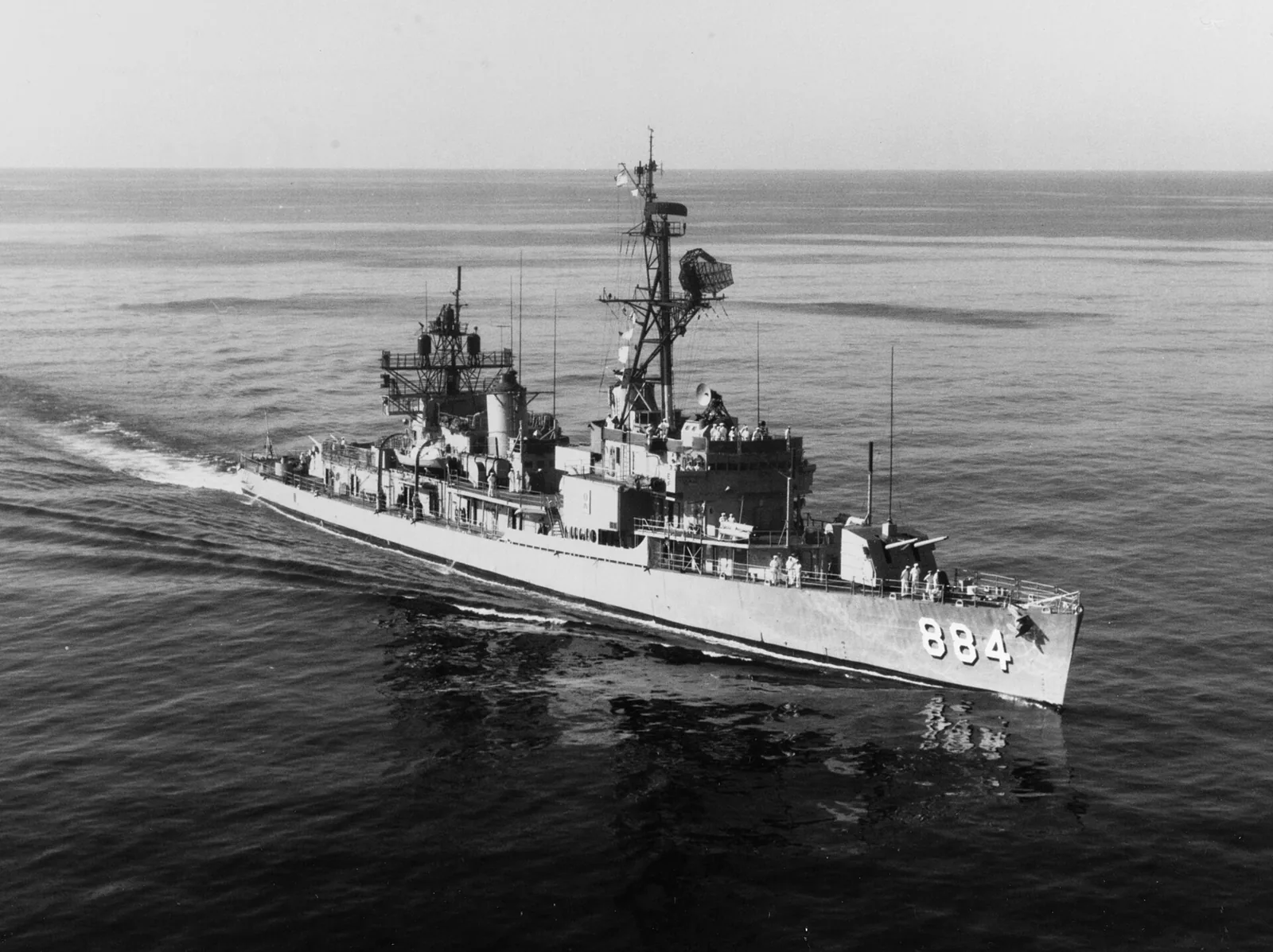
Floyd B. Parks (DD-884) was launched 31 March 1945 by Consolidated Steel Corp., Orange, Tex.; sponsored by Mrs. Floyd B. Parks, widow of Major Parks; and commissioned 31 July 1945, Commander M. Slayton in command.
Floyd B. Parks arrived at San Diego, her home port, 16 November 1945, and sailed 20 November for her first tour of duty in the Far East, patrolling the coast of China and operating in the Marianas until her return to San Diego 11 February 1947. In the period prior to the outbreak of war in Korea, Floyd B. Parks twice more deployed to the Far East for duty with the 7th Fleet, returning from her second such cruise 13 June 1950, just before the North Koreans crossed the 38th parallel. At once she prepared to return to duty as a standby at Pearl Harbor, available should war spread, returning to San Diego 20 August.
Floyd B. Parks sailed from San Diego 19 February 1951 to join in United Nations operations in Korea. On 16 March she joined the fast carrier task force, screening them during air operations off the east coast as well as spending a total of 60 days in Wonsan Harbor on blockade and bombardment duty. She returned to San Diego 10 October 1951, and after west coast operations, sailed for duty in the Far East again 31 May 1952. Along with duty similar to that of her first war cruise, she patrolled in the South China Sea and the Taiwan Strait. She returned to San Diego 18 December 1952, and began a peace-time schedule of annual Far East cruises interspersed with west coast training operations and necessary maintenance.
During her 1955 Far Eastern cruise, Floyd B. Parks took part in evacuation of the Tachen Islands, and while in the Orient once more 11 March 1956, collided with Columbus (CA-74), losing 2 men and a 40-foot section of her bow. Skillful work by her crew saved their ship, and brought her safely into Subic Bay for temporary repairs. Upon her return to Long Beach Naval Shipyard 14 May 1956, Floyd B. Parks' damaged bow was replaced with that of the uncompleted destroyer Lansdale (DD-766) and after completion of repairs and installation of new equipment Floyd B. Parks returned to her west coast-Far East rotation through 1962.
From the Dictionary of American Naval Fighting Ships, compiled by the Naval History and Heritage Command (Floyd B. Parks (DD-884)). A work of the United States Government, in the public domain.
Armament and machinery
Armament and machinery
- Propulsion
- 2 shaft; General Electric steam turbines; 4 boilers; 60000 shp
- Armament
- 6 × 5-inch 38 caliber anti-aircraft guns
- 12 × 40 mm anti-aircraft guns
- 11 × 20 mm anti-aircraft guns
- 10 × 21 inch (533 mm) torpedo tubes
Sister ships
- USS Abner Read (DD-769)
- USS Benner (DD-807)
- USS Bordelon
- USS Charles P. Cecil
- USS Charles R. Ware (DD-865)
- USS Chevalier (DD-805)
- USS Corry (DD-817)
- USS Dennis J. Buckley (DD-808)
- USS Duncan (DD-874)
- USS Dyess
- USS Eugene A. Greene
- USS Everett F. Larson (DD-830)
- USS Frank Knox
- USS Fred T. Berry
- USS Furse
- USS Gearing
- USS George K. MacKenzie
- USS Goodrich
- USS Gurke
- USS Gyatt
- USS Hanson
- USS Harold J. Ellison (DD-864)
- USS Hawkins
- USS Henderson (DD-785)
Sources
- Facts harvested from USS Floyd B. Parks on Wikipedia. Figures only — no wording is taken from it.
- Service history reproduced verbatim from Floyd B. Parks (DD-884) , Dictionary of American Naval Fighting Ships — public domain, a work of the United States Government.
- Photograph: Unknown author — U.S. Navy photo USN 1147454 — Public domain — Wikimedia Commons