USS Memphis (CL-13)
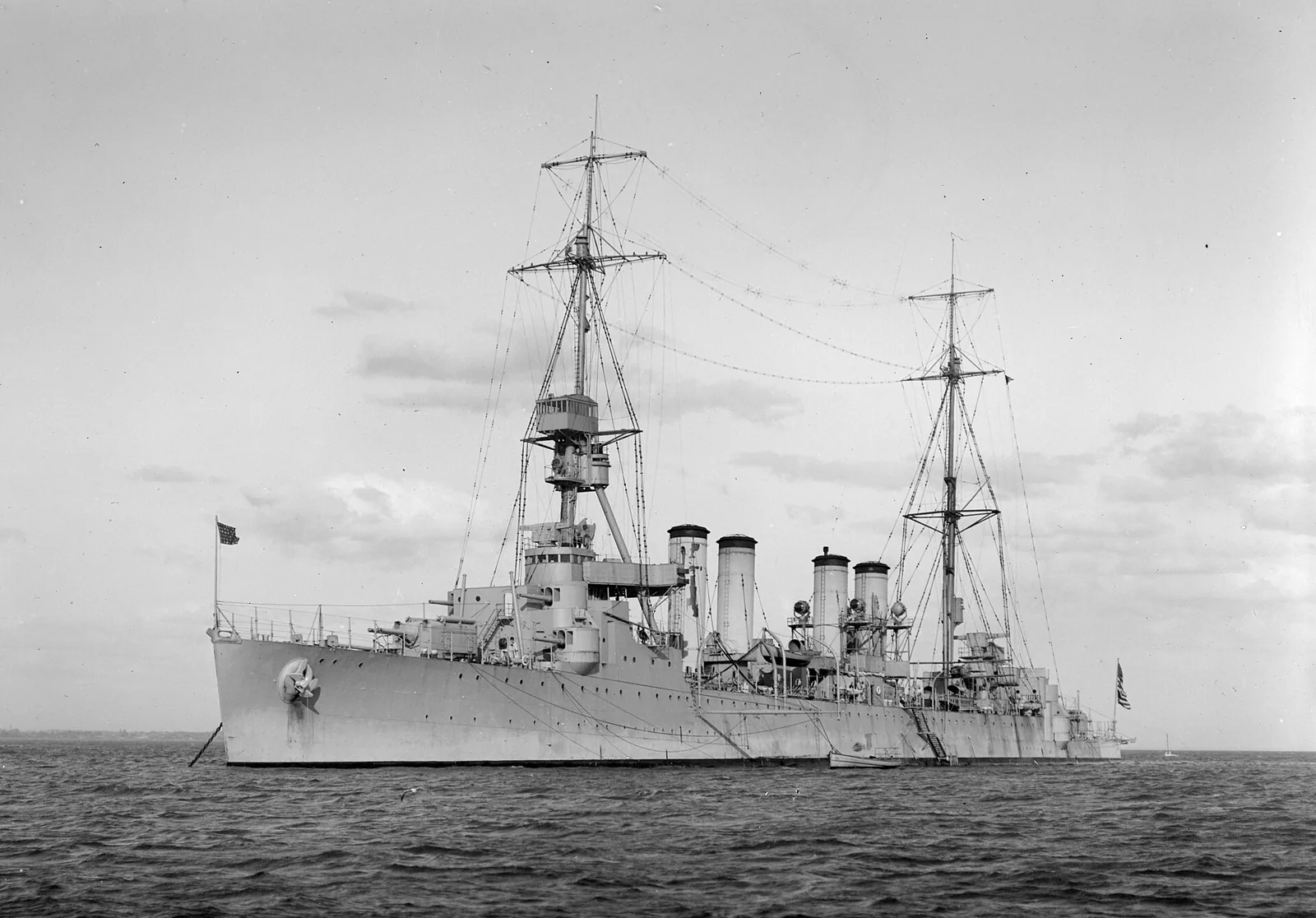
Service
- as Memphis4 February 1925 — 17 December 19452,193 days of the war
- Name
- USS Memphis
- Pennant / hull number
- CL-13
- Namesake
- City of Memphis, Tennessee
- Builder
- William Cramp & Sons, Philadelphia
- Ordered
- 1 July 1918
- Laid down
- 14 October 1920
- Launched
- 17 April 1924
- Commissioned
- 4 February 1925
- Decommissioned
- 17 December 1945
- Struck
- 8 January 1946
- Fate
- Scrapped at Baltimore, 1947 (1947)
- Status
- Scrapped
Specifications — As built
- Displacement, standard
- 7,050 long tons (7,163 t)
- Displacement, full load
- 9,508 long tons (9,661 t)
- Length
- 169.16 m (555 ft) OA
- Beam
- 16.76 m (55 ft)
- Draught
- 4.27 m (14 ft)
- Speed
- 35 knots (64.8 km/h, 40.3 mph)
- Main gun
- 152 mm (6 in)
A city in southwestern Tennessee; so named because it is situated upon the Mississippi River in a manner similar to the capital city of the Old Kingdom of ancient Egypt on the Nile. In the Civil War, Memphis fell 6 June 1862 to Union naval forces led by Flag Officer Charles H. Davis and was an important Federal base for the rest of the war. The first Memphis retained her merchant name.
Memphis (CL‑13) was laid down by William Cramp & Sons, Philadelphia, Pa., 14 October 1920; launched 17 April 1924; sponsored by Miss Elizabeth R. Paine, daughter of Mayor Rowlett Paine of Memphis; and commissioned at the Philadelphia Navy Yard 4 February 1925, Capt. Henry E. Lackey in command.
Late in February Memphis got underway for a shakedown cruise in the Caribbean. On 13 April the cruiser participated in the dedication of an American memorial gateway to Commodore Oliver H. Perry at Port‑of‑Spain, Trinidad. Six years after the indomitable Perry had defeated the British on Lake Erie 10 September 1813, he died on board frigate John Adams at Port‑of‑Spain and was interred there until his remains were removed to Newport, R.I., 7 years later. In June Memphis joined ships of a scouting fleet off Honolulu, Hawaii, for a cruise to the South Pacific through September, with visits to Australia and New Zealand. From October to April 1926 she again operated in the West Indies before returning to her home port, New York.
Continue to the full service history About 835 words
From the Dictionary of American Naval Fighting Ships, compiled by the Naval History and Heritage Command (Memphis IV (CL-13)). A work of the United States Government, in the public domain.
Armament and machinery
This vessel is recorded in 2 configurations. Wartime refits changed armament and complement substantially, so each is kept separately rather than averaged into one set of figures. The figures above are as built.
As built
- Propulsion
- 4 × Parsons steam turbines
- 4 × screws
- Power
- 12 × White-Forster boilers
- 90000 ihp (Estimated power produced on trials)
- Armament
- 2 × twin 6 in/53 caliber guns
- 8 × single 6 in/53 caliber guns
- 4 × 3 in caliber anti-aircraft guns
- 2 × triple 21 in torpedo tubes
- 2 × twin 21 in torpedo tubes
- 224 × mines (removed soon after completion)
- Armour
- Belt: 3 in
- Deck: 1+1/2 in
- Conning Tower: 1 in
- Bulkheads: 1-3 in
- Aircraft
- 2 × floatplanes
1945
- Main gun
- 152 mm (6 in)
- Armament
- 2 × twin 6 in/53 caliber
- 6 × single 6 in/53 caliber
- 7 × 3 in/50 caliber anti-aircraft guns
- 2 × triple 21 in torpedo tubes
- 2 × twin 40 mm Bofors guns
- 12 × single 20 mm Oerlikon cannons
Sister ships
Sources
- Facts harvested from USS Memphis (CL-13) on Wikipedia. Figures only — no wording is taken from it.
- Service history reproduced verbatim from Memphis IV (CL-13) , Dictionary of American Naval Fighting Ships — public domain, a work of the United States Government.
- Photograph: Allan C. Green 1878 - 1954 — This image is available from the Our Collections of the State Library of Victoria under the Accession Number: — Public domain — Wikimedia Commons