USS Trenton (CL-11)
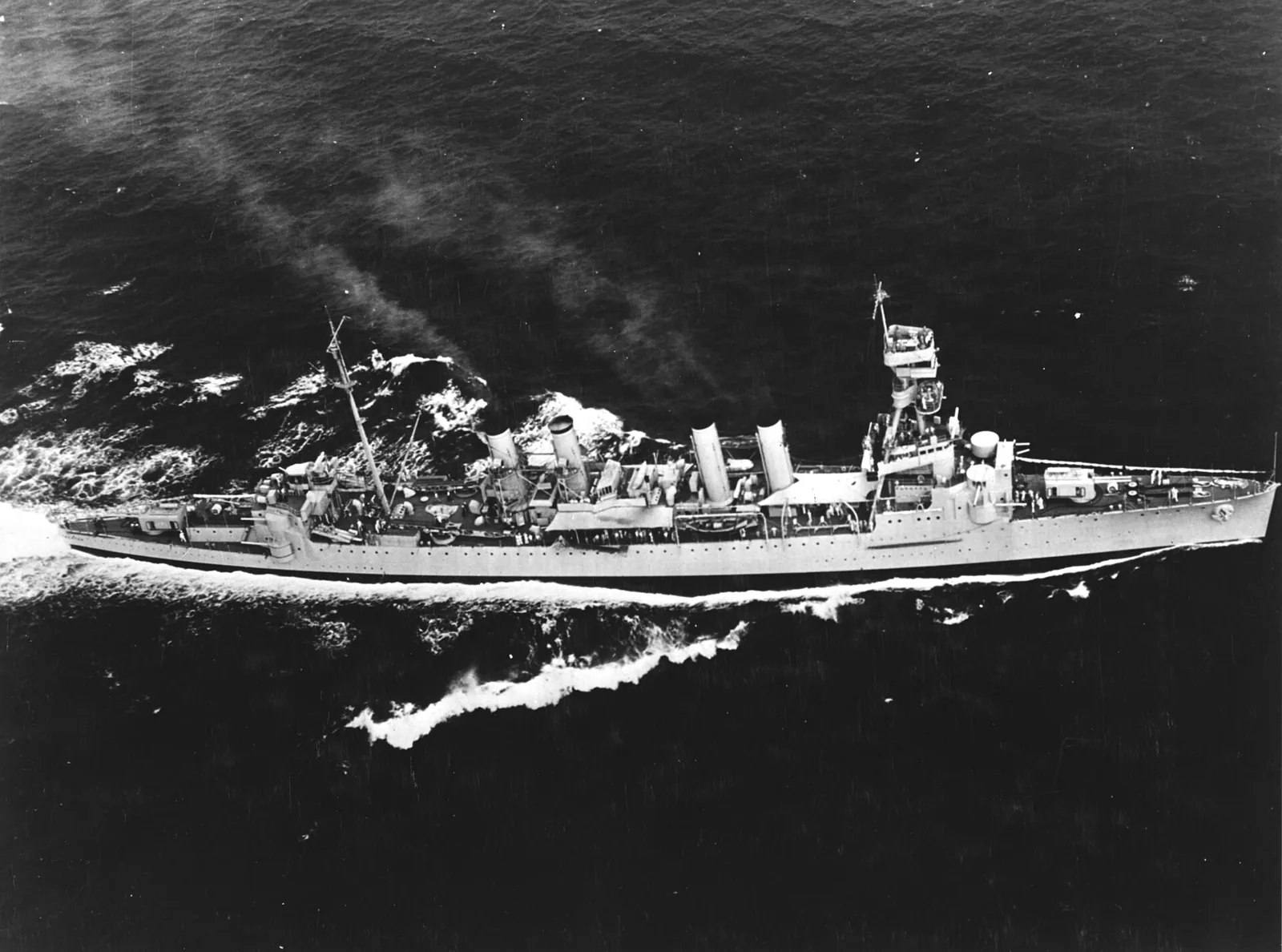
Service
- as Trenton19 April 1924 — 20 December 19452,193 days of the war
- Name
- USS Trenton
- Pennant / hull number
- CL-11
- Namesake
- City of Trenton, New Jersey
- Builder
- William Cramp & Sons, Philadelphia
- Ordered
- 1 July 1918
- Laid down
- 18 August 1920
- Launched
- 16 April 1923
- Commissioned
- 19 April 1924
- Decommissioned
- 20 December 1945
- Struck
- 21 January 1946
- Fate
- Sold for scrapping, 29 December 1946
Scrapped at Baltimore 1947 (1946) - Status
- Scrapped
Specifications — As built
- Displacement, standard
- 7,050 long tons (7,163 t)
- Displacement, full load
- 9,508 long tons (9,661 t)
- Length
- 169.16 m (555 ft) OA
- Beam
- 16.76 m (55 ft)
- Draught
- 4.27 m (14 ft)
- Speed
- 35 knots (64.8 km/h, 40.3 mph)
- Main gun
- 152 mm (6 in)
The capital city of the state of New Jersey and of Mercer County, located at the head of navigation on the Delaware River about 33.1 miles northeast of Philadelphia, Pa.
The second Trenton (CL-11) was authorized on 20 August 1916; and the Navy signed the contract for the scout cruiser on 24 January 1919. She was laid down on 18 August 1920, at Philadelphia, Pa., by William Cramp & Sons; launched on 16 April 1923; sponsored by Katherine E. Haulenbeek, née Donnelly, daughter of Trenton Mayor Frederick W. Donnelly; accepted on 15 April 1924; and commissioned on 19 April 1924, Capt. Edward C. Kalbfus in command.
Trenton carried out various drills and trials in Long Island Sound and visited Newport, R.I., and then accomplished additional work at New York Navy Yard. The newly commissioned cruiser cleared New York harbor on 24 May 1924, and set out on her 25,000-mile shakedown cruise through Trinidad in the British West Indies (28 May–2 June), and called at Cape Town and Durban (16–23 June and 25 June–1 July, respectively), South Africa, in June, as she rounded the stormy Cape of Good Hope. The ship made a splash there as this letter she received elaborates:
Continue to the full service history About 11,752 words
From the Dictionary of American Naval Fighting Ships, compiled by the Naval History and Heritage Command (Trenton II (CL-11)). A work of the United States Government, in the public domain.
Armament and machinery
This vessel is recorded in 2 configurations. Wartime refits changed armament and complement substantially, so each is kept separately rather than averaged into one set of figures. The figures above are as built.
As built
- Propulsion
- 4 × Parsons steam turbines
- 4 × screws
- Power
- 12 × White-Forster boilers
- 90000 ihp (Estimated power produced on trials)
- Armament
- 2 × twin 6 in/53 caliber guns
- 8 × single 6 in/53 caliber guns
- 4 × 3 in/50 caliber guns anti-aircraft
- 2 × triple 21 in torpedo tubes
- 2 × twin 21 in torpedo tubes
- 224 × mines (removed soon after completion)
- Armour
- Belt: 3 in
- Deck: 1+1/2 in
- Conning Tower: 1 in
- Bulkheads: 1-3 in
- Aircraft
- 2 × Curtiss SOC Seagulls and later 2 x Vought OS2U Kingfishers
1945
- Main gun
- 152 mm (6 in)
- Armament
- 2 × twin 6 in/53 caliber
- 6 × single 6 in/53 caliber
- 8 × 3 in/50 caliber anti-aircraft guns
- 2 × triple 21 in torpedo tubes
- 3 × twin 40 mm Bofors guns
- 12 × single 20 mm Oerlikon cannons
Sister ships
Sources
- Facts harvested from USS Trenton (CL-11) on Wikipedia. Figures only — no wording is taken from it.
- Service history reproduced verbatim from Trenton II (CL-11) , Dictionary of American Naval Fighting Ships — public domain, a work of the United States Government.
- Photograph: U.S. Navy — Official U.S. Navy photo NH 50251 from the U.S. Navy Naval History and Heritage Command — Public domain — Wikimedia Commons