USS Omaha (CL-4)
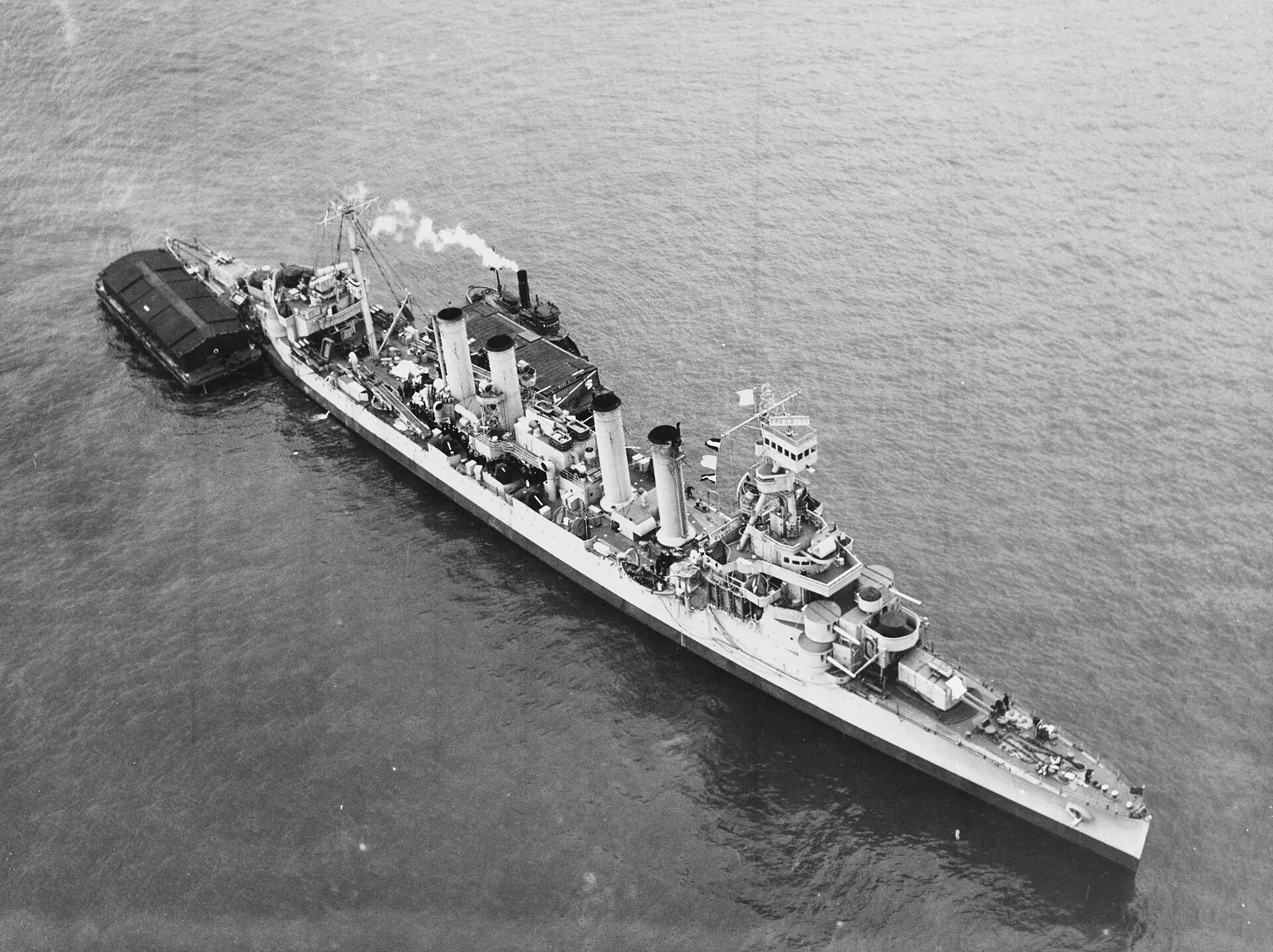
Service
- as Omaha24 February 1923 — 1 November 19452,193 days of the war
- Name
- USS Omaha
- Pennant / hull number
- CL-4
- Namesake
- City of Omaha, Nebraska
- Builder
- Todd Dry Dock and Construction Company, Tacoma, Washington
- Ordered
- 29 August 1916
- Laid down
- 6 December 1918
- Launched
- 14 December 1920
- Commissioned
- 24 February 1923
- Decommissioned
- 1 November 1945
- Struck
- 28 November 1945
- Fate
- Scrapped, February 1946 (1946)
- Status
- Scrapped
Specifications — As built
- Displacement, standard
- 7,500 long tons (7,620 t)
- Displacement, full load
- 9,507 long tons (9,660 t)
- Length
- 169.16 m (555 ft) OA
- Beam
- 16.76 m (55 ft)
- Draught
- 4.27 m (14 ft)
- Speed
- 35 knots (64.8 km/h, 40.3 mph)
- Main gun
- 152 mm (6 in)
The second Omaha (CL-4) was laid down on 6 December 1918 at Tacoma, Wash., by the Todd Dry Dock & Construction Co.; launched on 14 December 1920; sponsored by Miss Louise Bushnell White, a descendant of David Bushnell, inventor of the submarine Turtle; and commissioned on 24 February 1923, Capt. David C. Hanrahan in command.
On 14 March 1923, Omaha departed Puget Sound, Wash. for San Pedro, Calif . After pausing at San Pedro (16–22 March), she continued on to Magdalena Bay, Mexico (24–31 March) to begin her shakedown . Omaha returned to San Pedro on 31 March where she spent the first few weeks of April testing her systems . On 19 April, the new light cruiser set course for the Territory of Hawaii (T.H.) to continue her shakedown . While in Hawaiian waters, she made port calls at Honolulu (24–31 April, 3–7 May), Hilo (30 April–3 May) and Pearl Harbor (5–8 May) before steaming to San Francisco, Calif . After giving her crew a break from sea duty in San Francisco (11–21 May), Omaha got underway to “show the flag” at the May Time Frolic and Empire Day at Victoria, British Columbia, Canada (23–27 May) . She returned to Puget Sound and put into Bremerton, Wash., to undergo post-shakedown availability (27 June–4 August).
During August 1923, Omaha remained in the vicinity of Puget Sound conducting speed trials (5–7 August) and completing her official standardization trials (1–19 August) before mooring at Tacoma. Omaha did not get underway again until she moved to Puget Sound Navy Yard where her aircraft catapults were installed (6–15 October) . Omaha then proceeded to the Mare Island Navy Yard, Vallejo, Calif. (17–23 October) to load ammunition for target practice, then visited Portland, Ore., for the annual Navy Day Celebration (25–29 October 1923). She returned to Mare Island for repairs (31 October–10 November) before steaming back to San Pedro .
Continue to the full service history About 6,698 words
From the Dictionary of American Naval Fighting Ships, compiled by the Naval History and Heritage Command (Omaha II (CL-4)). A work of the United States Government, in the public domain.
Armament and machinery
This vessel is recorded in 2 configurations. Wartime refits changed armament and complement substantially, so each is kept separately rather than averaged into one set of figures. The figures above are as built.
As built
- Propulsion
- 4 × Westinghouse reduction geared steam turbines
- 4 × screws
- Power
- 12 × Yarrow boilers
- 90000 ihp (Estimated power produced on trials)
- Armament
- 2 × twin 6 in/53 caliber guns
- 8 × single 6 in/53 caliber guns
- 2 × 3 in/50 caliber anti-aircraft guns
- 2 × triple 21 in torpedo tubes
- 2 × twin 21 in torpedo tubes
- 224 × mines
- Armour
- Belt: 3 in
- Deck: 1+1/2 in
- Conning Tower: 1 in
- Bulkheads: 1-3 in
- Aircraft
- 2 × floatplanes
1945
- Main gun
- 152 mm (6 in)
- Armament
- 2 × twin 6 in/53 caliber guns
- 6 × single 6 in/53 caliber guns
- 8 × 3 in/50 caliber anti-aircraft guns
- 2 × triple 21 in torpedo tubes
- 3 × twin 40 mm Bofors guns
- 14 × single 20 mm Oerlikon cannons
Sister ships
Sources
- Facts harvested from USS Omaha (CL-4) on Wikipedia. Figures only — no wording is taken from it.
- Service history reproduced verbatim from Omaha II (CL-4) , Dictionary of American Naval Fighting Ships — public domain, a work of the United States Government.
- Photograph: Unknown author — U.S. Navy photo 19-N-40594 — Public domain — Wikimedia Commons