HMS Bath (I17)
Service
- as Hopewell22 March 1919 — 23 September 1940388 days of the war
- as Bath23 September 1940 — 1941461 days of the war
- as Bath9 April 1941 — 19 August 1941132 days of the war
- Name
- HMS Bath
- Pennant / hull number
- I17
- Namesake
- Pollard Hopewell
- Builder
- Newport News Shipbuilding
- Laid down
- 19 January 1918
- Launched
- 8 June 1918
- Commissioned
- 22 March 1919
- Decommissioned
- 17 July 1922
- Recommissioned
- 17 June 1940
- Fate
- Sunk 19 August 1941 (1941)
- Status
- Wreck
Specifications
- Displacement, standard
- 1,060 long tons (1,077 t)
- Length
- 95.71 m (314 ft)
- Beam
- 9.45 m (31 ft)
- Draught
- 2.74 m (9 ft)
- Speed
- 35 knots (64.8 km/h, 40.3 mph)
- Complement
- 101
- Main gun
- 102 mm (4 in)
Pollard Hopewell entered the Navy as a Midshipman in June 1812, and reported to frigate Chesapeake 21 August. With a new crew Captain Lawrence put to sea to engage the crack British frigate Shannon 1 June 1913. Despite their captain's famous cry, "Don't give up the ship", the crew was overwhelmed and the ship taken. Midshipman Hopewell was among those killed, as was the gallant Lawrence.
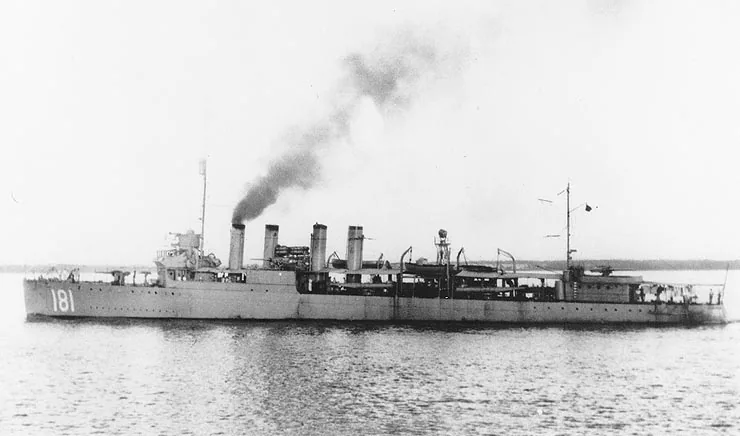
The first Hopewell (Destroyer No. 181) was launched by Newport News Shipbuilding and Dry Dock Co., Newport News, Va., 8 June 1918; sponsored by Mrs. Grote Hutcheson; and commissioned 22 March 1919 at Portsmouth, Va., Lt. Comdr. R. E. Rodgers in command.
Hopewell sailed from Norfolk 19 April 1919, to join the 3d Destroyer Squadron in New England waters, and in May was on observation station off the Azores during the historic crossing of the Atlantic by Navy seaplanes. The destroyer returned to New York 8 June to complete her interrupted fitting out, and rejoined her squadron in August for firing tests. The winter of 1920 was spent on intensive training and target practice in Caribbean waters.
The ship returned to New England in early May, where she remained until September training reservists and engaging in division maneuvers. Arriving Charleston 22 September, Hopewell carried out similar operations out of the South Carolina port, returning to New York in May 1921 for reserve training. Sailing from, Newport 10 October, the destroyer was placed in reserve at Charleston until 10 April, when she departed for Philadelphia. Hopewell decommissioned there 17 July 1922.
She recommissioned 17 June 1940 as America girded herself for the conflict that was to come, and after operating with the Neutrality Patrol off New England arrived Halifax 18 September. She decommissioned 23 September 1940 and was transferred to Great Britain as part of the destroyers-bases exchange. Renamed Bath, the ship was manned by the Norwegian Navy and was sunk in August 1941.
From the Dictionary of American Naval Fighting Ships, compiled by the Naval History and Heritage Command (Hopewell I (Destroyer No. 181)). A work of the United States Government, in the public domain.
Armament and machinery
Armament and machinery
- Propulsion
- 2 × steam turbines
- 2 × shafts
- Armament
- 4 × 4 in guns
- 2 × 3 in
- 4 × 21 inch (533 mm) torpedo tubes
Sister ships
- HMCS Annapolis (I04)
- HMCS Caldwell (I20)
- HMCS Chelsea (I35)
- HMCS Columbia (I49)
- HMCS Georgetown (I40)
- HMCS Hamilton (I24)
- HMCS Leamington (G19)
- HMCS Lincoln (G42)
- HMCS Mansfield (G76)
- HMCS Montgomery (G95)
- HMCS Niagara (I57)
- HMCS Richmond (G88)
- HMCS Salisbury (I52)
- HMCS St. Clair (I65)
- HMS Brighton (I08)
- HMS Caldwell (I20)
- HMS Campbeltown (I42)
- HMS Castleton (I23)
- HMS Charlestown (I21)
- HMS Chelsea (I35)
- HMS Georgetown (I40)
- HMS Hamilton (I24)
- HMS Lancaster (G05)
- HMS Leamington (G19)
Sources
- Facts harvested from HMS Bath (I17) on Wikipedia. Figures only — no wording is taken from it.
- Service history reproduced verbatim from Hopewell I (Destroyer No. 181) , Dictionary of American Naval Fighting Ships — public domain, a work of the United States Government.
- Photograph: U.S. Navy — Official U.S. Navy photo NH 78133 from the U.S. Navy Naval History and Heritage Command — Public domain — Wikimedia Commons