HMS Brighton (I08)
Service
- as USS Cowell17 March 1919 — 23 September 1940388 days of the war
- as HMS Brighton23 September 1940 — 16 July 19441,392 days of the war
- as Zharky (Жаркий / Torrid)16 July 1944 — 28 February 1949413 days of the war
- Name
- HMS Brighton
- Pennant / hull number
- I08
- Namesake
- John G. Cowell
- Builder
- Fore River Shipyard, Quincy, Massachusetts
- Laid down
- 15 July 1918
- Launched
- 23 November 1918
- Commissioned
- 17 March 1919
- Decommissioned
- 27 June 1922
- Fate
- Returned to United Kingdom for scrapping, 28 February 1949 (1949)
- Status
- Unknown
Specifications
- Displacement, standard
- 1,060 long tons (1,077 t)
- Length
- 95.71 m (314 ft)
- Beam
- 9.45 m (31 ft)
- Draught
- 2.74 m (9 ft)
- Speed
- 35 knots (64.8 km/h, 40.3 mph)
- Complement
- 101
- Main gun
- 102 mm (4 in)
John G. Cowell, born 18 September 1785 in Marblehead, Mass., entered the Navy as a master 21 January 1809. As acting lieutenant, Cowell was severely wounded, losing a leg, in the action on 28 March 1814 between Essex and HMS Phoebe and HMS Cherub off Valparaiso, Chile. Refusing to be carried below, Cowell cheered his companions on through the remainder of the action. He was carried on shore, and exhibited such gallantry and courage under severe pain until his death on 18 April that the people of Valparaiso honored him with a burial place in their principal church; a most unusual honor for a foreigner.
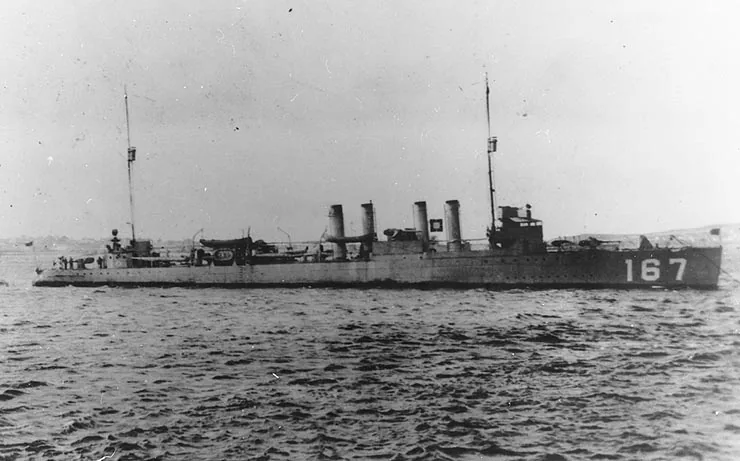
Cowell (Destroyer No. 167) was launched 23 November 1918 by Fore River Shipbuilding Co., Quincy, Mass.; sponsored by Miss E. P. Garney; and commissioned 17 March 1919, Lieutenant Commander C. E. Van Hook in command.
Cowell cleared Boston, Mass., 3 May 1919, to take station at Trepassey Bay, Nfld., first stopping point for the Navy seaplanes which that month began the historic first aerial crossing of the Atlantic. After patrolling her station, she returned to Boston 22 May to prepare for European service, and on 30 June sailed from New York to join the American naval force in the Adriatic. Here she served as dispatch ship for the Allied Peace Commission, and as station ship at Fiume, Istria, at Spalato, and at Trau, Dalmatia, in turn until 23 October, when she cleared for home.
In reserve at Boston and Charleston from 1 December 1919, Cowell put to sea for a training period out of Newport, R.I., with a reserve organization from April through October 1921, returning to Charleston. On 27 June 1922, she was decommissioned at Philadelphia Navy Yard, where she lay until recommissioned 17 June 1940 for patrol duty in the Atlantic. She cruised along the east coast on this duty until 18 September 1940 when she arrived at Halifax, Nova Scotia, there to be decommissioned 23 September 1940 and transferred to the Royal Navy the same day in the land bases for destroyers exchange.
Commissioned as HMS Brighton, the destroyer served with minelayers in the Denmark Strait and off the Faeroes Islands. On 27 February 1941, she rescued from the sea 19 survivors of torpedoed SS Baltisan. After refit, she served during 1943 and 1944 as target ship for naval aircraft training in the Western Approaches and at Rosyth, Scotland. On 16 July 1944 she was transferred to Russia, in whose Navy she served as Jarkyi until returned to the British at Rosyth 28 February 1949.
From the Dictionary of American Naval Fighting Ships, compiled by the Naval History and Heritage Command (Cowell I (Destroyer No. 167)). A work of the United States Government, in the public domain.
Armament and machinery
Armament and machinery
- Armament
- 4 x 4 in/50 guns
- 4 x 21 inch (533 mm) torpedo tubes
Sister ships
- HMCS Annapolis (I04)
- HMCS Caldwell (I20)
- HMCS Chelsea (I35)
- HMCS Columbia (I49)
- HMCS Georgetown (I40)
- HMCS Hamilton (I24)
- HMCS Leamington (G19)
- HMCS Lincoln (G42)
- HMCS Mansfield (G76)
- HMCS Montgomery (G95)
- HMCS Niagara (I57)
- HMCS Richmond (G88)
- HMCS Salisbury (I52)
- HMCS St. Clair (I65)
- HMS Bath (I17)
- HMS Caldwell (I20)
- HMS Campbeltown (I42)
- HMS Castleton (I23)
- HMS Charlestown (I21)
- HMS Chelsea (I35)
- HMS Georgetown (I40)
- HMS Hamilton (I24)
- HMS Lancaster (G05)
- HMS Leamington (G19)
Sources
- Facts harvested from HMS Brighton (I08) on Wikipedia. Figures only — no wording is taken from it.
- Service history reproduced verbatim from Cowell I (Destroyer No. 167) , Dictionary of American Naval Fighting Ships — public domain, a work of the United States Government.
- Photograph: U.S. Navy — Official U.S. Navy photo NH 70859 from the U.S. Navy Naval History and Heritage Command — Public domain — Wikimedia Commons