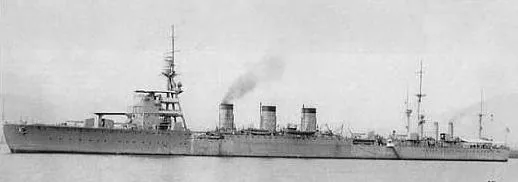
Japanese cruiser Nagara
Service
- as Nagara21 April 1922 — 10 October 19441,866 days of the war
- Name
- Nagara
- Builder
- Sasebo Naval Arsenal
- Ordered
- 1919
- Laid down
- 9 September 1920
- Launched
- 25 April 1921
- Commissioned
- 21 April 1922
- Struck
- 10 October 1944
- Fate
- Torpedoed and sunk, 7 August 1944
By torpedo (1944) - Status
- Wreck
Specifications
- Displacement, standard
- 5,570 long tons (5,659 t)
- Length
- 162.1 m (531.8 ft)
- Beam
- 14.2 m (46.6 ft)
- Draught
- 4.8 m (15.7 ft)
- Speed
- 36 knots (66.7 km/h, 41.4 mph)
- Range
- 9,000 nmi (16,668 km)
- Complement
- 450
- Main gun
- 140 mm (5.5 in)
Nagara was a Nagara-class cruiser light cruiser of the Imperial Japanese Navy. Sasebo Naval Arsenal laid her keel on 9 September 1920. She entered service on 21 April 1922, having been launched on 25 April 1921.
She was one of six ships of her class. The class followed the Kuma-class cruiser and was succeeded by the Japanese cruiser Yūbari (chronologically).
She displaced 5,570 long tons. She measured 162.1 m (532 ft) long with a beam of 14.2 m (47 ft). Her designed speed was 36 knots, and she carried a complement of 450.
Her main battery was seven 140 mm (5.5 in) guns. She carried one aircraft. Her machinery developed 90,000 shp through four shafts.
She was in commission for 1,866 days of the Second World War. She was struck from the register on 10 October 1944.
She was sunk on 7 August 1944 by torpedo, at 32°09′N 129°53′E. The wreck survives.
Written from the harvested record. Every figure above is sourced; the wording is this site's own.
Armament and machinery
Armament and machinery
- Propulsion
- 4 shafts; geared steam turbines
- Power
- 12 Kampon boilers
- 90000 shp
- Armament
- As built
- 7 × single 14 cm guns
- 2 × single 7.62 cm AA guns
- 2 x twin, 4 × single 25 mm AA guns
- 5 × twin 13.2 mm machine guns
- 2 × twin 61 cm torpedo tubes
- July 1944
- 5 × single 14 cm guns
- 1 × twin 12.7 cm DP guns
- 2 × single 7.62 cm AA guns
- 2 × triple, 6 × twin, 14 × single 25 mm AA guns
- 10 × 13.2 mm machine guns
- 2 × quadruple 61 cm torpedo tubes
- Armour
- 62 mm (belt)
- 30 mm (deck)
- Aircraft
- 1 × floatplane
Sister ships
Sources
- Facts harvested from Japanese cruiser Nagara on Wikipedia. Figures only — no wording is taken from it.
- Photograph: Patton Wayne (2005) Japanese light Cruisers of World War II in action Original uploader was Renegade at nl.wikipedia — Transferred from [1] (Original text : Modellversium: Japanese Light Cruisers of World War II in action Patton, Wayne (2005). Japanese Light Cruisers of World War II in action. ISBN 0-89747-497-X . This photographic image was published before 31st December 1956 or photographed before 1946 and not published for 10 years thereafter under jurisdiction of the Government of Japan. Thus this photographic image is considered to be public domain according to article 23 of old copyright law of Japan and article 2 of supplemental provision of copyright law of Japan. This applies world wide. ) — Public domain — Wikimedia Commons