USS Amberjack (SS-219)
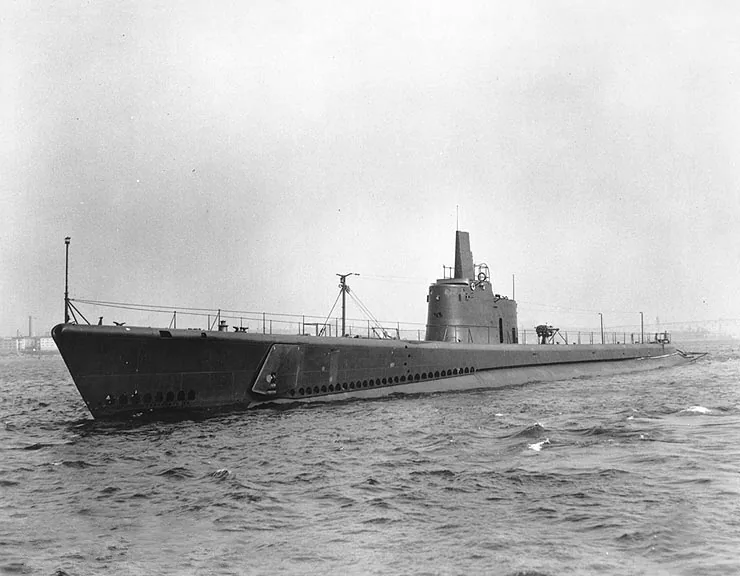
Service
- 19 June 1942 — 16 February 1943242 days of the war
- Name
- USS Amberjack
- Pennant / hull number
- SS-219
- Builder
- General Dynamics Electric Boat, Groton, Connecticut
- Laid down
- 15 May 1941
- Launched
- 6 March 1942
- Commissioned
- 19 June 1942
- Fate
- Sunk by Japanese torpedo boat Hiyodori and SC-18 off Rabaul, 16 February 1943
By torpedo (1943) - Status
- Wreck
Specifications
- Displacement, submerged
- 1,525 long tons (1,549 t)
- Length
- 94.79 m (311 ft)
- Beam
- 8.23 m (27 ft)
- Draught
- 5.18 m (17 ft)
- Range
- 11,000 nmi (20,372 km)
- Complement
- 60
- Main gun
- 76 mm (3 in)
The first Amberjack (SS-219) was laid down on 15 May 1941 at Groton, Conn., by the Electric Boat Co.; launched on 6 March 1942; sponsored by Mrs. Randall Jacobs, wife of Rear Adm. Randall Jacobs, the head of the Bureau of Personnel; and commissioned on 19 June 1942, Lt. Cmdr. John A. Bole, Jr., in command.
After shakedown training in waters off New London, Conn., and Newport, R.I., the submarine got underway on 20 July 1942, bound for the Pacific. She transited the Panama Canal in mid-August and reached Pearl Harbor, Hawaii, on the 20th. Following training exercises, Amberjack got underway for her first war patrol on 3 September. Two days later, she touched at Johnston Island to refuel and, later that day, resumed her voyage to her patrol area between the northeast coast of New Ireland and Bougainville, Solomon Islands.
On 15 September, Amberjack was patrolling off Kavieng, New Ireland. Three days later, she made contact with a large Japanese transport escorted by a destroyer and fired a spread of four torpedoes at the vessels, but none hit. While patrolling in Bougainville Strait on the 19th, the submarine fired two torpedoes at an enemy freighter. The first hit under the target's bridge, and the second broke her keel in two. Amberjack was credited with having sunk the passenger-cargo vessel Shirogane Maru.
Continue to the full service history About 1,380 words
From the Dictionary of American Naval Fighting Ships, compiled by the Naval History and Heritage Command (Amberjack I (SS-219)). A work of the United States Government, in the public domain.
Armament and machinery
Armament and machinery
- Propulsion
- 4 × General Motors Model 16-248 V16 Diesel engines driving electric generators
- 2 × 126-cell Sargo batteries
- 4 × high-speed General Electric electric motors with reduction gears
- two propellers
- 5,400 shp (4.0 MW) surfaced
- 2,740 shp (2.0 MW) submerged
- Armament
- 10 × 21-inch (533 mm) torpedo tubes
- 6 forward, 4 aft
- 24 torpedoes
- 1 × 3-inch (76 mm) / 50 caliber deck gun
- Bofors 40 mm and Oerlikon 20 mm cannon
Sister ships
- USS Albacore (SS-218)
- USS Angler
- USS Barb (SS-220)
- USS Bashaw
- USS Blackfish
- USS Bluefish (SS-222)
- USS Bluegill
- USS Bonefish (SS-223)
- USS Bream
- USS Cavalla (SS-244)
- USS Cero (SS-225)
- USS Cobia
- USS Cod
- USS Corvina
- USS Croaker
- USS Dace (SS-247)
- USS Darter (SS-227)
- USS Dorado (SS-248)
- USS Drum (SS-228)
- USS Finback (SS-230)
- USS Flasher (SS-249)
- USS Flier
- USS Flounder
- USS Flying Fish (SS-229)
Sources
- Facts harvested from USS Amberjack (SS-219) on Wikipedia. Figures only — no wording is taken from it.
- Service history reproduced verbatim from Amberjack I (SS-219) , Dictionary of American Naval Fighting Ships — public domain, a work of the United States Government.
- Photograph: Unknown author — https://www.history.navy.mil/content/history/nhhc/our-collections/photography/numerical-list-of-images/nhhc-series/nh-series/NH-98000/NH-98486.html — Public domain — Wikimedia Commons