USS Cero (SS-225)
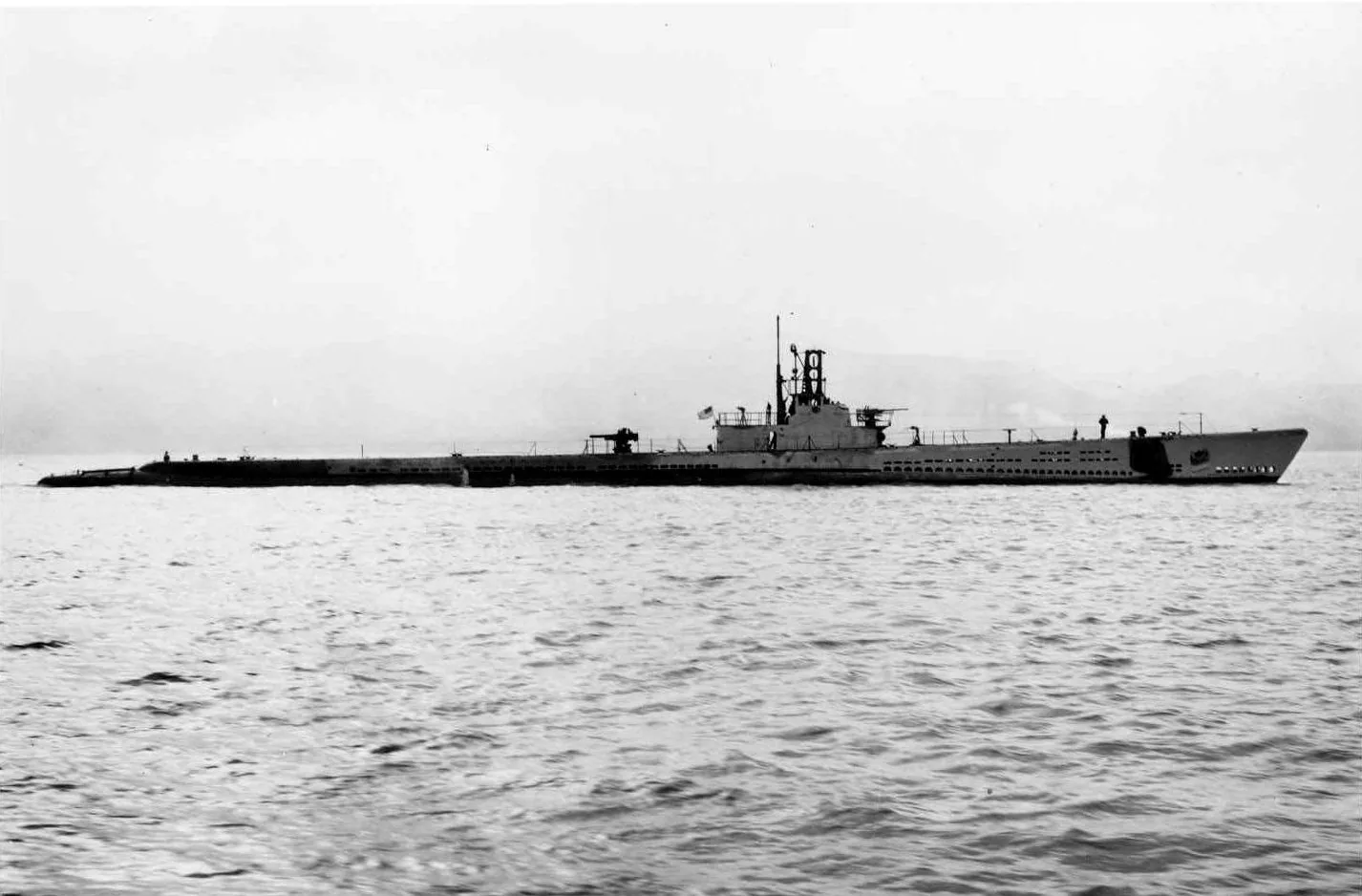
Service
- as USS Cero4 July 1943 — 23 December 1953791 days of the war
- Name
- USS Cero
- Pennant / hull number
- SS-225
- Namesake
- Cero mackerel
- Builder
- Electric Boat Company, Groton, Connecticut
- Laid down
- 24 August 1942
- Launched
- 4 April 1943
- Commissioned
- 4 July 1943
- Decommissioned
- 8 June 1946
- Struck
- 30 June 1967
- Fate
- Sold for scrap, October 1970 (1970)
- Status
- Scrapped
Specifications
- Displacement, surfaced
- 1,525 long tons (1,549 t)
- Displacement, submerged
- 2,424 long tons (2,463 t)
- Length
- 94.79 m (311 ft)
- Beam
- 8.23 m (27 ft)
- Draught
- 5.18 m (17 ft)
- Speed
- 21 knots (38.9 km/h, 24.2 mph)
- Range
- 11,000 nmi (20,372 km)
- Complement
- 60
- Main gun
- 76 mm (3 in)
The second Cero (SS-225) was launched 4 April 1943 by Electric Boat Co., Groton, Conn.; sponsored by Mrs. D. E. Barbey; and commissioned 4 July 1943, Commander D. C. White in command.
Cero cleared New London 17 August 1943 for Pacific action waters, and on 26 September sailed from Pearl Harbor on her first war patrol, which was conducted in the East China and Yellow Seas. At dawn on 12 October, she made her first attack on a convoy of three freighters escorted by two destroyers. After heavily damaging one of the merchantmen, Cero plunged deep to endure the depth charging which followed. During the same patrol, she damaged two other freighters, and a small patrol boat which she engaged on the surface.
After refitting at Midway from 16 November to 13 December 1943, Cero made her second war patrol, an unproductive one, along the Truk-New Ireland route, then put in to Milne Bay, New Guinea, from 12 January to 4 February 1944. Returning to the Truk-New Ireland shipping lanes, she attacked a freighter (later sunk by one of her sister submarines) and inflicted damage on another merchantman. She put in to Brisbane, Australia, 2 March, and sailed on her fourth war patrol, to be conducted off the Palau Islands, 3 April. Her most successful day to date came on 23 May, when she attacked two freighters and a tanker, sinking one cargo ship, and damaging the tanker.
Continue to the full service history About 648 words
From the Dictionary of American Naval Fighting Ships, compiled by the Naval History and Heritage Command (Cero II (SS-225)). A work of the United States Government, in the public domain.
Armament and machinery
Armament and machinery
- Propulsion
- 4 × General Motors Model 16-248 V16 Diesel engines driving electric generators
- 2 × 126-cell Sargo batteries
- 4 × high-speed General Electric electric motors with reduction gears
- two propellers
- 5,400 shp (4.0 MW) surfaced
- 2,740 shp (2.0 MW) submerged
- Armament
- 10 × 21-inch (533 mm) torpedo tubes
- 6 forward, 4 aft
- 24 torpedoes
- 1 × 3-inch (76 mm) / 50 caliber deck gun
- Bofors 40 mm and Oerlikon 20 mm cannon
Sister ships
- USS Albacore (SS-218)
- USS Amberjack (SS-219)
- USS Angler
- USS Barb (SS-220)
- USS Bashaw
- USS Blackfish
- USS Bluefish (SS-222)
- USS Bluegill
- USS Bonefish (SS-223)
- USS Bream
- USS Cavalla (SS-244)
- USS Cobia
- USS Cod
- USS Corvina
- USS Croaker
- USS Dace (SS-247)
- USS Darter (SS-227)
- USS Dorado (SS-248)
- USS Drum (SS-228)
- USS Finback (SS-230)
- USS Flasher (SS-249)
- USS Flier
- USS Flounder
- USS Flying Fish (SS-229)
Sources
- Facts harvested from USS Cero (SS-225) on Wikipedia. Figures only — no wording is taken from it.
- Service history reproduced verbatim from Cero II (SS-225) , Dictionary of American Naval Fighting Ships — public domain, a work of the United States Government.
- Photograph: US Navy photo — https://www.navsource.net/archives/08/08225.htm via http://ussubvetsofworldwarii.org — Public domain — Wikimedia Commons