USS Amberjack (SS-522)
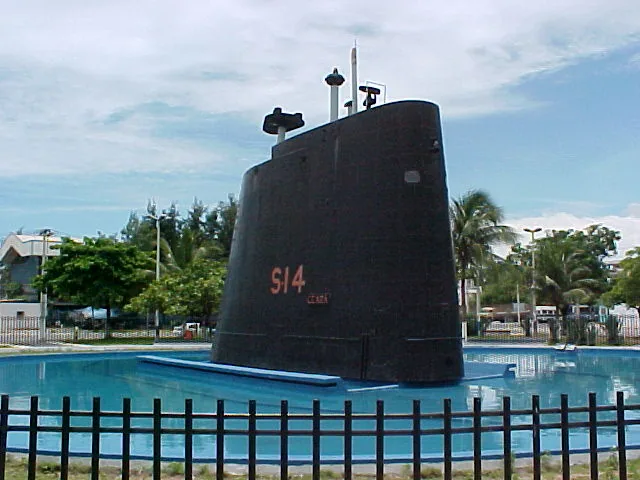
Service
- 4 March 1946 — 17 October 1973
- as Ceará (S-14)17 October 1973 — 21 September 1987
- Name
- USS Amberjack
- Pennant / hull number
- SS-522
- Builder
- Boston Navy Yard
- Laid down
- 8 February 1944
- Launched
- 15 December 1944
- Commissioned
- 4 March 1946
- Decommissioned
- 17 October 1973
- Struck
- 17 October 1973
- Fate
- Scrapped; sail preserved in Fortaleza, Ceará.
- Status
- Preserved
Specifications — As completed
- Displacement, surfaced
- 1,570 long tons (1,595 t)
- Displacement, submerged
- 2,428 long tons (2,467 t)
- Length
- 94.79 m (311 ft)
- Beam
- 8.23 m (27 ft)
- Draught
- 5.18 m (17 ft)
- Speed
- 20.3 knots (37.5 km/h, 23.3 mph)
- Range
- 11,000 nmi (20,372 km)
- Complement
- 81
- Main gun
- 127 mm (5 in)
The second Amberjack (SS-522) was laid down on 8 February 1944 at the Boston Navy Yard; launched on 15 December 1944; sponsored by Mrs. Dina C. Lang; and commissioned on 4 March 1946, Cmdr. William B. Parham in command.
Following shakedown training in the West Indies and in the Gulf of Mexico, Amberjack reported on 17 June for duty with Submarine Squadron (SubRon) 8. Operating out of the Submarine Base, New London, Conn., she conducted training missions in the North Atlantic, and, in November 1946, made a cruise above the Arctic Circle. In January 1947, the submarine entered the Portsmouth (N. H.) Naval Shipyard for extensive modifications and thereafter spent about a year undergoing a "Guppy" II conversion (from greater underwater propulsive power) during which her hull and sail were streamlined and additional batteries and a snorkel were installed to increase her submerged speed, endurance, and maneuverability. In January 1948, she reported for duty with SubRon 4 based at Key West, Fla. She operated along the east coast and in the West Indies for a little more than 11 years. Her schedule included the development of tactics and independent ship exercises, type training, periodic overhauls, and fleet exercises. During this period, she also visited numerous Caribbean ports. In July of 1952, Amberjack was transferred to the newly established SubRon 12, though she remained based at Key West and her employment continued as before.
Early in August 1959, after more than 11 years of operations out of Key West, the submarine's home port was changed to Charleston, S.C. She arrived there on the 8th and reported for duty with her former squadron, SubRon 4. While working out of her new home port, Amberjack's operations remained much as they had been before with one significant difference: she began making deployments to European waters. In August, September, and October of 1960, the submarine participated in a NATO exercise before making a week-long port visit to Portsmouth, England. She returned to Charleston late in October and r sumed her normal routine. Between May and September of 1961, the warship deployed to the Mediterranean Sea for duty in the 6th Fleet. After a three-year interlude operating along the east coast and in the West Indies, Amberjack made another Mediterranean cruise between 7 July and l November 1964. She spent the ensuing 29 months working out of Charleston. In 1967, the submarine made a three-month deployment to the Mediterranean between 24 April and 24 July. On 2 September 1969, following another 25 months of operations along the east coast and in the West Indies, she embarked upon her last Charleston-based tour of duty in European waters during which she participated in another NATO exercise with units of the British, Canadian, and Dutch navies. At the conclusion of the exercise, Amberjack visited a number of ports in northern Europe before returning to Charleston on 12 December 1969.
On 9 July 1970, Amberjack arrived in her new home port, Key West, her base for the remainder of her service in the American Navy. She made her last deployment to the Mediterranean between 27 November 1972 and 30 March 1973. On 17 October 1973, Amberjack was decommissioned at Key West, and her name was struck from the Navy list. That same day, she was transferred to the Brazilian Navy and commissioned as Ceara (S-12). She served under that name until decommissioned in 1987.
From the Dictionary of American Naval Fighting Ships, compiled by the Naval History and Heritage Command (Amberjack II (SS-522)). A work of the United States Government, in the public domain.
Armament and machinery
This vessel is recorded in 2 configurations. Wartime refits changed armament and complement substantially, so each is kept separately rather than averaged into one set of figures. The figures above are as built.
As completed
- Propulsion
- 4 × Fairbanks-Morse Model 38D8-⅛ 10-cylinder opposed piston diesel engines driving electrical generators
- 2 × 126-cell Sargo batteries
- 2 × low-speed direct-drive Westinghouse electric motors
- two propellers
- 5,400 shp (4.0 MW) surfaced
- 2,740 shp (2.0 MW) submerged
- Armament
- 10 × 21 inch (533 mm) torpedo tubes
- (six forward, four aft)
- 28 torpedoes
- 2 × 5 in caliber deck guns
- Bofors 40 mm and Oerlikon 20 mm cannon
Guppy II
- Displacement, surfaced
- 1,870 long tons (1,900 t)
- Displacement, submerged
- 2,440 long tons (2,479 t)
- Length
- 93.57 m (307 ft)
- Beam
- 8.23 m (27 ft)
- Draught
- 5.18 m (17 ft)
- Speed
- 18 knots (33.3 km/h, 20.7 mph)
- Range
- 15,119 nmi (28,000 km)
- Complement
- 9
- Propulsion
- Snorkel added
- Batteries upgraded to GUPPY type, capacity expanded to 504 cells (1 × 184 cell, 1 × 68 cell, and 2 × 126 cell batteries)
- Armament
- 10 × 21 in torpedo tubes
- (six forward, four aft)
- all guns removed
Sister ships
- PNS Ghazi
- USS Argonaut (SS-475)
- USS Conger
- USS Cutlass
- USS Diablo
- USS Grampus (SS-523)
- USS Irex
- USS Medregal
- USS Odax
- USS Pickerel (SS-524)
- USS Quillback
- USS Remora
- USS Requin
- USS Runner (SS-476)
- USS Sea Leopard
- USS Tench
- USS Thornback
- USS Tigrone
- USS Tirante
- USS Toro
- USS Torsk
- USS Trutta
- USS Volador (SS-490)
Sources
- Facts harvested from USS Amberjack (SS-522) on Wikipedia. Figures only — no wording is taken from it.
- Service history reproduced verbatim from Amberjack II (SS-522) , Dictionary of American Naval Fighting Ships — public domain, a work of the United States Government.
- Photograph: Brazilian Navy — https://www.navsource.net/archives/08/08522.htm — Attribution — Wikimedia Commons