USS Volador (SS-490)
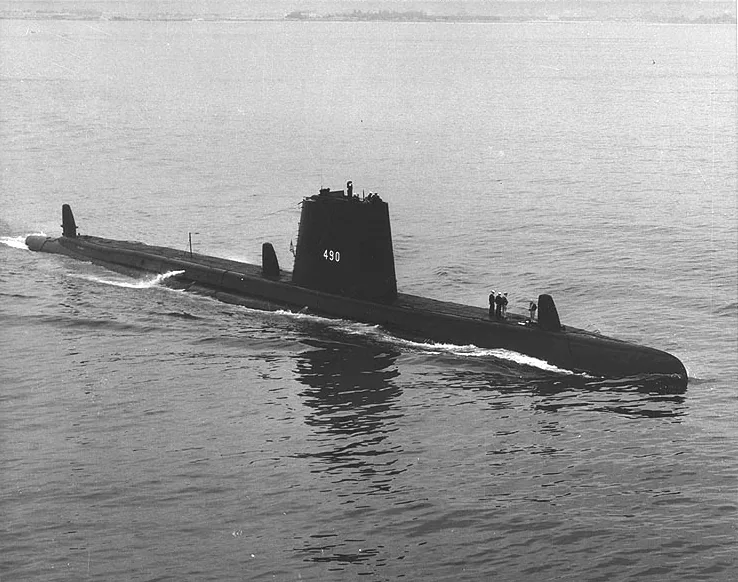
Service
- as USS Volador (SS-490)1 October 1948 — 18 August 1972
- as Gianfranco Gazzana Priaroggia (S 502)18 August 1972 — 1981
- Name
- USS Volador
- Pennant / hull number
- SS-490
- Builder
- Portsmouth Naval Shipyard, Kittery, Maine
- Laid down
- 15 June 1945
- Launched
- 21 May 1948
- Commissioned
- 1 October 1948
- Decommissioned
- 18 August 1972
- Struck
- 5 December 1977
- Fate
- Transferred to Italy, 18 August 1972; sold to Italy 5 December 1977 (1972)
- Status
- Unknown
Specifications — Completed as GUPPY II
- Displacement, surfaced
- 1,870 long tons (1,900 t)
- Displacement, submerged
- 2,440 long tons (2,479 t)
- Length
- 93.57 m (307 ft)
- Beam
- 8.23 m (27 ft)
- Draught
- 5.18 m (17 ft)
- Speed
- 18 knots (33.3 km/h, 20.7 mph)
- Range
- 15,119 nmi (28,000 km)
- Complement
- 9
The second Volador (SS-490) was laid down on 15 June 1945 by the Portsmouth (N.H.) Naval Shipyard, but work on her construction was discontinued in January 1946. Her unfinished hulk remained on the ways until August 1947 when construction resumed. The submarine was launched on 21 May 1948; sponsored by Mrs. Dudley W. Morton; and commissioned on 1 October 1948, Comdr. H. A. Thompson in command.
Volador completed her builder's trials on 20 January 1949, left Portsmouth three days later, and stopped at Newport and New London before sailing for the Gulf of Mexico on 5 February. Volador arrived at New Orleans on 11 February and proceeded to the west coast, via Galveston and the Panama Canal, and arrived at San Diego on 11 March. The submarine conducted local operations along the California coast between San Diego and San Francisco until she departed San Diego on 13 October, bound for Hawaii. She arrived at Pearl Harbor on 7 November but returned to San Diego on the 18th and spent the remainder of 1949 as well as most of the following year on the west coast, conducting various training exercises. During that period, she also visited Portland, Vancouver, and Pearl Harbor. In June 1950, Volador embarked reserves at Treasure Island, Calif., and proceeded on a two-week reserve cruise to Hawaii. En route, the Korean War broke out; and the submarine spent two months training in Hawaiian waters before returning to San Diego for operations on the west coast that lasted into the summer of 1951.
Volador returned to San Diego in January 1952 and conducted local operations until early summer. She then spent three months in the Juan de Fuca Strait and the Puget Sound area before entering the Mare Island Naval Shipyard in October. During the five-month overhaul which followed, a new battery and an Askania automatic depth control system were installed. Upon her return to San Diego, Volador provided services to ASW surface units, aircraft, and the Fleet Sonar School and participated in type training, Exercise "Pacphibex," and hunter/killer exercises. She departed San Diego on 7 August 1953 and arrived at Pearl Harbor on the 15th, received briefings by members of the Commander in Chief, Pacific Fleet, and the Commander, Submarines, Pacific staffs on 17 and 18 August and tested experimental sonar equipment at sea on 20 August.
Continue to the full service history About 2,117 words
From the Dictionary of American Naval Fighting Ships, compiled by the Naval History and Heritage Command (Volador II (SS-490)). A work of the United States Government, in the public domain.
Armament and machinery
This vessel is recorded in 2 configurations. Wartime refits changed armament and complement substantially, so each is kept separately rather than averaged into one set of figures. The figures above are as built.
Completed as GUPPY II
- Propulsion
- 4 × Fairbanks-Morse Model 38D8-1 10-cylinder opposed piston diesel engines, equipped with a snorkel, driving electrical generators
- 1 × 184 cell, 1 × 68 cell, and 2 × 126 cell GUPPY-type batteries (total 504 cells)
- 2 × low-speed direct-drive Elliott electric motors
- two propellers
- Armament
- 10 × 21 in torpedo tubes
- (six forward, four aft)
Guppy III
- Displacement, surfaced
- 1,975 long tons (2,007 t)
- Displacement, submerged
- 2,450 long tons (2,489 t)
- Length
- 97.84 m (321 ft)
- Beam
- 8.23 m (27 ft)
- Draught
- 5.18 m (17 ft)
- Speed
- 17.2 knots (31.9 km/h, 19.8 mph)
- Range
- 15,875 nmi (29,401 km)
- Complement
- 8
Sister ships
- PNS Ghazi
- USS Amberjack (SS-522)
- USS Argonaut (SS-475)
- USS Conger
- USS Cutlass
- USS Diablo
- USS Grampus (SS-523)
- USS Irex
- USS Medregal
- USS Odax
- USS Pickerel (SS-524)
- USS Quillback
- USS Remora
- USS Requin
- USS Runner (SS-476)
- USS Sea Leopard
- USS Tench
- USS Thornback
- USS Tigrone
- USS Tirante
- USS Toro
- USS Torsk
- USS Trutta
Sources
- Facts harvested from USS Volador (SS-490) on Wikipedia. Figures only — no wording is taken from it.
- Service history reproduced verbatim from Volador II (SS-490) , Dictionary of American Naval Fighting Ships — public domain, a work of the United States Government.
- Photograph: U.S. Navy — Official U.S. Navy photo NH 98637 from the U.S. Navy Naval History and Heritage Command — Public domain — Wikimedia Commons