USS Argonaut (SS-475)
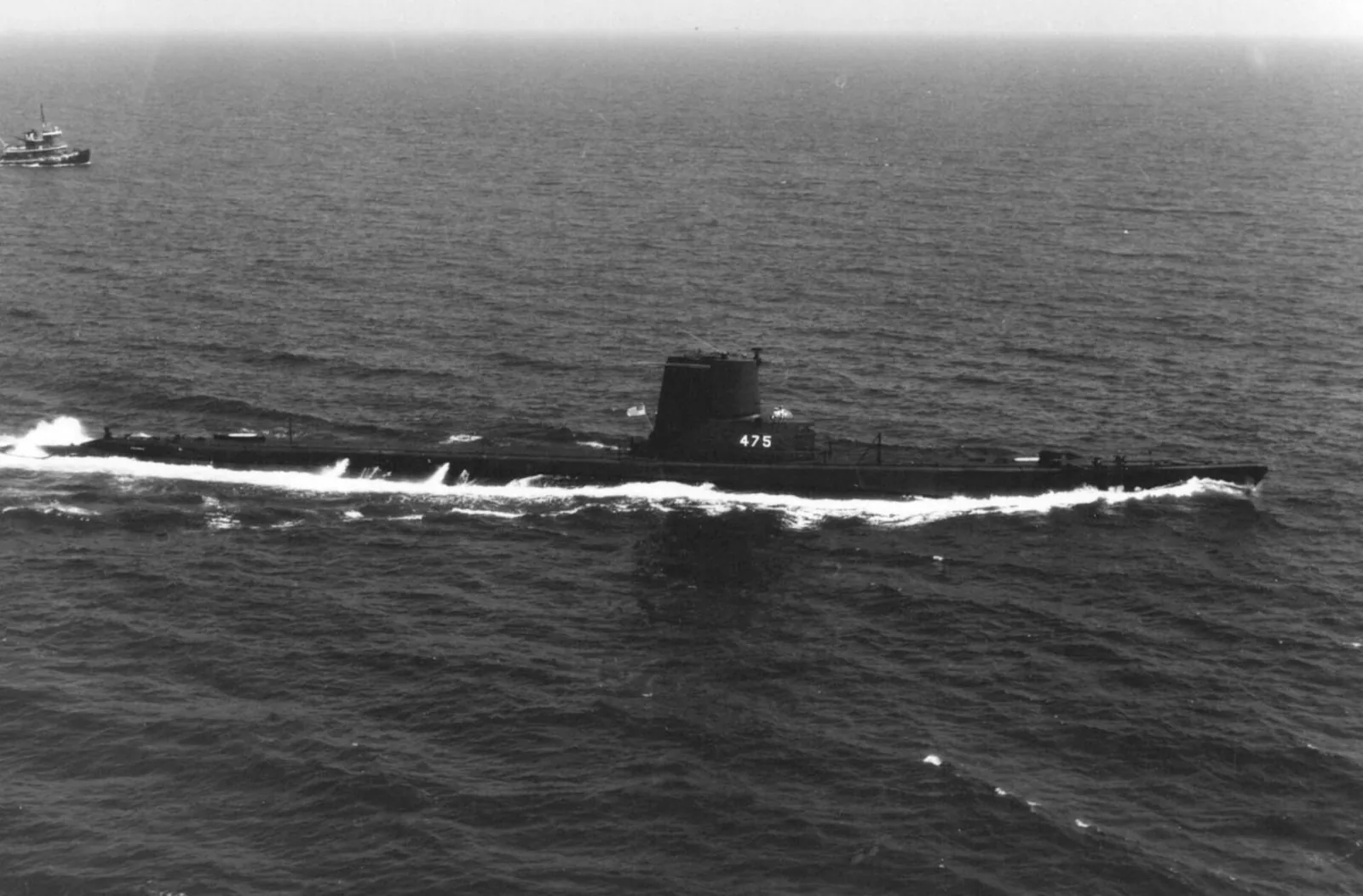
Service
- as USS Argonaut15 January 1945 — 2 December 1968230 days of the war
- as HMCS Rainbow2 December 1968 — 31 December 1974
- Name
- USS Argonaut
- Pennant / hull number
- SS-475
- Builder
- Portsmouth Naval Shipyard, Kittery, Maine
- Laid down
- 28 June 1944
- Launched
- 1 October 1944
- Commissioned
- 15 January 1945
- Decommissioned
- 2 December 1968
- Struck
- 2 December 1968
- Fate
- Scrapped in 1977 (1977)
- Status
- Scrapped
Specifications
- Displacement, submerged
- 2,414 long tons (2,453 t)
- Length
- 94.79 m (311 ft)
- Beam
- 8.23 m (27 ft)
- Draught
- 5.18 m (17 ft)
- Range
- 11,000 nmi (20,372 km)
- Complement
- 81
- Main gun
- 127 mm (5 in)
A relative of the octopus, sometimes called the paper nautilus, which propels itself underwater by expelling a jet of water. The name argonaut may also have been inspired by the submarine of that name built in 1897 by Simon Lake which was the first submarine to navigate extensively in the open sea. Ultimately, the name is derived from the band of 50 heroes in Greek legend who sailed with Jason in the ship Argo to retrieve the Golden Fleece.
The second Argonaut (SS-475) was laid down on 28 June 1944 by the Portsmouth (N.H.) Navy Yard; launched on 1 October 1944; sponsored by Mrs. Allen R. McCann, the wife of Capt. McCann; and commissioned on 15 January 1945, Lt. Comdr. John Sneed Schmidt in command.
The submarine held shakedown in the Portsmouth area and in Narragansett Bay and returned briefly to Portsmouth on 27 March for post-shakedown availability. She then sailed on 14 April for Key West, Fla., where she conducted special tests for lighter-than-air craft and training operations with the Fleet Sound School. Argonaut departed the Florida coast on 13 May to transit the Panama Canal en route Hawaii. Reaching Pearl Harbor on 11 June, the submarine spent two weeks in repairs and training exercises before beginning her first war patrol on 28 June.
Continue to the full service history About 926 words
From the Dictionary of American Naval Fighting Ships, compiled by the Naval History and Heritage Command (Argonaut II (SS-475)). A work of the United States Government, in the public domain.
Armament and machinery
Armament and machinery
- Propulsion
- 4 × Fairbanks-Morse Model 38D8-⅛ 10-cylinder opposed piston diesel engines driving electrical generators
- 2 × 126-cell Sargo batteries
- 2 × low-speed direct-drive Elliott electric motors
- two propellers
- 5,400 shp (4.0 MW) surfaced
- 2,740 shp (2.0 MW) submerged
- Armament
- 10 × 21-inch (533 mm) torpedo tubes
- (6 forward, 4 aft)
- 28 torpedoes
- 1 × 5-inch (127 mm) / 25 caliber deck gun
- Bofors 40 mm and Oerlikon 20 mm cannon
Sister ships
- PNS Ghazi
- USS Amberjack (SS-522)
- USS Conger
- USS Cutlass
- USS Diablo
- USS Grampus (SS-523)
- USS Irex
- USS Medregal
- USS Odax
- USS Pickerel (SS-524)
- USS Quillback
- USS Remora
- USS Requin
- USS Runner (SS-476)
- USS Sea Leopard
- USS Tench
- USS Thornback
- USS Tigrone
- USS Tirante
- USS Toro
- USS Torsk
- USS Trutta
- USS Volador (SS-490)
Sources
- Facts harvested from USS Argonaut (SS-475) on Wikipedia. Figures only — no wording is taken from it.
- Service history reproduced verbatim from Argonaut II (SS-475) , Dictionary of American Naval Fighting Ships — public domain, a work of the United States Government.
- Photograph: U.S. Navy — https://www.navsource.net/archives/08/08475.htm — Public domain — Wikimedia Commons