USS Astoria (CA-34)
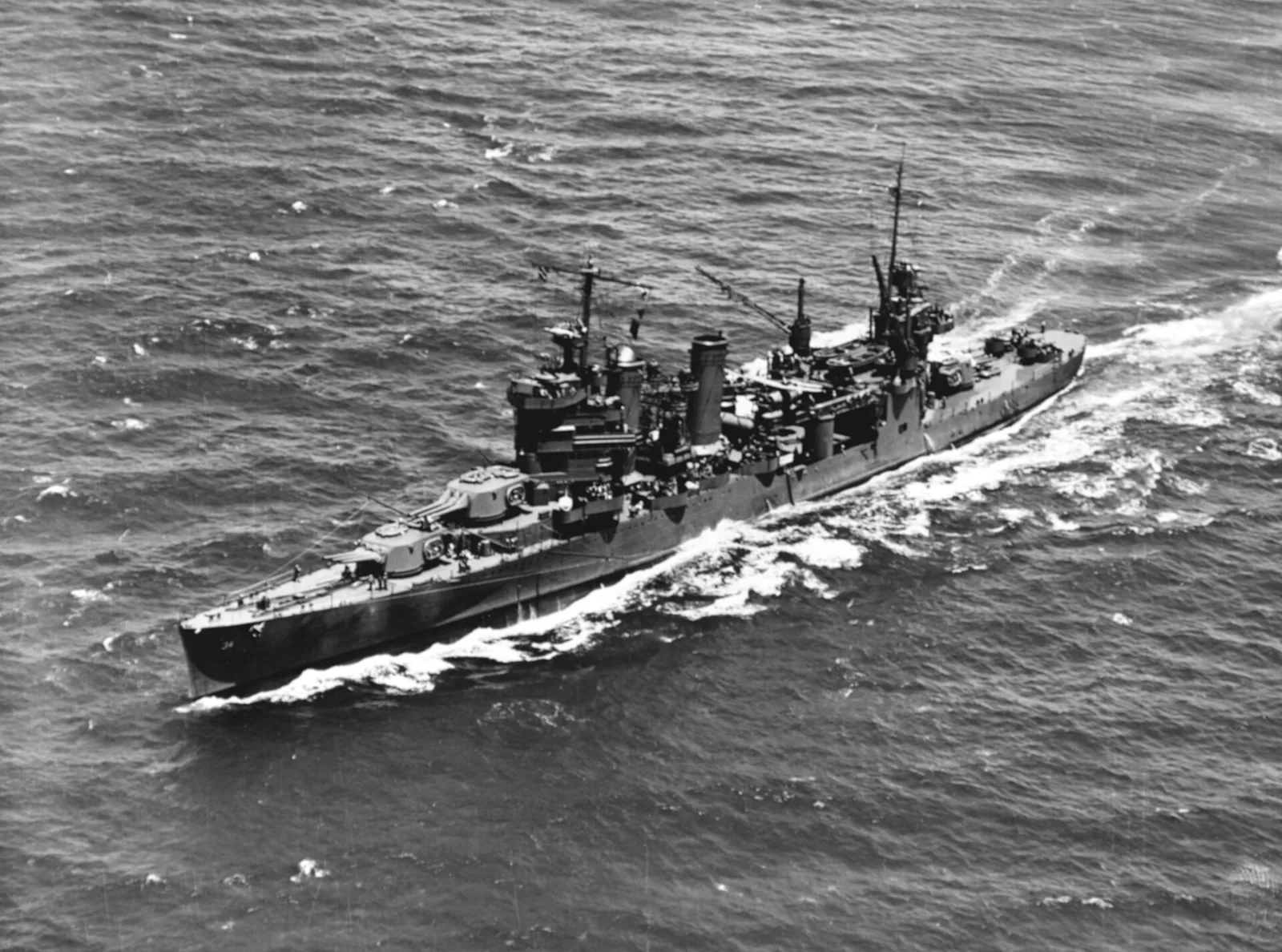
Service
- as Astoria28 April 1934 — 9 August 19421,073 days of the war
- Name
- USS Astoria
- Pennant / hull number
- CA-34
- Namesake
- City of Astoria, Oregon
- Builder
- Puget Sound Navy Yard, Bremerton, Washington
- Ordered
- 13 February 1929
- Laid down
- 1 September 1930
- Launched
- 16 December 1933
- Commissioned
- 28 April 1934
- Fate
- Sunk during the Battle of Savo Island 9 August 1942 (1942)
- Status
- Wreck
Specifications — As built
- Displacement, standard
- 9,950 long tons (10,110 t)
- Length
- 179.22 m (588 ft) OA
- Beam
- 18.59 m (61 ft)
- Draught
- 5.79 m (19 ft)
- Speed
- 32.7 knots (60.6 km/h, 37.6 mph)
- Complement
- 899
- Main gun
- 203 mm (8 in)
A city and port of entry in northwestern Oregon located on the southern bank at the mouth of the Columbia River. It is the seat of government for Clatsop County.
The second Astoria (CL-34) was laid down on 1 September 1930 at Bremerton, Wash., by the Puget Sound Navy Yard; reclassified as a heavy cruiser, CA-34, on 1 July 1931; launched on 16 December 1933; sponsored by Miss Leila C. McKay, a decendant of one of the partners in the Astor expedition that founded Astoria, Oreg.; and commissioned on 28 April 1934, Capt. Edmund S. Root in command.
During the summer of 1934, Astoria conducted a lengthy shakedown cruise in the course of which she voyaged extensively in the Pacific. In addition to the Hawaiian Islands, the heavy cruiser also visited Samoa, Fiji, Sydney, Australia, and Noumea, New Caledonia. She returned to San Francisco on 25 September 1934. Between the fall of 1934 and February 1937, she operated as a unit of Cruiser Division (CruDiv) 7, Scouting Force, based at San Pedro, Calif. In February 1937, the warship was reassigned to CruDiv 6, as an element of Scouting Force based at San Pedro. In both assignments, she carried out normal peacetime maneuvers the culmination of which came in the annual fleet problem that brought the entire United States Fleet together in a single, vast exercise.
Continue to the full service history About 4,036 words
From the Dictionary of American Naval Fighting Ships, compiled by the Naval History and Heritage Command (Astoria II (CA-34)). A work of the United States Government, in the public domain.
Armament and machinery
This vessel is recorded in 2 configurations. Wartime refits changed armament and complement substantially, so each is kept separately rather than averaged into one set of figures. The figures above are as built.
As built
- Propulsion
- 4 × Westinghouse geared turbines
- 4 × screws
- Power
- 8 × Babcock & Wilcox boilers
- 107000 shp
- Armament
- 9 × 8 in/55 caliber guns (3x3)
- 8 × 5 in/25 caliber anti-aircraft guns
- 2 × 3-pounder 47 mm saluting guns
- 8 × caliber 0.50 in machine guns
- Armour
- Belt: 3-5 in
- Deck: 1+1/4 - 2+1/4 in
- Barbettes: 5 in
- Turrets: 1+1/2 - 8 in
- Conning Tower: 5 in
- Aircraft
- 4 × floatplanes
1942
- Main gun
- 203 mm (8 in)
- Armament
- 9 × 8 in/55 caliber guns (3x3)
- 8 × 5 in/25 caliber anti-aircraft guns
- 2 × 3-pounder 47 mm saluting guns
- 12 × single 20 mm Oerlikon anti-aircraft cannons
- 4 × quad 1.1 in/75 caliber anti-aircraft guns
Sister ships
Sources
- Facts harvested from USS Astoria (CA-34) on Wikipedia. Figures only — no wording is taken from it.
- Service history reproduced verbatim from Astoria II (CA-34) , Dictionary of American Naval Fighting Ships — public domain, a work of the United States Government.
- Photograph: U.S. Navy — Official U.S. Navy photo NH 97682 from the U.S. Navy Naval History and Heritage Command — Public domain — Wikimedia Commons