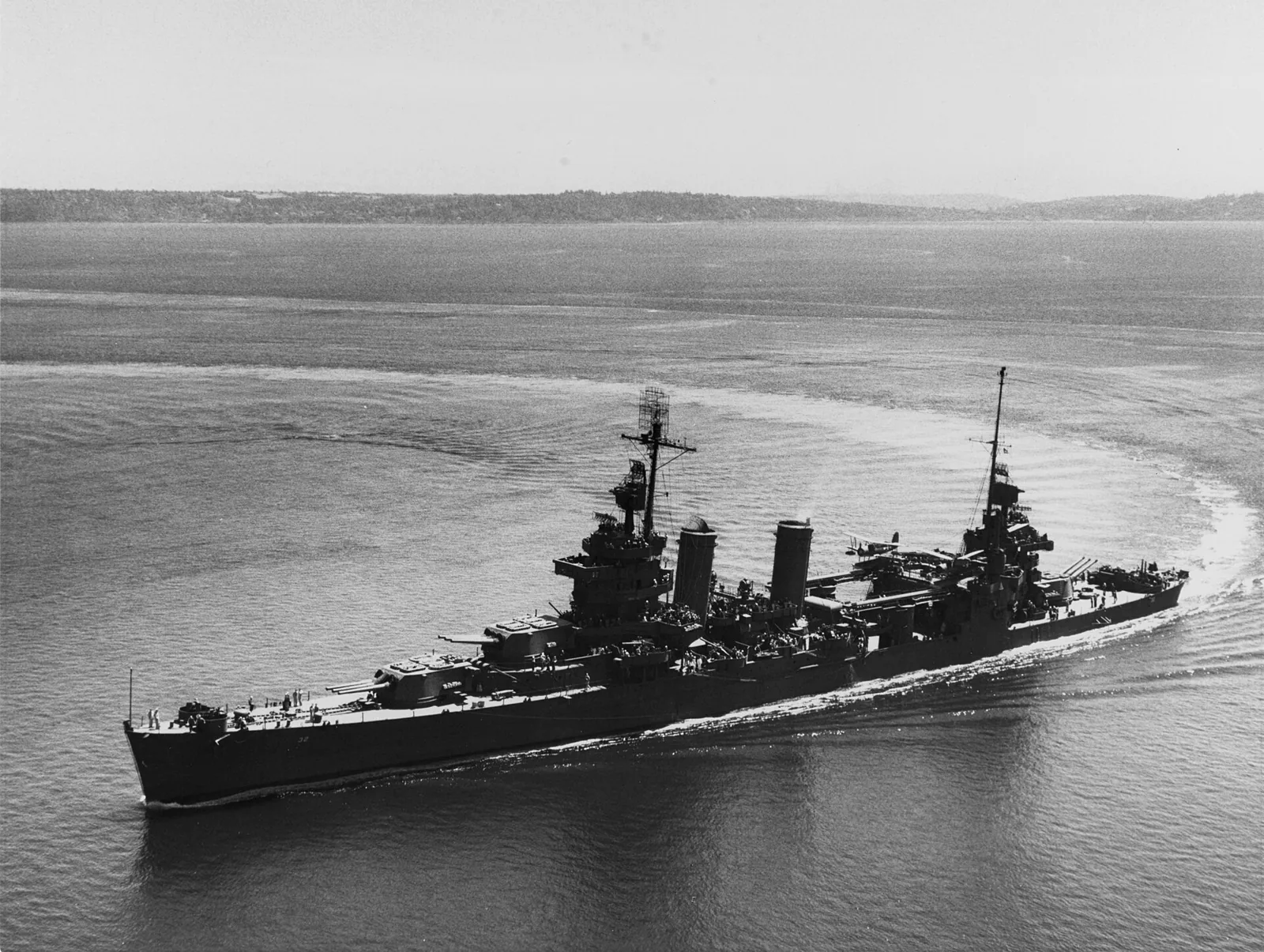
USS New Orleans (CA-32)
Service
- as New Orleans15 February 1934 — 10 February 19472,193 days of the war
- Name
- USS New Orleans
- Pennant / hull number
- CA-32
- Namesake
- City of New Orleans, Louisiana
- Builder
- Brooklyn Navy Yard, Brooklyn, New York
- Ordered
- 13 February 1929
- Laid down
- 14 March 1931
- Launched
- 12 April 1933
- Commissioned
- 15 February 1934
- Decommissioned
- 10 February 1947
- Struck
- 1 March 1959
- Fate
- Sold for scrap 22 September 1959 (1959)
- Status
- Scrapped
Specifications — As built
- Displacement, standard
- 9,950 long tons (10,110 t)
- Length
- 179.22 m (588 ft) OA
- Beam
- 18.59 m (61 ft)
- Draught
- 5.79 m (19 ft)
- Speed
- 32.7 knots (60.6 km/h, 37.6 mph)
- Complement
- 915
- Main gun
- 203 mm (8 in)
Largest city of Louisiana, New Orleans was the scene of Andrew Jackson's great victory at the close of the War of 1812, in which small naval forces under Commodore David Patterson played a large role; and of a key naval action in the Civil War, in which Admiral David Farragut opened the southern Mississippi to Union forces.
The second New Orleans (CA-32), formerly CL-32, was laid down 14 March 1931 by New York Navy Yard; launched 12 April 1933; sponsored by Miss Cora S. Jahncke, daughter of Assistant Secretary of the Navy Ernest L. Jahncke; and commissioned 15 February 1934, Captain Allen B. Reed in command.
New Orleans made a shakedown cruise to Northern Europe in May and June 1934, returning to New York 28 June. On 5 July she sailed to rendezvous with Houston, President Franklin D. Roosevelt embarked, for a cruise through the Panama Canal and an exercise with airship Macon and her brood of aircraft off California. The cruise ended at Astoria, Oreg., 2 August, and New Orleans sailed at once for Panama and Cuba. New Orleans exercised off New England into 1935, then visited her namesake city while en route to join Cruiser Division 6 in operations in the eastern Pacific for over a year. She returned to New York from 20 August to 7 December, 1936 and was once more in the Pacific early in 1937. Aside from winter training in the Caribbean early in 1939, she served out of California ports until joining the Hawaiian Detachment 12 October 1939 for exercises, training, and, as war drew close, vigilant patrol.
Continue to the full service history About 1,725 words
From the Dictionary of American Naval Fighting Ships, compiled by the Naval History and Heritage Command (New Orleans II (CA-32)). A work of the United States Government, in the public domain.
Armament and machinery
This vessel is recorded in 2 configurations. Wartime refits changed armament and complement substantially, so each is kept separately rather than averaged into one set of figures. The figures above are as built.
As built
- Propulsion
- 4 × Westinghouse geared turbines
- 4 × screws
- Power
- 8 × Babcock & Wilcox boilers
- 107000 shp
- Armament
- 9 × 8 in/55 caliber guns (3x3)
- 8 × 5 in/25 caliber anti-aircraft guns
- 2 × 3-pounder 47 mm saluting guns
- 8 × caliber 0.50 in machine guns
- Armour
- Belt: 3-5 in
- Deck: 1+1/4 - 2+1/4 in
- Barbettes: 5 in
- Turrets: 1+1/2 - 8 in
- Conning Tower: 5 in
- Aircraft
- 4 × floatplanes
1945
- Main gun
- 203 mm (8 in)
- Armament
- 9 × 8 in/55 caliber guns (3x3)
- 8 × 5 in/25 caliber anti-aircraft guns
- 2 × 3-pounder 47 mm saluting guns
- 6 × quad 40 mm Bofors anti-aircraft guns
- 28 × single 20 mm Oerlikon anti-aircraft cannons
Sister ships
Sources
- Facts harvested from USS New Orleans (CA-32) on Wikipedia. Figures only — no wording is taken from it.
- Service history reproduced verbatim from New Orleans II (CA-32) , Dictionary of American Naval Fighting Ships — public domain, a work of the United States Government.
- Photograph: Unknown author — U.S. Navy photo NH 94847 — Public domain — Wikimedia Commons