USS Quincy (CA-39)
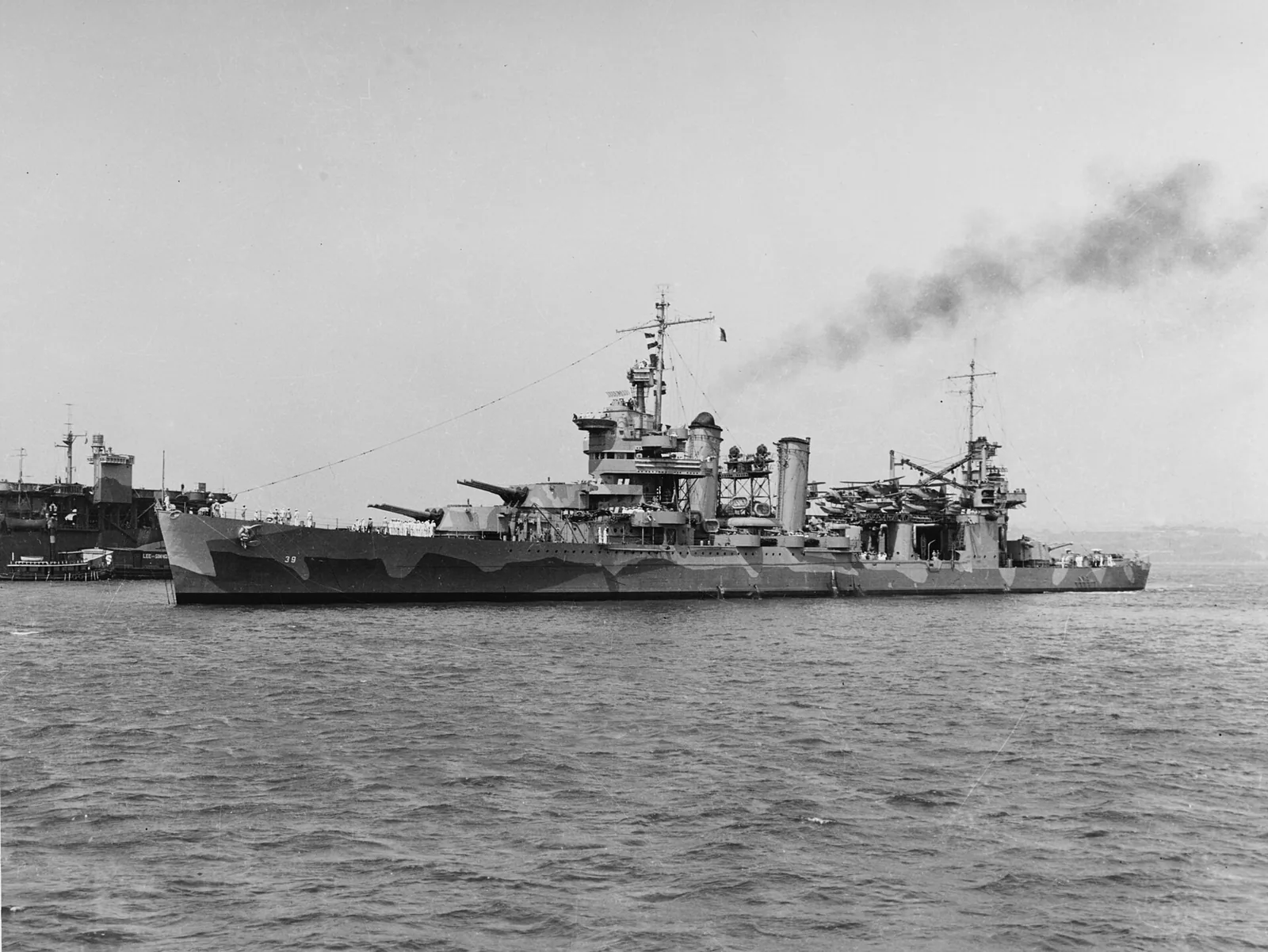
Service
- as Quincy9 June 1936 — 9 August 19421,073 days of the war
- Name
- USS Quincy
- Pennant / hull number
- CA-39
- Namesake
- City of Quincy, Massachusetts
- Builder
- Bethlehem Shipbuilding Corporation's Fore River Shipyard, Quincy, Massachusetts
- Ordered
- 13 February 1929
- Laid down
- 15 November 1933
- Launched
- 19 June 1935
- Commissioned
- 9 June 1936
- Fate
- Sunk, Battle of Savo Island 9 August 1942 (1942)
- Status
- Wreck
Specifications — As built
- Displacement, standard
- 10,136 long tons (10,299 t)
- Displacement, full load
- 12,463 long tons (12,663 t)
- Length
- 179.22 m (588 ft) OA
- Beam
- 18.59 m (61 ft)
- Draught
- 5.79 m (19 ft)
- Speed
- 32.7 knots (60.6 km/h, 37.6 mph)
- Range
- 10,000 nmi (18,520 km)
- Complement
- 866
- Main gun
- 203 mm (8 in)
Quincy (CA-39) was laid down by the Bethlehem Shipbuilding Corp., Quincy, Mass., 15 November 1933; launched 19 June 1935; sponsored by Mrs. Henry S. Morgan,. and commissioned at Boston 9 June 1936, Capt. William Faulkner Amsden in command.
Soon after being assigned to Cruiser Division 8 Atlantic Fleet, Quincy was ordered to Mediterranean waters 20 July 1936 to protect American interests in Spain during the height of the Spanish Civil War. Quincy passed through the Straits of Gibraltar 26 July and arrived at Malaga, Spain, 27 July to assume her duties. While in Spanish waters she operated with an international rescue fleet that included the German pocket-battleships Deutschland, Admiral Graf Spec and Admiral Scheer. Quincy evacuated 490 refugees to Marseilles and Villefranche, France, before being relieved by Raleigh 27 September.
Quincy returned to the Boston Navy Yard 5 October for refit preparatory to final acceptance trials which were held 15-18 March 1937. She got underway for the Pacific 12 April to join Cruiser Division 7, transited the Panama Canal 23-27 April and arrived at Pearl Harbor 10 May.
Continue to the full service history About 601 words
From the Dictionary of American Naval Fighting Ships, compiled by the Naval History and Heritage Command (Quincy II (CA-39)). A work of the United States Government, in the public domain.
Armament and machinery
This vessel is recorded in 2 configurations. Wartime refits changed armament and complement substantially, so each is kept separately rather than averaged into one set of figures. The figures above are as built.
As built
- Propulsion
- 4 × Parsons reduction steam turbines
- 4 × screws
- Power
- 8 × Babcock & Wilcox boilers
- 107000 shp
- Armament
- 9 × 8 in/55 caliber guns (3x3)
- 8 × 5 in/25 caliber anti-aircraft guns
- 2 × 3-pounder 47 mm saluting guns
- 8 × caliber 0.50 in machine guns
- Armour
- Belt: 3-5 in
- Deck: 1+1/4 - 2+1/4 in
- Barbettes: 5 in
- Turrets: 1+1/2 - 8 in
- Conning Tower: 5 in
- Aircraft
- 4 × floatplanes
1942
- Main gun
- 203 mm (8 in)
- Armament
- 9 × 8 in/55 caliber guns (3x3)
- 8 × 5 in/25 caliber anti-aircraft guns
- 2 × 3-pounder 47 mm saluting guns
- 12 × single 20 mm Oerlikon anti-aircraft cannons
- 4 × quad 1.1 in/75 caliber anti-aircraft guns
Sister ships
Sources
- Facts harvested from USS Quincy (CA-39) on Wikipedia. Figures only — no wording is taken from it.
- Service history reproduced verbatim from Quincy II (CA-39) , Dictionary of American Naval Fighting Ships — public domain, a work of the United States Government.
- Photograph: Unknown author — This image has been extracted from another file — Public domain — Wikimedia Commons