USS Minneapolis (CA-36)
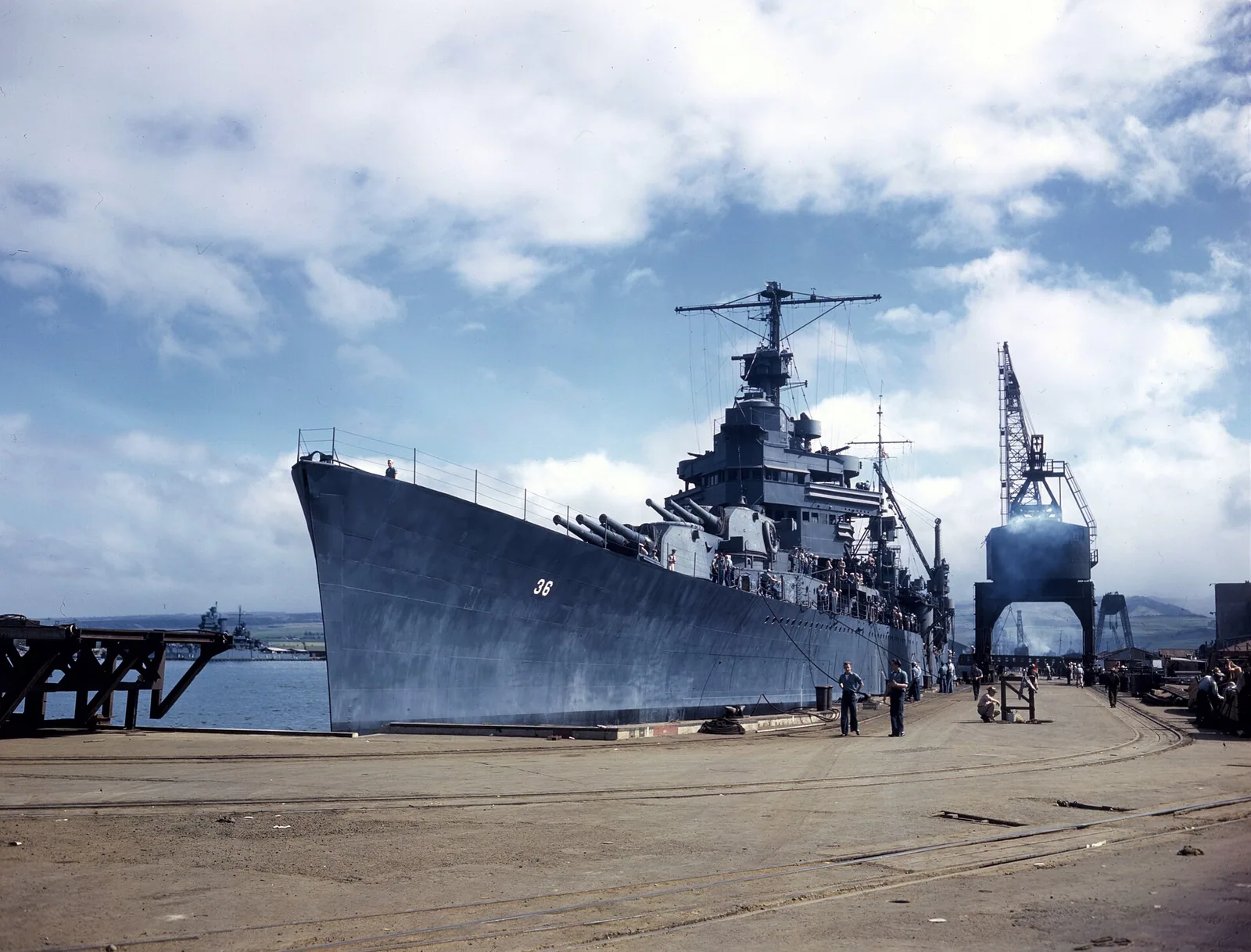
Service
- as Minneapolis19 May 1934 — 10 February 19472,193 days of the war
- Name
- USS Minneapolis
- Pennant / hull number
- CA-36
- Namesake
- City of Minneapolis, Minnesota
- Builder
- Philadelphia Naval Shipyard, Philadelphia, Pennsylvania
- Ordered
- 13 February 1929
- Laid down
- 27 June 1931
- Launched
- 6 September 1933
- Commissioned
- 19 May 1934
- Decommissioned
- 10 February 1947
- Struck
- 1 March 1959
- Fate
- Scrapped in Chester, Pennsylvania, July 1960 (1960)
- Status
- Scrapped
Specifications — As built
- Displacement, standard
- 9,950 long tons (10,110 t)
- Length
- 179.22 m (588 ft) OA
- Beam
- 18.59 m (61 ft)
- Draught
- 5.79 m (19 ft)
- Speed
- 32.7 knots (60.6 km/h, 37.6 mph)
- Complement
- 919
- Main gun
- 203 mm (8 in)
The second Minneapolis (CA‑36) was laid down 27 June 1921 by Philadelphia Navy Yard; launched 6 September 1933; sponsored by Miss Grace L. Newton ; and commissioned 19 May 1934, Capt. Gordon W. Haines in command.
After shakedown in European waters during July to September 1934 and alterations in Philadelphia Navy Yard, the new heavy cruiser departed 4 April 1935 for the Panama Canal and San Diego, arriving 18 April to join Cruiser Division 7, Scouting Force. She operated along the west coast, aside from a cruise to the Caribbean early in 1939, until arriving at Pearl Harbor in 1940.
When Japan attacked her base 7 December 1941, Minneapolis was at sea for gunnery practice about 20 miles from Pearl Harbor. She immediately took up patrol until late January 1942 when she joined a carrier task force about to raid the Gilberts and Marshalls. While screening Lexington 1 February, she helped turn back an air attack in which three Japanese "Bettys" were splashed. She screened the carriers during their successful raids 20 February and again 10 March, when they blasted Japanese shipping at Lae and Salamaua, disrupting enemy supply lines to those garrisons.
Continue to the full service history About 1,316 words
From the Dictionary of American Naval Fighting Ships, compiled by the Naval History and Heritage Command (Minneapolis II (CA-36)). A work of the United States Government, in the public domain.
Armament and machinery
This vessel is recorded in 2 configurations. Wartime refits changed armament and complement substantially, so each is kept separately rather than averaged into one set of figures. The figures above are as built.
As built
- Propulsion
- 4 × Westinghouse geared turbines
- 4 × screws
- Power
- 8 × Babcock & Wilcox boilers
- 107000 shp
- Armament
- 9 × 8 in/55 caliber guns (3x3)
- 8 × 5 in/25 caliber anti-aircraft guns
- 2 × 3-pounder 47 mm saluting guns
- 8 × caliber 0.50 in machine guns
- Armour
- Belt: 3-5 in
- Deck: 1+1/4 - 2+1/4 in
- Barbettes: 5 in
- Turrets: 1+1/2 - 8 in
- Conning Tower: 5 in
- Aircraft
- 4 × floatplanes
1945
- Main gun
- 203 mm (8 in)
- Armament
- 9 × 8 in/55 caliber guns (3x3)
- 8 × 5 in/25 caliber anti-aircraft guns
- 2 × 3-pounder 47 mm saluting guns
- 7 × quad 40 mm Bofors anti-aircraft guns
- 9 × dual 20 mm Oerlikon anti-aircraft cannons
Sister ships
Sources
- Facts harvested from USS Minneapolis (CA-36) on Wikipedia. Figures only — no wording is taken from it.
- Service history reproduced verbatim from Minneapolis II (CA-36) , Dictionary of American Naval Fighting Ships — public domain, a work of the United States Government.
- Photograph: Unknown author — U.S. Navy photo 80-G-K-544 — Public domain — Wikimedia Commons