USS Atlanta (CL-51)
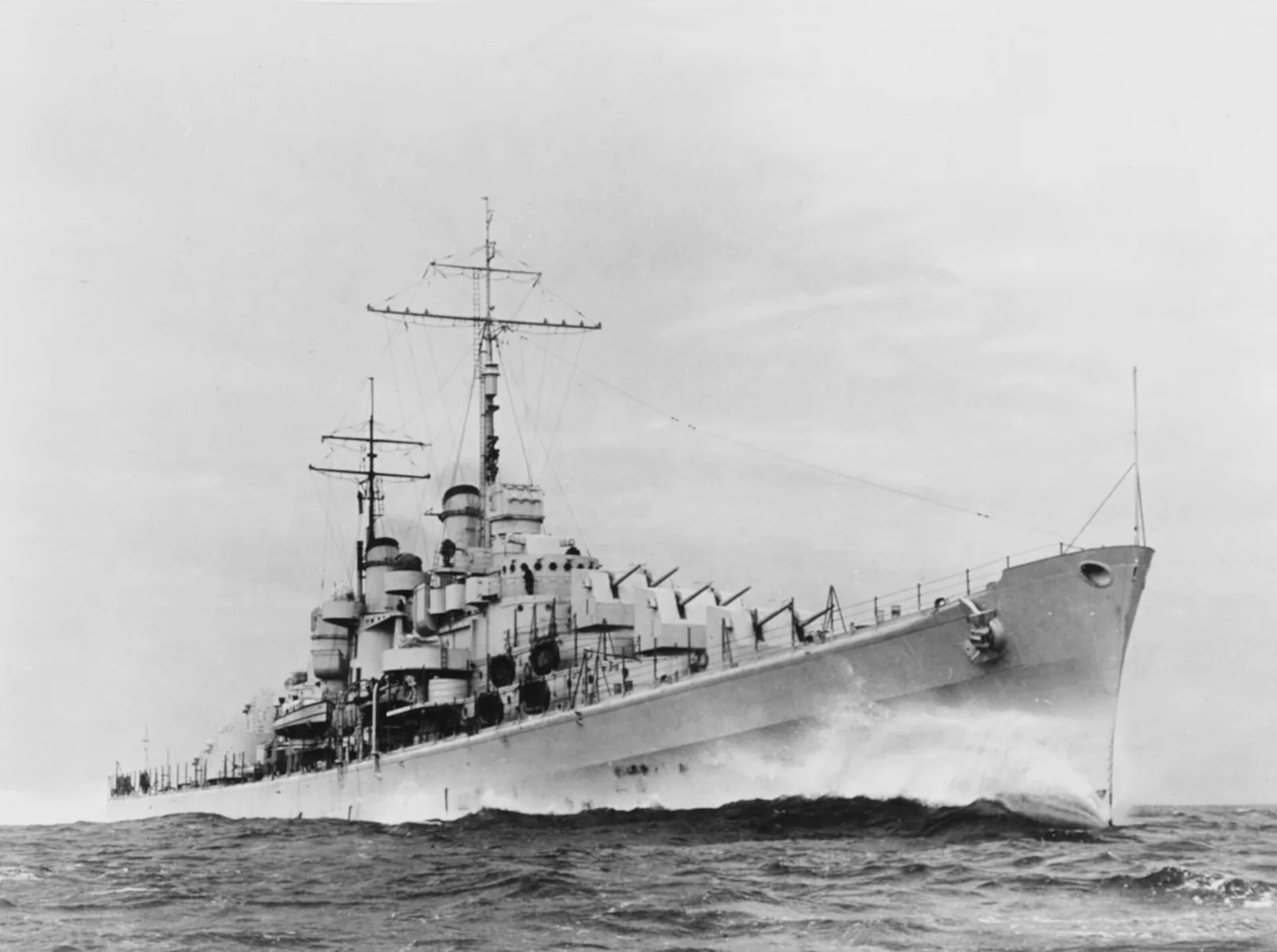
Service
- as Atlanta24 December 1941 — 13 January 1943385 days of the war
- Name
- USS Atlanta
- Pennant / hull number
- CL-51
- Namesake
- City of Atlanta, Georgia
- Builder
- Federal Shipbuilding and Drydock Company, Kearny, New Jersey
- Laid down
- 22 April 1940
- Launched
- 6 September 1941
- Commissioned
- 24 December 1941
- Struck
- 13 January 1943
- Fate
- Scuttled after severe damage in Naval Battle of Guadalcanal by Japanese torpedo and friendly fire from USS San Francisco (CA-38), 13 November 1942 (1942)
- Status
- Wreck
Specifications
- Displacement, standard
- 6,718 long tons (6,826 t)
- Displacement, full load
- 8,340 long tons (8,474 t)
- Length
- 164.9 m (541 ft) OA
- Beam
- 16.15 m (53 ft)
- Draught
- 6.1 m (20 ft)
- Speed
- 32.5 knots (60.2 km/h, 37.4 mph)
- Complement
- 673
- Main gun
- 127 mm (5 in)
The third Atlanta (CL-51), the first of a new class of ships originally conceived as destroyer flotilla leaders but which came to be employed as particularly effective antiaircraft cruisers, was laid down on 22 April 1940 at Kearny, N.J., by the Federal Shipbuilding and Drydock Co.; launched on 6 September 1941; sponsored by Mrs. John R. Marsh (better known by her pen name, Margaret Mitchell, the author of the novel Gone With the Wind ; and commissioned at the New York Navy Yard on the day before Christmas [24 December] 1941, Capt. Samuel P. Jenkins in command.
After fitting out, Atlanta conducted shakedown training until 13 March 1942, first in Chesapeake Bay and then in Maine's Casco Bay, after which she returned to the New York Navy Yard for post-shakedown repairs and alterations. Adjudged "ready for distant service" on 31 March, the new light cruiser departed New York for the Panama Canal Zone on 5 April. She reached Cristobal on the 8th. After transiting the Isthmian Waterway, Atlanta then cleared Balboa on 12 April with orders to reconnoiter Clipperton Islanda tiny, barren, uninhabited atoll about 670 miles southwest of Acapulco, Mexico, in the course of her voyage to the Hawaiian islands, for any signs of enemy activity. Finding none, she ultimately reached Pearl Harbor on 23 April.
Punctuating her brief stay in Hawaiian waters with an antiaircraft practice off Oahu on 3 May 1942, Atlanta , in company with destroyer McCall (DD-400), sailed on 10 May as escort for the ammunition ship Rainier (AE-5) and the oiler Kaskaskia (AO-27), bound for Noumea, New Caledonia. On 16 May, having seen the auxiliaries to their destination, she joined Vice Admiral William F. Halsey, Jr.'s Task Force (TF) 16, formed around the carriers Enterprise (CV-6) and Hornet (CV-8), as it steamed back to Pearl Harbor, having been summoned back to Hawaiian waters in response to an imminent Japanese thrust in the direction of Midway atoll. TF 16 reached Pearl on 26 May.
Continue to the full service history About 3,003 words
From the Dictionary of American Naval Fighting Ships, compiled by the Naval History and Heritage Command (Atlanta III (CL-51)). A work of the United States Government, in the public domain.
Armament and machinery
Armament and machinery
- Propulsion
- 2 × geared turbines
- 2 × screws
- Power
- 4 × Steam boilers
- 75000 shp
- Armament
- 16 × 5 in/38 caliber Mark 12 guns (8×2)
- 16 × 1.1 in/75 anti-aircraft guns (4 × 4)
- 8 × single 20 mm Oerlikon anti-aircraft cannons
- 8 × 21 in torpedo tubes
- Armour
- Belt: 1.1 - 3+3/4 in
- Deck: 1+1/4 in
- Turrets: 1+1/4 in
- Conning tower: 2+1/2 in
Sister ships
Sources
- Facts harvested from USS Atlanta (CL-51) on Wikipedia. Figures only — no wording is taken from it.
- Service history reproduced verbatim from Atlanta III (CL-51) , Dictionary of American Naval Fighting Ships — public domain, a work of the United States Government.
- Photograph: Unknown author — U.S. Navy photo NH 57455 — Public domain — Wikimedia Commons