USS Flint (CL-97)
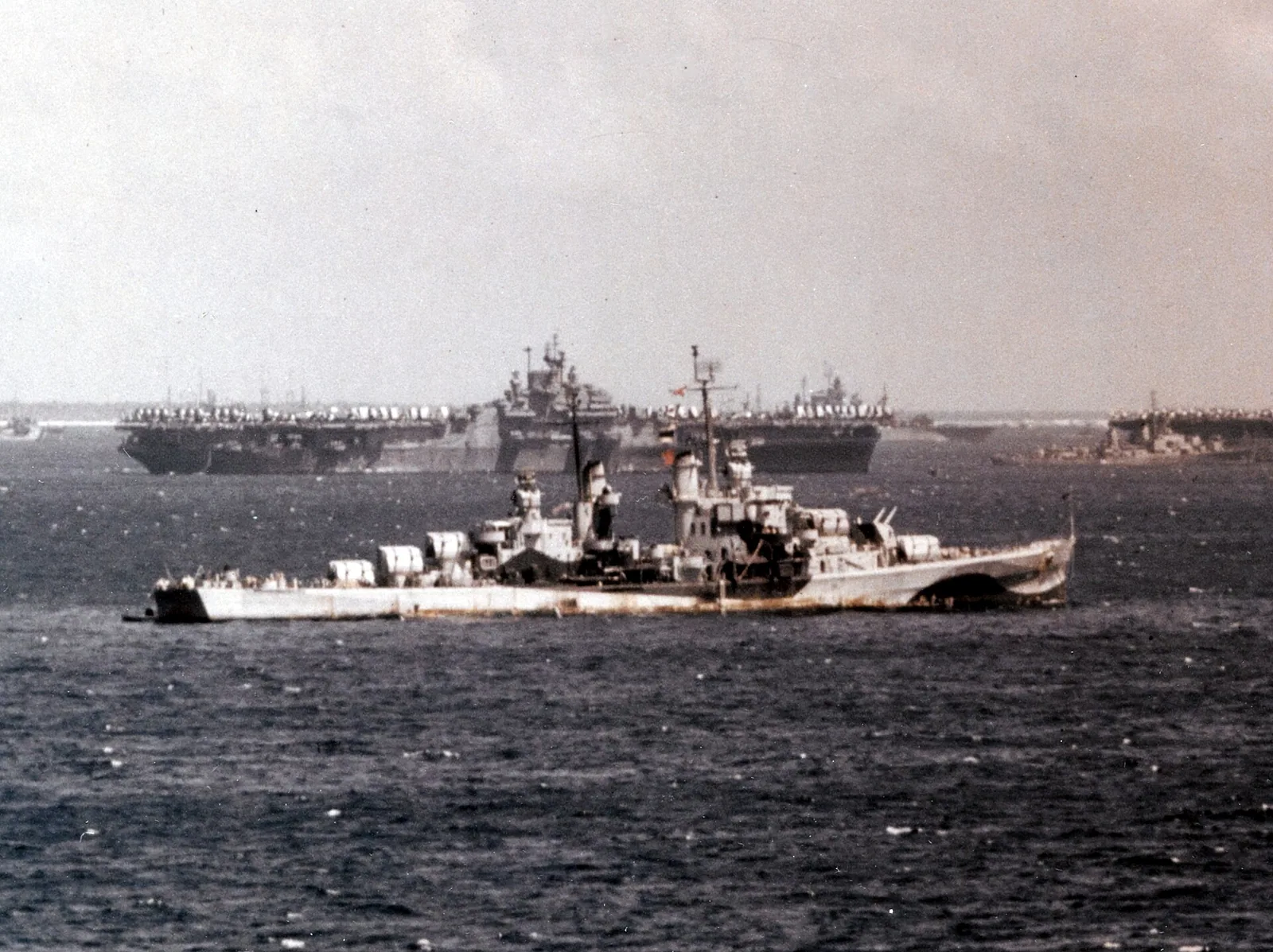
Service
- as Flint31 August 1944 — 6 May 1947370 days of the war
- Name
- USS Flint
- Pennant / hull number
- CL-97
- Namesake
- City of Flint, Michigan
- Builder
- Bethlehem Shipbuilding Corporation, San Francisco, California
- Laid down
- 1 August 1941
- Launched
- 25 January 1944
- Commissioned
- 31 August 1944
- Decommissioned
- 6 May 1947
- Struck
- 1 June 1965
- Fate
- Sold for scrap on 6 October 1966 (1966)
- Status
- Scrapped
Specifications
- Displacement, standard
- 6,718 long tons (6,826 t)
- Displacement, full load
- 8,340 long tons (8,474 t)
- Length
- 164.9 m (541 ft) OA
- Beam
- 16.15 m (53 ft)
- Draught
- 6.1 m (20 ft)
- Speed
- 32.5 knots (60.2 km/h, 37.4 mph)
- Complement
- 688
- Main gun
- 127 mm (5 in)
Flint (CL-97) was launched 25 January 1944 by Bethlehem Steel Co., San Francisco, Calif.; sponsored by Mrs. R. A. Pitcher; and commissioned 31 August 1944, Captain C. R. Will in command. She was reclassified CLAA-97 on 18 March 1949.
Flint reported to the 3d Fleet for duty at Ulithi 27 December 1944, and 6 days later sailed with TF 38 for a month-long cruise in support of the invasion of Luzon. She screened carriers as they launched strikes on Luzon, Taiwan, and the China coast, and fired protective antiaircraft cover during a Japanese kamikaze attack on 21 January 1945. Replenishing at Ulithi from 26 January to 10 February, Flint then sailed with newly designated TF 58 for air strikes on Tokyo preceding the attack on Iwo Jima. Her force arrived off Iwo Jima 21 February to fly air support for the Marines who had landed 2 days previously, and Flint returned to Ulithi 12 March for a brief 2 days of replenishment.
Putting to sea with TF 58 for strikes against Kyushu in preparation for the invasion of Okinawa, Flint aided in bringing down several airplanes in heavy attacks on the task force from 18 to 22 March 1945. The task force then closed Okinawa, and Flint with other cruisers bombarded beach installations in preparation for the landings on 1 April. Aside from the period 14 to 24 May, when she was at Ulithi for upkeep, Flint operated off Okinawa until 13 June, when she anchored in Leyte Gulf.
Flint sortied from Leyte 1 July 1945 to screen the final air attacks on the Japanese home islands and to join the bombardment of the east coast of Honshu until the cessation of hostilities. On 24 August, she took station off Nii Shima to serve as rescue ship and homing station for transport planes carrying occupation troops to Japan. Between 10 and 15 September, she lay in Tokyo Bay, then sailed with a carrier task force to provide air and sea surveillance of Central Honshu until 21 September.
The cruiser made a voyage from Japan to Eniwetok, then loaded homeward bound servicemen at Yokosuka 13 October 1945, bringing them into San Francisco Bay 28 November. After sailing to Kwajalein to bring home more servicemen eligible for discharge, Flint reported at Puget Sound Naval Shipyard, Bremerton, Wash., 11 January 1946, and there was placed out of commission in reserve at Bremerton 6 May 1947.
From the Dictionary of American Naval Fighting Ships, compiled by the Naval History and Heritage Command (Flint I (CL-97)). A work of the United States Government, in the public domain.
Armament and machinery
Armament and machinery
- Propulsion
- 2 × geared turbines
- 2 × screws
- Power
- 4 × Steam boilers
- 75000 shp
- Armament
- 12 × 5 in/38 caliber Mark 12 guns (6×2)
- 8 × dual 40 mm Bofors anti-aircraft guns
- 16 × 20 mm/70 cal anti-aircraft cannons
- 8 × 21 in torpedo tubes
- 6 × depth charge projectors
- 2 × depth charge tracks
- Armour
- Belt: 1.1 - 3+3/4 in
- Deck: 1+1/4 in
- Turrets: 1+1/4 in
- Conning Tower: 2+1/2 in
Sister ships
Sources
- Facts harvested from USS Flint (CL-97) on Wikipedia. Figures only — no wording is taken from it.
- Service history reproduced verbatim from Flint I (CL-97) , Dictionary of American Naval Fighting Ships — public domain, a work of the United States Government.
- Photograph: U.S. Navy — Official U.S. Navy photo 80-G-K-3813 (cropped) from the U.S. Navy Naval History and Heritage Command — Public domain — Wikimedia Commons