USS San Diego (CL-53)
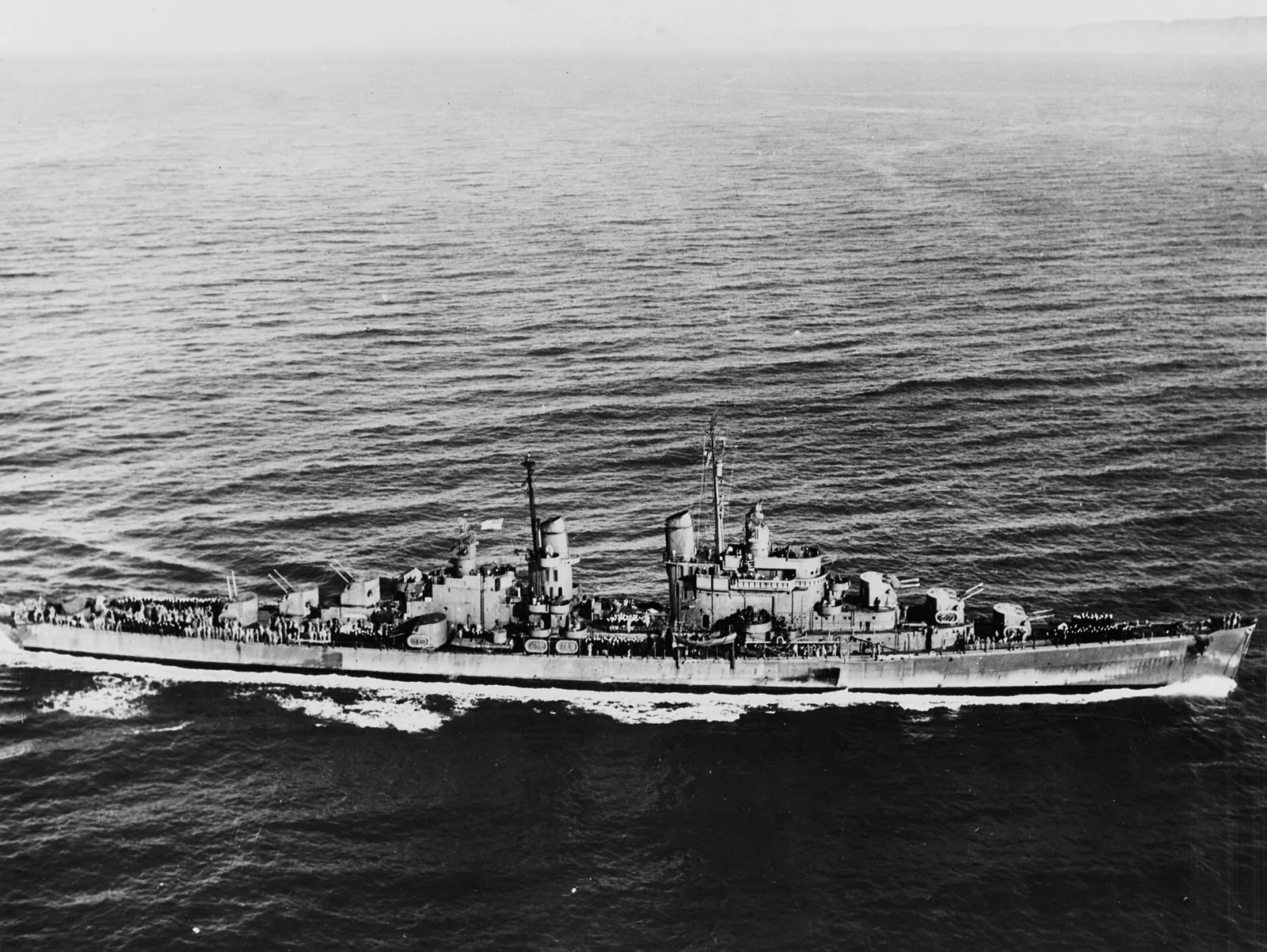
Service
- as San Diego10 January 1942 — 4 November 19461,331 days of the war
- Name
- USS San Diego
- Pennant / hull number
- CL-53
- Namesake
- City of San Diego, California
- Builder
- Bethlehem Shipbuilding Corporation's Fore River Shipyard, Quincy, Massachusetts
- Laid down
- 27 March 1940
- Launched
- 26 July 1941
- Commissioned
- 10 January 1942
- Decommissioned
- 4 November 1946
- Struck
- 1 March 1959
- Fate
- Sold for scrap December 1960 (1960)
- Status
- Scrapped
Specifications — As built
- Displacement, standard
- 6,718 long tons (6,826 t)
- Displacement, full load
- 8,340 long tons (8,474 t)
- Length
- 164.9 m (541 ft) OA
- Beam
- 16.15 m (53 ft)
- Draught
- 6.1 m (20 ft)
- Speed
- 32.5 knots (60.2 km/h, 37.4 mph)
- Complement
- 796
- Main gun
- 127 mm (5 in)
The second San Diego, an antiaircraft light cruiser, was laid down on 27 March 1940 by Bethlehem Steel Co., Quincy, Mass.; sponsored by Mrs. Percy J. Benbough ; launched on 26 July 1941; and acquired by the Navy and commissioned on 10 January 1942, Capt. Benjamin F. Perry in command.
After shakedown training in Chesapeake Bay, San Diego sailed via the Panama Canal to the west coast, arriving at her name-sake city on 16 May 1942. Escorting Saratoga (CV-3) at best speed, San Diego barely missed the Battle of Midway. On 15 June, she began escort duty for Hornet (CV-8) in operations in the South Pacific. Early in August, she supported the first American offensive of the war, the invasion of the Solomons at Guadalcanal. With powerful air and naval forces, the Japanese fiercely contested the American thrust and inflicted heavy damage; San Diego was the unwilling witness to the sinking of Wasp (CV-7) on 15 September and of Hornet on 26 October.
San Diego gave antiaircraft protection for Enter prise (CV-6) as part of the decisive three-day Naval Battle of Guadalcanal, 12 to 15 November 1942. After several months of service in the dangerous waters surrounding the Solomon Islands, San Diego sailed via Espiritu Santo, New Hebrides, to Auckland, New Zealand, for replenishment.
Continue to the full service history About 928 words
From the Dictionary of American Naval Fighting Ships, compiled by the Naval History and Heritage Command (San Diego II (CL-53)). A work of the United States Government, in the public domain.
Armament and machinery
This vessel is recorded in 2 configurations. Wartime refits changed armament and complement substantially, so each is kept separately rather than averaged into one set of figures. The figures above are as built.
As built
- Propulsion
- 2 × geared turbines
- 2 × screws
- Power
- 4 × Steam boilers
- 75000 shp
- Armament
- 16 × 5 in/38 caliber Mark 12 guns (8×2)
- 16 × 1.1 in/75 anti-aircraft guns (4×4)
- 8 × single 20 mm Oerlikon anti-aircraft cannons
- 8 × 21 in torpedo tubes
- 6 × depth charge projectors
- 2 × depth charge tracks
- Armour
- Belt: 1.1 - 3+3/4 in
- Deck: 1+1/4 in
- Turrets: 1+1/4 in
- Conning Tower: 2+1/2 in
1945
- Main gun
- 127 mm (5 in)
- Armament
- 16 × 5 in/38 caliber Mark 12 guns (8×2)
- 4 × quad 40 mm Bofors anti-aircraft guns
- 13 × 20 mm Oerlikon anti-aircraft cannons
- 8 × 21 in torpedo tubes
- 6 × depth charge projectors
- 2 × depth charge tracks
Sister ships
Sources
- Facts harvested from USS San Diego (CL-53) on Wikipedia. Figures only — no wording is taken from it.
- Service history reproduced verbatim from San Diego II (CL-53) , Dictionary of American Naval Fighting Ships — public domain, a work of the United States Government.
- Photograph: Photographed from an airship of Blimp Squadron 32 (ZP-32). — U.S. Navy photo NH 97825 — Public domain — Wikimedia Commons