USS Juneau (CLAA-52)
Service
- as Juneau14 February 1942 — 13 November 1942272 days of the war
- Name
- USS Juneau
- Pennant / hull number
- CLAA-52
- Namesake
- City of Juneau, Alaska
- Builder
- Federal Shipbuilding and Drydock Company, Kearny, New Jersey
- Laid down
- 27 May 1940
- Launched
- 25 October 1941
- Commissioned
- 14 February 1942
- Fate
- Torpedoed and sunk during Naval Battle of Guadalcanal on 13 November 1942
Shipwreck found, 17 March 2018
By surface_action (1942) - Status
- Wreck
Specifications
- Displacement, standard
- 6,718 long tons (6,826 t)
- Displacement, full load
- 8,340 long tons (8,474 t)
- Length
- 164.9 m (541 ft) OA
- Beam
- 16.15 m (53 ft)
- Draught
- 6.1 m (20 ft)
- Speed
- 32.5 knots (60.2 km/h, 37.4 mph)
- Complement
- 673
- Main gun
- 127 mm (5 in)
The first Juneau (CL-52) was laid down on 27 May 1940 at Kearny, N.J., by the Federal Shipbuilding Co; launched on 25 October 1941; and sponsored by Mrs. Harry I. Lucas, wife of the Mayor of the City of Juneau.
Commissioned at the New York Navy Yard, Brooklyn, N.Y., on 14 February 1942, Capt. Lyman K. Swenson in command, Juneau fit out at her delivery yard, departing New York on 22 March 1942, and proceeded to nearby Gravesend Bay. She arrived in her designated training area at 0800, took on ammunition and then conducted exercises in those waters through the 24th. Underway at 0748 on 25 March, Juneau participated in exercises near Staten Island and anchored for the night off Tompkinsville. She continued to drill in the vicinity through the 27th.
At 0000, on 28 March 1942, Juneau reported for duty with Commander Task Group (TG) 27.1 in response to a potential submarine menace. She passed the Delaware capes at 1700, and anchored north of the Harbor of Refuge overnight. Juneau got underway by 0730 the next morning, and while steaming in heavy seas made radar contact with an unknown object 780 yards distant. While she employed three embarrassing barrages that yielded unknown results, the concussion of the depth charges opened circuit breakers on the forward distribution board resulting in a temporary loss of steering control and gyros. Despite such issues the new cruiser arrived in the Chesapeake Bay at 1530 without further incident. Over the course of the next week Juneau participated in multiple training drills.
Continue to the full service history About 6,673 words
From the Dictionary of American Naval Fighting Ships, compiled by the Naval History and Heritage Command (Juneau I (CL-52)). A work of the United States Government, in the public domain.
Armament and machinery
Armament and machinery
- Propulsion
- 2 × geared turbines
- 2 × screws
- Power
- 4 × Steam boilers
- 75000 shp
- Armament
- 16 × 5 in/38 caliber Mark 12 guns (8×2)
- 16 × 1.1 in/75 anti-aircraft guns (4×4)
- 8 × single 20 mm Oerlikon anti-aircraft cannons
- 8 × 21 in torpedo tubes
- 6 × depth charge projectors
- 2 × depth charge tracks
- Armour
- Belt: 1.1 - 3+3/4 in
- Deck: 1+1/4 in
- Turrets: 1+1/4 in
- Conning Tower: 2+1/2 in
Sister ships
Sources
- Facts harvested from USS Juneau (CLAA-52) on Wikipedia. Figures only — no wording is taken from it.
- Service history reproduced verbatim from Juneau I (CL-52) , Dictionary of American Naval Fighting Ships — public domain, a work of the United States Government.
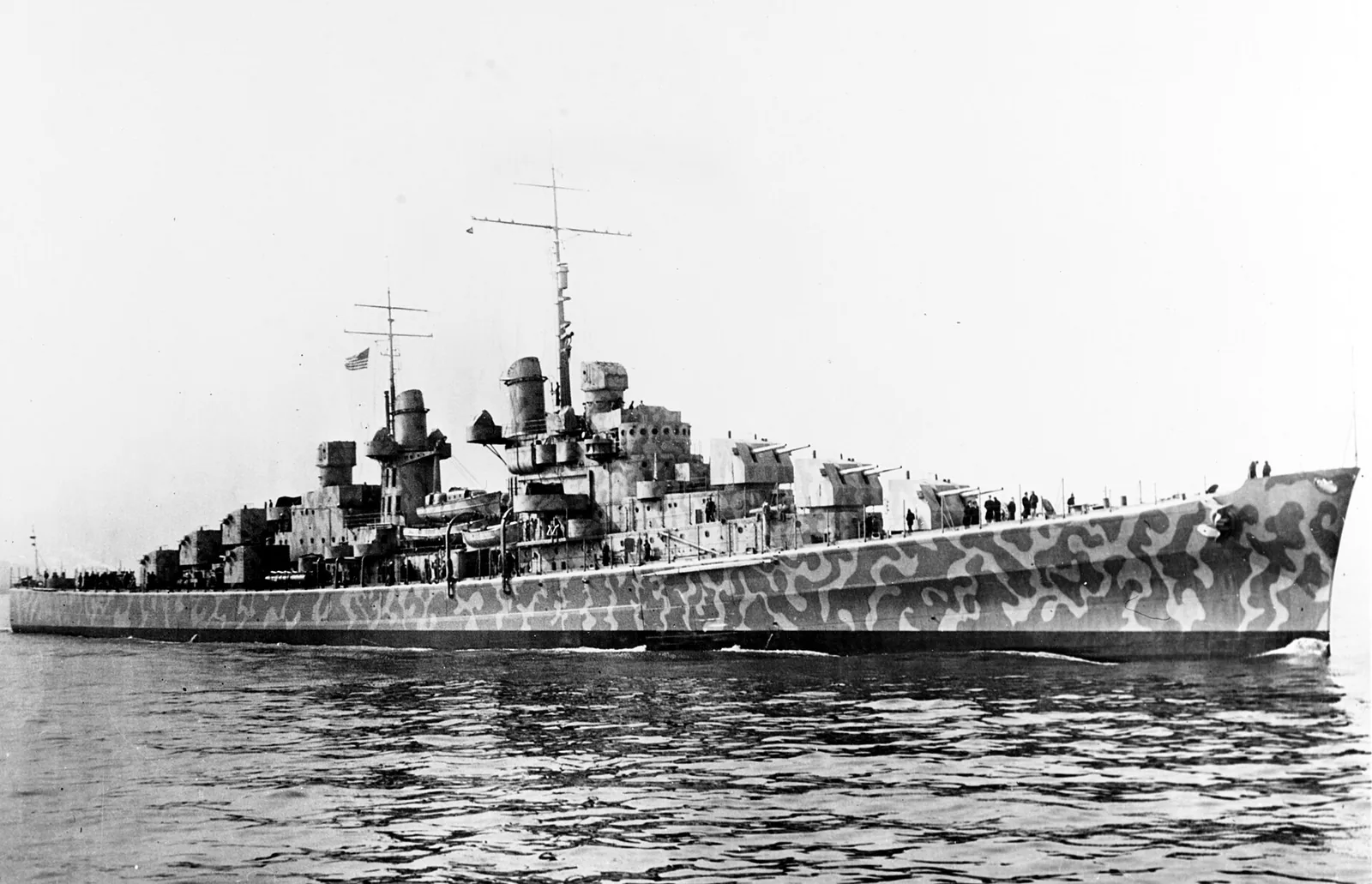
- Photograph: Unknown author — This image has been extracted from another file — Public domain — Wikimedia Commons