USS Cowie
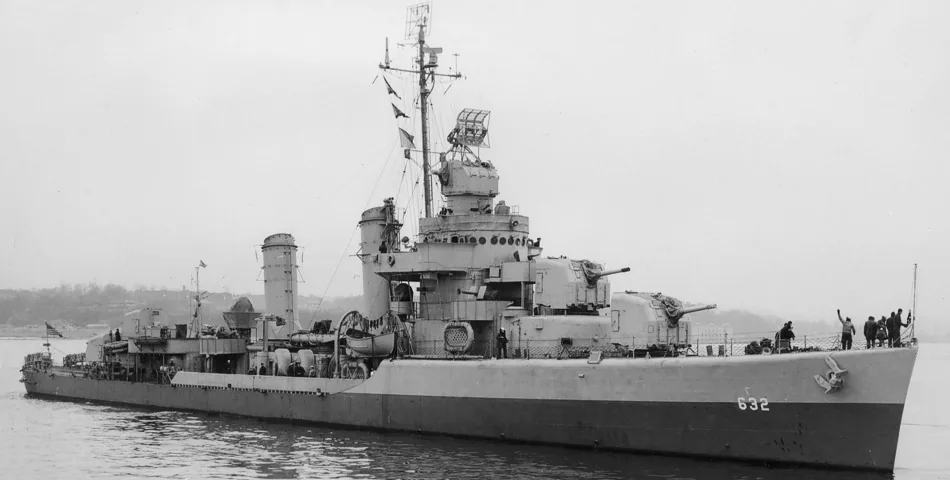
Service
- as Cowie1 June 1942 — 27 April 19471,189 days of the war
- Name
- USS Cowie
- Pennant / hull number
- DD-632
- Namesake
- Thomas Jefferson Cowie
- Builder
- Boston Navy Yard
- Laid down
- 18 March 1941
- Launched
- 27 September 1941
- Commissioned
- 1 June 1942
- Decommissioned
- 27 April 1947
- Struck
- 1 December 1970
- Fate
- Sold 22 February 1972 and broken up for scrap (1972)
- Status
- Scrapped
Specifications
- Displacement, standard
- 1,630 long tons (1,656 t)
- Length
- 106.07 m (348 ft)
- Beam
- 10.97 m (36 ft)
- Draught
- 3.35 m (11 ft)
- Speed
- 37.4 knots (69.3 km/h, 43 mph)
- Range
- 6,500 nmi (12,038 km)
- Complement
- 276
- Main gun
- 127 mm (5 in)
Thomas Jefferson Cowie was born 15 February 1857 at Montezuma, Iowa, and served as engineer's yeoman in Alliance from 8 January 1877 to 19 October 1878, then enlisted in the Navy 21 October 1878 at Constantinople. He was commissioned as assistant paymaster from 16 June 1880, rising to the rank of Rear Admiral and the position of Paymaster General and Chief of the Bureau of Supplies and Accounts 1 July 1910. He was awarded the Navy Cross for his valuable services in connection with the Liberty Loans of World War I. Retired from the Navy 15 February 1921, he was ordered to special duty in charge of the Navy Liberty Loan section of the Navy Allotment Office in March 1921, and in June 1923 was ordered to additional duty as secretary-treasurer of the Navy Mutual Aid Association, a position which he held until his death 16 July 1936 in Washington, D.C.
Cowie (DD-632) was launched 27 September 1941 by Boston Navy Yard; sponsored by Mrs. C. R. Robinson, daughter of Rear Admiral Cowie and wife of Captain C. R. Robinson; commissioned 1 June 1942, Lieutenant Commander C. J. Whiting in command; and reported to the Atlantic Fleet.
Departing New York 5 October 1942, Cowie escorted Chenango (CVE-28) to Norfolk, then cruised on antisubmarine partol off Cape Hatteras until 23 October when she sailed from Norfolk with TF 34 for the invasion of North Africa. She screened transports off Safi, French Morocco, from 8 to 13 November, and returned to New York 25 November for repairs and upkeep. After training exercises with submarines off New London, Cowie sailed on escort duty, screening two convoys to Casablanca between 12 December 1942 and 28 April 1943.
Sailing from Norfolk for North Africa again 8 June 1943, Cowie sortied from Oran 22 June for the invasion of Sicily. In the van of the invading forces, she contacted the British navigational marker submarine Seraph on 9 July to guide the invasion landings at Scoglitti, Sicily, from 9 to 13 July, then took station to give fire support to the assault troops ashore. Cowie was one of those whose prompt and effective response to calls for fire support broke up the counterattack by German tanks against the 180th Regimental Combat team on 11 July. Returning to Oran 16 July, Cowie sailed on local escort duty out of that port until 20 July when she arrived at Bizerte to patrol. She sortied 28 July for the invasion landings at Palermo, screening Philadelphia to provide fire support to the Army landing forces, and then swept from Palermo to Cape Milazzo hunting Axis shipping between 31 July and 1 August. Cowie returned to Oran 4 August and cleared for New York 8 days later, arriving 22 August.
After escorting a convoy to Belfast, North Ireland between 5 and 30 September 1943, Cowie was overhauled at New York before returning to convoy escort duty. She made 18 transatlantic voyages to United Kingdom and Mediterranean ports until 5 May 1945 when she entered Boston Navy Yard for conversion to a high speed minesweeper, Cowie was reclassified DMS-39 on 30 May 1945.
Sailing from Boston 24 June 1945, Cowie joined in minesweeping exercises at Norfolk until 18 July when she departed for San Diego, arriving 3 August. Following the cessation of hostilities, she sailed from San Diego 29 August for Okinawa, arriving 27 September. Sweeping mines in the Yellow Sea and off Kobe and Wakayama, Japan, Cowie remained in the Far East until 25 March 1946 when she departed Yokosuka for San Francisco, arriving 11 April 1946. Cowie was placed out of commission in reserve 21 April 1947, berthed at San Diego. She was reclassified DD-632, 15 July 1955.
From the Dictionary of American Naval Fighting Ships, compiled by the Naval History and Heritage Command (Cowie (DD-632)). A work of the United States Government, in the public domain.
Armament and machinery
Armament and machinery
- Propulsion
- 50000 shp
- 4 boilers
- 2 propellers
- Armament
- 4 × 5 in/38 caliber DP guns
- 4 × 40 mm guns
- 7 × 20 mm AA guns
- 5 × 21 in torpedo tubes (5 Mark 15 torpedoes)
- 6 × depth charge projectors
- 2 × depth charge tracks
Sister ships
- USS Aaron Ward (DD-483)
- USS Baldwin
- USS Beatty (DD-640)
- USS Bristol (DD-453)
- USS Buchanan (DD-484)
- USS Butler
- USS Carmick
- USS Corry (DD-463)
- USS Davison
- USS Doran (DD-634)
- USS Doyle (DMS-34)
- USS Duncan (DD-485)
- USS Earle
- USS Eberle
- USS Edison (DD-439)
- USS Edwards (DD-619)
- USS Ellyson
- USS Emmons
- USS Endicott
- USS Ericsson (DD-440)
- USS Fitch
- USS Forrest
- USS Frankford
- USS Gherardi
Sources
- Facts harvested from USS Cowie on Wikipedia. Figures only — no wording is taken from it.
- Service history reproduced verbatim from Cowie (DD-632) , Dictionary of American Naval Fighting Ships — public domain, a work of the United States Government.
- Photograph: USN — Official U.S. Navy Bureau of Ships photo 19-N-85005 available at Destroyerhistory.org — Public domain — Wikimedia Commons