USS Higbee
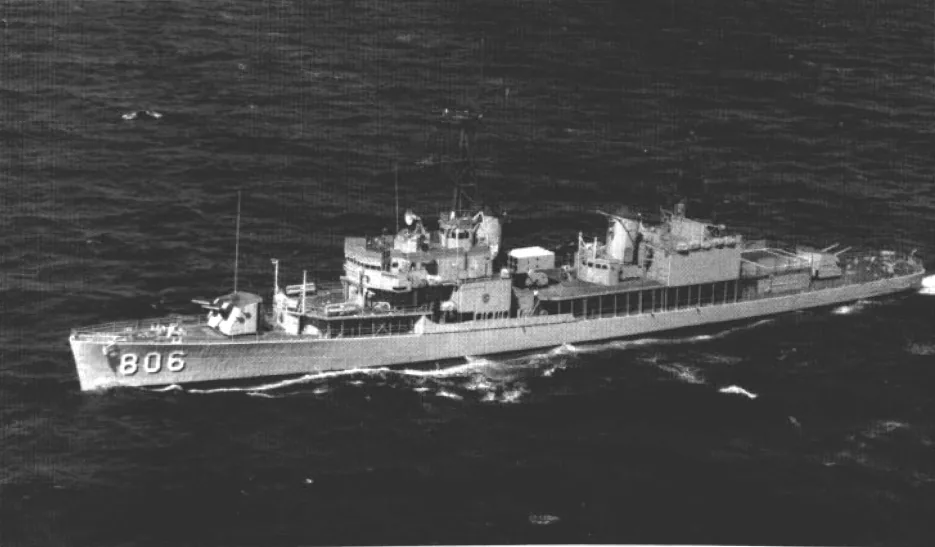
Service
- as USS Higbee27 January 1945 — 15 July 1979218 days of the war
- Name
- USS Higbee
- Pennant / hull number
- DD-806
- Namesake
- Lenah Higbee
- Builder
- Bath Iron Works, Bath, Maine, U.S.
- Laid down
- 26 June 1944
- Launched
- 13 November 1944
- Commissioned
- 27 January 1945
- Decommissioned
- 15 July 1979
- Struck
- 15 July 1979
- Fate
- Sunk as a target, 24 April 1986 (1986)
- Status
- Wreck
Specifications
- Displacement, standard
- 2,425 long tons (2,464 t)
- Length
- 118.87 m (390 ft)
- Beam
- 12.19 m (40 ft)
- Draught
- 4.27 m (14 ft)
- Speed
- 35 knots (64.8 km/h, 40.3 mph)
- Range
- 4,500 nmi (8,334 km)
- Complement
- 336
- Main gun
- 127 mm (5 in)
Lenah S. Higbee , first woman to receive the Navy Cross while still living, was born 18 May 1874 in Chatham, New Brunswick, Canada. After completing nurses' training at New York Postgraduate Hospital in 1899 and further training at Fordham Hospital, she engaged in private practice until entering the U.S. Navy Nurse Corps 1 October 1908. Widow of the late Lieutenant Colonel John Henley Higbee, USMC, Mrs. Higbee became Chief Nurse 14 April 1909 and second commandant of the Nurse Corps 20 January 1911. For her World War I service she received the Navy Cross 11 November 1920. Mrs. Higbee retired from the Nurse Corps 30 November 1922 and died 10 January 1941 at Winter Park, Fla. She is buried beside her husband at Arlington National Cemetery.
Higbee (DD-806) was launched 13 November 1944 by the Bath Iron Works, Bath, Maine; sponsored by Mrs. A. M. Wheaton, sister of the late Mrs. Lenah S. Higbee; and commissioned 27 January 1945, Comdr. Lindsay Williamson in command.
Higbee immediately sailed to Boston, where she was converted to a radar picket destroyer. After shakedown in the Caribbean, she sailed for the Pacific 24 May, joining the famed Carrier Task Force 38 less than 400 miles from Tokyo Bay 19 July. "Leaping Lenah," as she had been dubbed by her crew, screened the carriers as their planes launched heavy air attacks against the Japanese mainland until the end of hostilities 15 August. She helped clear Japanese mine fields and supported the occupation forces for the following 7 months, finally returning to San Diego 11 April 1946. The post-war years saw Higbee make two peacetime Western Pacific cruises as well as participate in fleet exercises and tactical training maneuvers during both these cruises and off the West Coast. On her second WestPac cruise, Higbee escorted the heavy cruiser Toledo as they paid official visits to the recently constituted governments of India and Pakistan in the summer of 1948.
Continue to the full service history About 753 words
From the Dictionary of American Naval Fighting Ships, compiled by the Naval History and Heritage Command (Higbee (DD-806)). A work of the United States Government, in the public domain.
Armament and machinery
Armament and machinery
- Propulsion
- Geared turbines, 2 shafts, 60000 shp
- Armament
- 6 × 5"/38 caliber guns
- 12 × 40 mm AA guns
- 11 × 20 mm AA guns
- 10 × 21-inch (533 mm) torpedo tubes
- 6 × depth charge projectors
- 2 × depth charge tracks
- 1 x RUR-5 ASROC Anti Submarine Rocket
Sister ships
- USS Abner Read (DD-769)
- USS Benner (DD-807)
- USS Bordelon
- USS Charles P. Cecil
- USS Charles R. Ware (DD-865)
- USS Chevalier (DD-805)
- USS Corry (DD-817)
- USS Dennis J. Buckley (DD-808)
- USS Duncan (DD-874)
- USS Dyess
- USS Eugene A. Greene
- USS Everett F. Larson (DD-830)
- USS Floyd B. Parks
- USS Frank Knox
- USS Fred T. Berry
- USS Furse
- USS Gearing
- USS George K. MacKenzie
- USS Goodrich
- USS Gurke
- USS Gyatt
- USS Hanson
- USS Harold J. Ellison (DD-864)
- USS Hawkins
Sources
- Facts harvested from USS Higbee on Wikipedia. Figures only — no wording is taken from it.
- Service history reproduced verbatim from Higbee (DD-806) , Dictionary of American Naval Fighting Ships — public domain, a work of the United States Government.
- Photograph: U.S. Navy — U.S. Navy All Hands magazine May 1980 , p. 44 — Public domain — Wikimedia Commons