USS Wintle (DE-25)
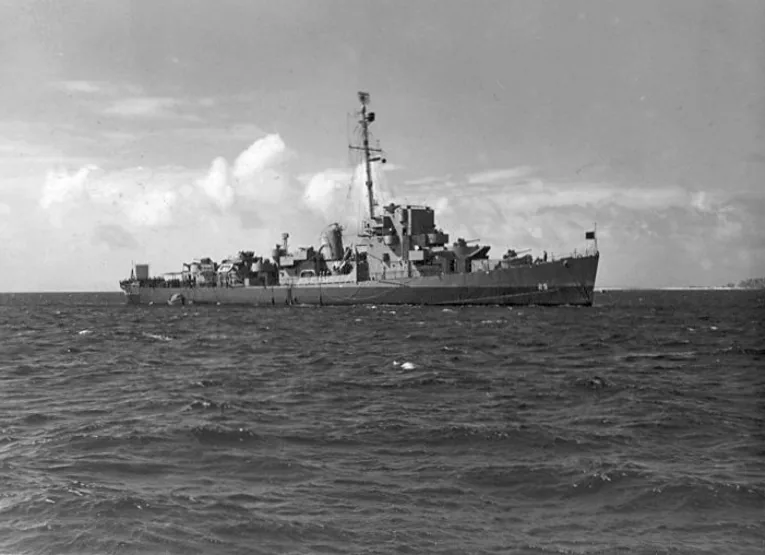
Service
- as USS Wintle10 July 1943 — 14 November 1945785 days of the war
- Name
- USS Wintle
- Pennant / hull number
- DE-25
- Builder
- Mare Island Navy Yard
- Laid down
- 1 October 1942
- Launched
- 18 February 1943
- Commissioned
- 10 July 1943
- Decommissioned
- 14 November 1945
- Struck
- 28 November 1945
- Fate
- Sold for scrapping, 25 August 1947 (1947)
- Status
- Scrapped
Specifications
- Displacement, standard
- 1,140 long tons (1,158 t)
- Length
- 88.09 m (289 ft) OA
- Beam
- 10.67 m (35 ft)
- Draught
- 3.35 m (11 ft)
- Speed
- 19 knots (35.2 km/h, 21.9 mph)
- Range
- 4,150 nmi (7,686 km)
- Complement
- 198
- Main gun
- 76 mm (3 in)
Jack William Wintle, born on 18 April 1908 at Pittsburg, Kansas, was appointed a midshipman at the U.S. Naval Academy on 14 June 1928, where a classmate wrote that “Jack” (or “Wintly”) exhibited a “sunny disposition and generous ways,” and “all of the qualifications of a good Naval Officer.” Graduating with the Class of 1932 on 2 June, he reported for duty in California (BB-44) on the 30th and served a three-year tour of duty in that battleship before being transferred to the submarine tender Bushnell (AS-2), an assignment that lasted for 17 months. Following that service, he traveled to the Puget Sound Navy Yard, Bremerton, Wash., reporting on 6 August 1936 to help fit out the destroyer Perkins (DD-377), remaining in that ship after she went into commission on 18 September 1936.
In the summer of 1939, Lt. (j.g.) Wintle received postgraduate instruction at the Naval Academy before reporting for duty to prepare Du Pont (DD-152) for recommissioning and service with the Neutrality Patrol that had been instituted following the outbreak of hostilities in Europe. His tour of duty in that destroyer, one of the first in the Atlantic squadrons to be equipped with sonar, ended in August 1940, when he was sent to New Orleans, La., where he instructed Naval Reserve Officer Training Corps midshipmen.
Late in April 1942, Wintle reported to the Bureau of Navigation in Washington, D.C., where he learned of his assignment to be aide and flag lieutenant to the Commander South Pacific Area and South Pacific Force. On 15 June 1942, he received promotion to lieutenant commander, and four days later reported for duty in his new assignment in the South Pacific.
Continue to the full service history About 1,843 words
From the Dictionary of American Naval Fighting Ships, compiled by the Naval History and Heritage Command (Wintle (DE-25)). A work of the United States Government, in the public domain.
Armament and machinery
Armament and machinery
- Propulsion
- 4 × General Motors Model 16-278A diesel engines with electric drive, 6000 shp
- 2 screws
- Armament
- 3 × single 3"/50 Mk.22 dual-purpose guns
- 1 × quad 1.1"/75 Mk.2 AA gun
- 9 × 20 mm Mk.4 AA guns
- 1 × Hedgehog Projector Mk.10 (144 rounds)
- 8 × Mk.6 depth charge projectors
- 2 × Mk.9 depth charge tracks
Sister ships
- HMS Bazely
- HMS Goodson
- HMS Inglis
- HMS Lawford (K514)
- USS Andres
- USS Austin (DE-15)
- USS Bebas
- USS Brackett
- USS Brennan
- USS Burden R. Hastings
- USS Cabana
- USS Canfield
- USS Carlson
- USS Charles R. Greer
- USS Cloues
- USS Connolly
- USS Crouter
- USS Crowley
- USS Decker
- USS Deede
- USS Dempsey (DE-26)
- USS Dionne
- USS Dobler
- USS Doherty
Sources
- Facts harvested from USS Wintle (DE-25) on Wikipedia. Figures only — no wording is taken from it.
- Service history reproduced verbatim from Wintle (DE-25) , Dictionary of American Naval Fighting Ships — public domain, a work of the United States Government.
- Photograph: U.S. Navy — U.S. Navy photo [1] from Navsource.org — Public domain — Wikimedia Commons