USS Beatty (DD-640)
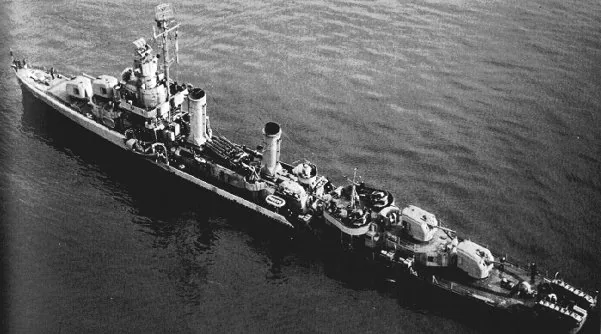
Service
- as Beatty7 May 1942 — 6 November 1943548 days of the war
- Name
- USS Beatty
- Pennant / hull number
- DD-640
- Namesake
- Frank E. Beatty
- Builder
- Charleston Navy Yard
- Laid down
- 1 May 1941
- Launched
- 20 December 1941
- Commissioned
- 7 May 1942
- Fate
- Sunk by German aircraft, off Algeria, 6 November 1943
By aircraft (1943) - Status
- Wreck
Specifications
- Displacement, standard
- 2,060 long tons (2,093 t)
- Length
- 106.07 m (348 ft)
- Beam
- 10.97 m (36 ft)
- Draught
- 3.35 m (11 ft)
- Speed
- 37.4 knots (69.3 km/h, 43 mph)
- Range
- 6,500 nmi (12,038 km)
- Complement
- 276
- Main gun
- 127 mm (5 in)
In the spring of 1892, Beatty returned to duty afloat, serving briefly in Ranger before being ordered to the monitor Miantonomah . After torpedo instruction, the young officer, by then a lieutenant, served in the dynamite cruiser Vesuvius ; and spent the next few years alternating between duty ashore at the Naval Academy and afloat, in Monongahela . Reporting to the gunboat Adams in the summer of 1897, he became that ship's executive officer in October and served in that capacity until transferred to the monitor Monterey in March 1898. The following spring, Beatty became the executive officer of gunboat Wheeling
Shore duty at the Washington Navy Yard preceded a tour in charge of the Department of Yards and Docks in the Navy Department from 13 February 1901 to 21 January 1902. Two commands followed in succession: first, the nautical school ship Saratoga and then Gloucester , before he became Commander, Naval Base, Culebra, Puerto Rico, in February 1904, with additional duty commanding Gloucester .
After a brief tour first as assistant inspector and later as the inspector of the 9th Light House District, headquartered at Chicago, Ill., Beatty spent the next decade alternating between ordnance duty ashore and service afloat, commanding in turn the cruisers Columbia and Charleston and the battleship Wisconsin . His shore duty included a tour as Assistant Superintendent of the Naval Gun Factory, Washington Navy Yard; one in the Bureau of Ordnance as a member of the board on sights; and, ultimately, a stint as Commandant of the Washington Navy Yard and Superintendent of the Naval Gun Factory. While holding the latter post from 1905 to 1907, Beatty was instrumental in the development of an electric range finder.
Continue to the full service history About 3,318 words
From the Dictionary of American Naval Fighting Ships, compiled by the Naval History and Heritage Command (Beatty I (DD-640)). A work of the United States Government, in the public domain.
Armament and machinery
Armament and machinery
- Propulsion
- 50000 shp
- 4 boilers
- 2 propellers
- Armament
- 4 × 5 in/ 38 caliber DP guns
- 4 × Bofors 40 mm guns
- 5 × Oerlikon 20 mm cannons
- 5 × 21 in torpedo tubes (5 Mark 15 torpedoes)
- 6 × depth charge projectors
- 2 × depth charge tracks
Sister ships
- USS Aaron Ward (DD-483)
- USS Baldwin
- USS Bristol (DD-453)
- USS Buchanan (DD-484)
- USS Butler
- USS Carmick
- USS Corry (DD-463)
- USS Cowie
- USS Davison
- USS Doran (DD-634)
- USS Doyle (DMS-34)
- USS Duncan (DD-485)
- USS Earle
- USS Eberle
- USS Edison (DD-439)
- USS Edwards (DD-619)
- USS Ellyson
- USS Emmons
- USS Endicott
- USS Ericsson (DD-440)
- USS Fitch
- USS Forrest
- USS Frankford
- USS Gherardi
Sources
- Facts harvested from USS Beatty (DD-640) on Wikipedia. Figures only — no wording is taken from it.
- Service history reproduced verbatim from Beatty I (DD-640) , Dictionary of American Naval Fighting Ships — public domain, a work of the United States Government.
- Photograph: United States Navy — U.S. Navy photo [1] from Navsource.org — Public domain — Wikimedia Commons