USS Grampus (SS-523)
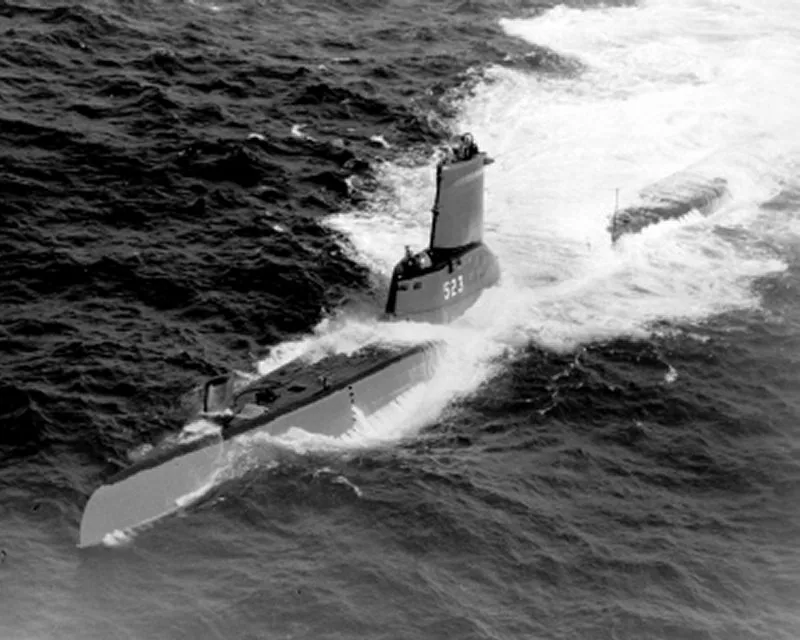
Service
- as USS Grampus (SS-523)26 October 1949 — 13 May 1972
- as Rio Grande do Sul (S-11)13 May 1972 — 16 November 1978
- Name
- USS Grampus
- Pennant / hull number
- SS-523
- Builder
- Boston Navy Yard
- Laid down
- 8 February 1944
- Launched
- 15 December 1944
- Commissioned
- 26 October 1949
- Decommissioned
- 13 May 1972
- Struck
- 13 May 1972
- Fate
- Scrapped 1981 (1981)
- Status
- Scrapped
Specifications
- Displacement, surfaced
- 1,870 long tons (1,900 t)
- Displacement, submerged
- 2,440 long tons (2,479 t)
- Length
- 93.57 m (307 ft)
- Beam
- 8.23 m (27 ft)
- Draught
- 5.18 m (17 ft)
- Speed
- 18 knots (33.3 km/h, 20.7 mph)
- Range
- 15,119 nmi (28,000 km)
- Complement
- 9
The grampus is a large cetacean ( Grampus griseus ) of the "blackfish family" commonly referred to as Risso's dolphin. Found in warm seas throughout the world, the dolphin has a blunt head, barrel-shaped body and ranges in color from grey to black. Risso's dolphins swim in groups of 3-50 animals and prefer offshore waters, where they hunt squid, octopi and fish.
Built at the Naval Shipyard, Boston, Grampus (SS-523) was begun in 1944 but left uncompleted at the end of the war. Construction was resumed in 1948, and Grampus launched 26 October 1949; sponsored by Mrs. Clark H. Woodward, who also sponsored the previous Grampus ; and commissioned that same day, Comdr. George F. Sharp in command.
With new "snorkeling equipment," which permitted her to remain submerged for periods far longer than the World War II fleet-class boats, Grampus served as a prototype for the post-war "Guppy" class diesel-electric submarines. Attached to Submarine Division (SubDiv) 61 at Norfolk, the boat helped train and familiarize surface navy anti-submarine warfare (ASW) forces with fast underwater submarines, that being the main naval threat posed by the Soviet Union during the Cold War. These exercises took place primarily off the East Coast and in the Caribbean and included torpedo attack exercises, snorkeling tests and demonstrations, and tactical ASW training. Grampus also helped develop early HUK (Hunter-Killer) antisubmarine patrol doctrine in support of Pacific and Atlantic Fleet overseas deployments.
Continue to the full service history About 503 words
From the Dictionary of American Naval Fighting Ships, compiled by the Naval History and Heritage Command (Grampus VI (SS-523)). A work of the United States Government, in the public domain.
Armament and machinery
Armament and machinery
- Propulsion
- 4 × Fairbanks-Morse Model 38D8-1 10-cylinder opposed piston diesel engines, equipped with a snorkel, driving electrical generators
- 1 × 184 cell, 1 × 68 cell, and 2 × 126 cell GUPPY-type batteries (total 504 cells)
- 2 × low-speed direct-drive Westinghouse electric motors
- two propellers
- Armament
- 10 × 21 in torpedo tubes
- (six forward, four aft)
Sister ships
- PNS Ghazi
- USS Amberjack (SS-522)
- USS Argonaut (SS-475)
- USS Conger
- USS Cutlass
- USS Diablo
- USS Irex
- USS Medregal
- USS Odax
- USS Pickerel (SS-524)
- USS Quillback
- USS Remora
- USS Requin
- USS Runner (SS-476)
- USS Sea Leopard
- USS Tench
- USS Thornback
- USS Tigrone
- USS Tirante
- USS Toro
- USS Torsk
- USS Trutta
- USS Volador (SS-490)
Sources
- Facts harvested from USS Grampus (SS-523) on Wikipedia. Figures only — no wording is taken from it.
- Service history reproduced verbatim from Grampus VI (SS-523) , Dictionary of American Naval Fighting Ships — public domain, a work of the United States Government.
- Photograph: US Navy — https://www.navsource.net/archives/08/08523.htm — Public domain — Wikimedia Commons