USS Gwin (DD-433)
Service
- as Gwin15 January 1941 — 13 July 1943909 days of the war
- Name
- USS Gwin
- Pennant / hull number
- DD-433
- Namesake
- William Gwin
- Builder
- Boston Navy Yard
- Laid down
- 1 June 1939
- Launched
- 25 May 1940
- Commissioned
- 15 January 1941
- Fate
- Sunk at Battle of Kolombangara, 13 July 1943 (1943)
- Status
- Wreck
Specifications
- Displacement, standard
- 1,630 long tons (1,656 t)
- Length
- 106.07 m (348 ft)
- Beam
- 10.97 m (36 ft)
- Draught
- 3.35 m (11 ft)
- Speed
- 37.4 knots (69.3 km/h, 43 mph)
- Range
- 6,500 nmi (12,038 km)
- Complement
- 276
- Main gun
- 127 mm (5 in)
William Gwin was born 6 December 1832 in Columbus, Ind., and appointed a Midshipman 7 April 1847. One of the most promising officers in the nation, he had risen to the rank of Lieutenant Commander by the time of his death. During the Civil War he commanded several ships of the Mississippi Squadron. He was one of Flag Officer Foote's "can do" officers, displaying outstanding initiative, energy and dash. After the fall of Fort Henry he swept with his wooden gunboats up the Tennessee River all the way to regions of Alabama, spreading destruction and terror. This action was a major factor in the collapse of the Confederate lines far behind him in Kentucky. Fire support from two of his gunboats, Tyler and Lexington, helped save Union troops from disaster in the Battle of Shiloh, bringing high praise from General Grant. He was wounded in action 27 December 1862 while commanding gunboat Benton in the battle of Haines Bluff on the Yazoo River. He died from these injuries 3 January 1863 on board a hospital ship in the Mississippi River.
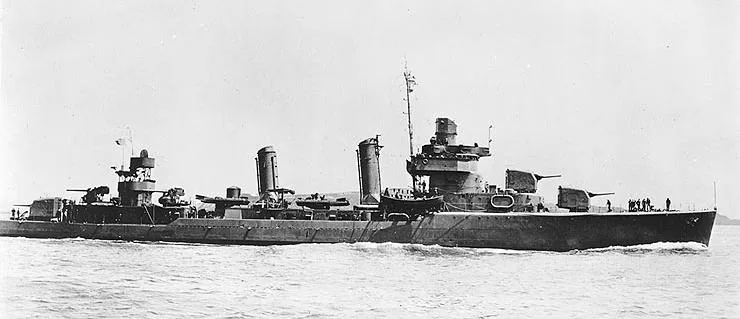
The third Gwin (DD-433) was launched 25 May 1940 by the Boston Navy Yard; sponsored by Mrs. Jesse T. Lippincott, second cousin of Lt. Cmdr. Gwin and commissioned at Boston 15 January 1941, Lt. Cmdr. J. M. Higgins in command.
Gwin completed shakedown training 25 April 1941 and underwent final alterations in the Boston Navy Yard before conducting neutrality patrol throughout the Caribbean Sea. On 28 September 1941 she assumed identical service in the North Atlantic from her base at Hvalfjordur, Iceland. After the infamous raid on Pearl Harbor, she hurried back to the Eastern Seaboard thence through the Panama Canal to San Francisco, Calif.
Continue to the full service history About 1,305 words
From the Dictionary of American Naval Fighting Ships, compiled by the Naval History and Heritage Command (Gwin III (DD-433)). A work of the United States Government, in the public domain.
Armament and machinery
Armament and machinery
- Propulsion
- 50000 shp
- 4 boilers
- 2 propellers
- Armament
- 5 × 5 in DP guns
- 6 × 20 mm AA guns
- 6 × .50 cal (12.7 mm) guns
- 10 × 21 in torpedo tubes
- 2 × depth charge tracks
Sister ships
- USS Aaron Ward (DD-483)
- USS Baldwin
- USS Beatty (DD-640)
- USS Bristol (DD-453)
- USS Buchanan (DD-484)
- USS Butler
- USS Carmick
- USS Corry (DD-463)
- USS Cowie
- USS Davison
- USS Doran (DD-634)
- USS Doyle (DMS-34)
- USS Duncan (DD-485)
- USS Earle
- USS Eberle
- USS Edison (DD-439)
- USS Edwards (DD-619)
- USS Ellyson
- USS Emmons
- USS Endicott
- USS Ericsson (DD-440)
- USS Fitch
- USS Forrest
- USS Frankford
Sources
- Facts harvested from USS Gwin (DD-433) on Wikipedia. Figures only — no wording is taken from it.
- Service history reproduced verbatim from Gwin III (DD-433) , Dictionary of American Naval Fighting Ships — public domain, a work of the United States Government.
- Photograph: Unknown author — Public domain — Wikimedia Commons