USS Knight
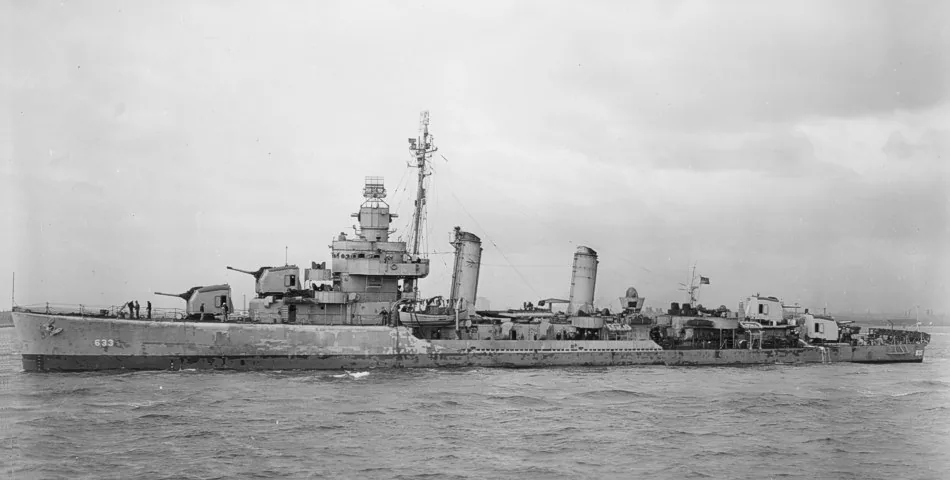
Service
- as Knight23 June 1942 — 19 March 19471,167 days of the war
- Name
- USS Knight
- Pennant / hull number
- DD-633
- Namesake
- Austin M. Knight
- Builder
- Boston Navy Yard
- Laid down
- 18 March 1941
- Launched
- 27 September 1941
- Commissioned
- 23 June 1942
- Decommissioned
- 19 March 1947
- Struck
- 1 December 1966
- Fate
- Sunk as a target off San Diego, California 27 October 1967 (1967)
- Status
- Wreck
Specifications
- Displacement, standard
- 1,630 long tons (1,656 t)
- Length
- 106.07 m (348 ft)
- Beam
- 10.97 m (36 ft)
- Draught
- 3.35 m (11 ft)
- Speed
- 37.4 knots (69.3 km/h, 43 mph)
- Range
- 6,500 nmi (12,038 km)
- Complement
- 276
- Main gun
- 127 mm (5 in)
Austin Melvin Knight, born in Ware, Mass., 16 December 1854, graduated from the Naval Academy in 1873. After service as a Passed Midshipman, he was commissioned Ensign 16 July 1874. He served in various sea and shore assignments over the next two decades, including tours at the Naval Academy, and in Tuscarora, Constellation, Chicago, Monadnock, and Lancaster.
During the Spanish-American War he served in Puritan, blockading the coasts of Cuba and Puerto Rico. After attending the Naval War College at Newport in 1901, he commanded several ships during the next decade including Yankton, Washington (ACR-11), and Castine. Knight was promoted to Captain in 1907 and was commissioned Rear Admiral 29 January 1911. Subsequently he served twice as Commander in Chief, Atlantic Reserve Fleet, and commanded the Special Squadron and the Narragansett Bay Naval Station.
From 15 December 1913 to 16 February 1917 he served with distinction as President, Naval War College. On 22 May 1917, he took command of the Asiatic Fleet with the rank of Admiral (temporary); he was awarded the Distinguished Service Medal during Allied naval operations at Vladivostok, Siberia. He transferred to the retired list 16 December but subsequently served on active duty from 13 March 1919 until 30 June 1920 as Senior Member, Board of Awards. He died 26 February 1927, at Washington, D.C., and was buried at the Naval Academy Cemetery. On 17 November 1930, Austin Melvin Knight was commissioned Admiral posthumously on the Retired List from 26 February 1927.
Continue to the full service history About 878 words
From the Dictionary of American Naval Fighting Ships, compiled by the Naval History and Heritage Command (Knight (DD-633)). A work of the United States Government, in the public domain.
Armament and machinery
Armament and machinery
- Propulsion
- 50000 shp
- 4 boilers
- 2 propellers
- Armament
- 4 × 5 in/38 caliber dual purpose guns
- 4 × Bofors 40 mm guns (2×2)
- 7 × Oerlikon 20 mm cannons (5×1)
- 5 × 21 in torpedo tubes (5 Mark 15 torpedoes)
- 6 × depth charge projectors
- 2 × depth charge tracks
Sister ships
- USS Aaron Ward (DD-483)
- USS Baldwin
- USS Beatty (DD-640)
- USS Bristol (DD-453)
- USS Buchanan (DD-484)
- USS Butler
- USS Carmick
- USS Corry (DD-463)
- USS Cowie
- USS Davison
- USS Doran (DD-634)
- USS Doyle (DMS-34)
- USS Duncan (DD-485)
- USS Earle
- USS Eberle
- USS Edison (DD-439)
- USS Edwards (DD-619)
- USS Ellyson
- USS Emmons
- USS Endicott
- USS Ericsson (DD-440)
- USS Fitch
- USS Forrest
- USS Frankford
Sources
- Facts harvested from USS Knight on Wikipedia. Figures only — no wording is taken from it.
- Service history reproduced verbatim from Knight (DD-633) , Dictionary of American Naval Fighting Ships — public domain, a work of the United States Government.
- Photograph: USN — Official U.S. Navy Bureau of Ships photo 19-N-55085 available at Destroyerhistory.org — Public domain — Wikimedia Commons