USS Raleigh (CL-7)
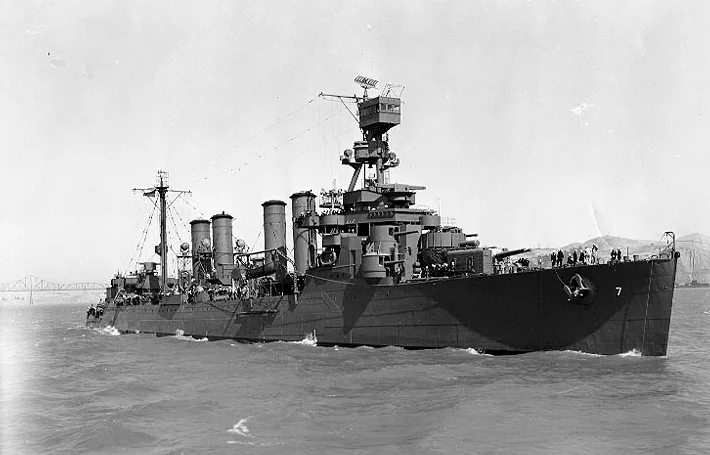
Service
- as Raleigh6 February 1924 — 2 November 19452,193 days of the war
- Name
- USS Raleigh
- Pennant / hull number
- CL-7
- Namesake
- City of Raleigh, North Carolina
- Builder
- Bethlehem Shipbuilding Corporation's Fore River Shipyard, Quincy, Massachusetts
- Ordered
- 29 August 1916
- Laid down
- 16 August 1920
- Launched
- 25 October 1922
- Commissioned
- 6 February 1924
- Decommissioned
- 2 November 1945
- Struck
- 28 November 1945
- Fate
- Sold for scrap, 27 February 1946 (1946)
- Status
- Scrapped
Specifications — As built
- Displacement, standard
- 7,500 long tons (7,620 t)
- Displacement, full load
- 9,508 long tons (9,661 t)
- Length
- 169.16 m (555 ft) OA
- Beam
- 16.76 m (55 ft)
- Draught
- 4.27 m (14 ft)
- Speed
- 35 knots (64.8 km/h, 40.3 mph)
- Main gun
- 152 mm (6 in)
The capital of North Carolina which honors the English explorer Sir Walter Raleigh, the first to attempt the establishment of an English settlement in North America.
The third Raleigh (CL-7) was laid down by Bethlehem Steel Co., Quincy, Mass., 16 August 1920; launched 25 October 1922; sponsored by Miss Jennie Proctor; and commissioned in the Boston Navy Yard 6 February 1924, Capt. William C. Watts in command.
Raleigh shifted to the New York Navy Yard 26 February to complete fitting out and cleared that port 16 April for shakedown off the Virginia Capes. Final building yard alterations were completed at Quincy 24 June. After shifting to Provincetown, Mass., Raleigh put to sea from that harbor 30 July to join the Light Cruiser Division, Scouting Fleet, in northern European waters for duty in connection with the Army World Flight. After calling at ports in Norway, Denmark, and Scotland, she took up her reconnaissance station 31 July off Harafjord, Iceland. She shifted her station to the east coast of Greenland 10 August, and, upon completion of duty with the flight operations, she returned to the Boston Navy Yard 3 September 1924 for voyage repairs.
Continue to the full service history About 1,253 words
From the Dictionary of American Naval Fighting Ships, compiled by the Naval History and Heritage Command (Raleigh III (CL-7)). A work of the United States Government, in the public domain.
Armament and machinery
This vessel is recorded in 2 configurations. Wartime refits changed armament and complement substantially, so each is kept separately rather than averaged into one set of figures. The figures above are as built.
As built
- Propulsion
- 4 × Curtis steam turbines
- 4 × screws
- Power
- 12 × Yarrow boiler
- 90000 shp (designed horse power)
- Armament
- 2 × twin 6 in/53 caliber guns
- 8 × single 6 in/53 caliber guns
- 2 × 3 in/50 caliber anti-aircraft guns
- 2 × triple 21 in torpedo tubes
- 2 × twin 21 in torpedo tubes
- 224 × mines
- Armour
- Belt: 3 in
- Deck: 1+1/2 in
- Conning Tower: 1 in
- Bulkheads: 1-3 in
- Aircraft
- 2 × Curtiss SOC Seagulls and later 2 × Vought OS2U Kingfishers
1945
- Main gun
- 152 mm (6 in)
- Armament
- 2 × twin 6 in/53 caliber
- 6 × single 6 in/53 caliber
- 8 × 3 in/50 caliber anti-aircraft guns
- 2 × triple 21 in torpedo tubes
- 3 × twin 40 mm Bofors guns
- 8 × single 20 mm Oerlikon cannons
Sister ships
Sources
- Facts harvested from USS Raleigh (CL-7) on Wikipedia. Figures only — no wording is taken from it.
- Service history reproduced verbatim from Raleigh III (CL-7) , Dictionary of American Naval Fighting Ships — public domain, a work of the United States Government.
- Photograph: Unknown author — U.S. Navy photo 19-N-30916 — Public domain — Wikimedia Commons