USS Stockton (DD-646)
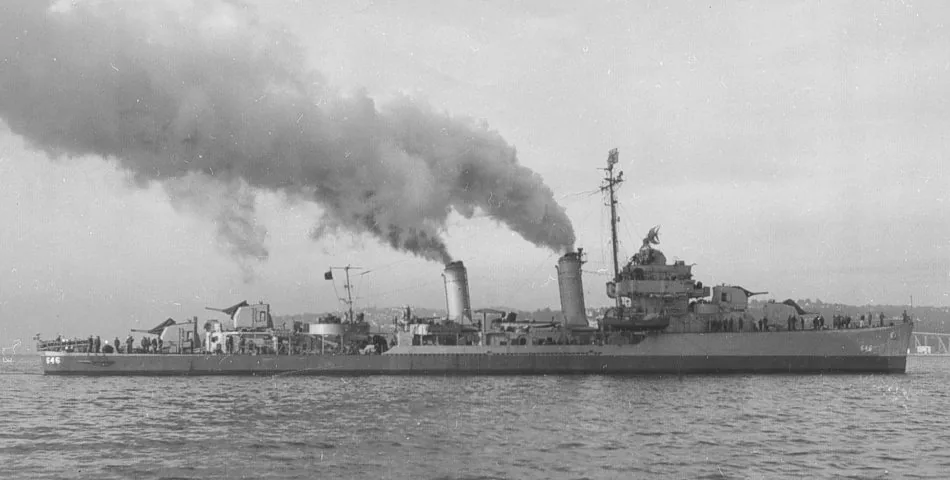
Service
- as Stockton11 January 1943 — 16 May 1946965 days of the war
- Name
- USS Stockton
- Pennant / hull number
- DD-646
- Namesake
- Robert F. Stockton
- Builder
- Federal Shipbuilding and Drydock Company
- Laid down
- 24 July 1942
- Launched
- 11 November 1942
- Commissioned
- 11 January 1943
- Decommissioned
- 16 May 1946
- Struck
- 1 July 1971
- Fate
- Sold 25 May 1973 and broken up for scrap (1973)
- Status
- Scrapped
Specifications
- Displacement, standard
- 1,630 long tons (1,656 t)
- Length
- 106.07 m (348 ft)
- Beam
- 10.97 m (36 ft)
- Draught
- 3.35 m (11 ft)
- Speed
- 37.4 knots (69.3 km/h, 43 mph)
- Range
- 6,500 nmi (12,038 km)
- Complement
- 276
- Main gun
- 127 mm (5 in)
Robert Field Stockton, born on 20 August 1795 at Princeton, N.J., entered the United States Navy as a midshipman in 1811. During the War of 1812, he served with distinction on board a frigate, President, and later ashore defending Washington and Baltimore. After the war, Stockton served in the Mediterranean Squadron, operating against Barbary pirates in waters off the west coast of Africa, suppressing the slave trade, and in the Caribbean fighting buccaneers. He commanded Erie and Alligator between 1820 and 1822. Stockton left active duty in 1828 to become involved in the Delaware & Raritan Canal Co.
Returning to active duty in 1838 with the rank of captain, Stockton assumed command of ship-of-the-line Ohio. He declined President Tyler's offer to appoint him Secretary of the Navy in 1841 and instead worked with John Ericsson on the construction of the Navy's first screw warship Princeton; and, in 1843, he became her first commander. In 1845, he was chosen by the President to convey the United States government's annexation resolution to the government of Texas.
After relieving Commodore Sloat in command of the Pacific Squadron on 23 July 1847, Commodore Stockton directed operations which captured California and added other territory to the nation. He resigned from the Navy on 28 May 1850; and, in the following year, was sent to the United States Senate by New Jersey. During his term as Senator, Stockton introduced a bill providing for abolition of flogging in the Navy; and he was energetic in urging adequate coastal defenses. From 1853 until his death, Commodore Stockton was president of the Delaware & Raritan Canal Co. He died on 7 October 1866 at Princeton, N.J.
Continue to the full service history About 765 words
From the Dictionary of American Naval Fighting Ships, compiled by the Naval History and Heritage Command (Stockton III (DD-646)). A work of the United States Government, in the public domain.
Armament and machinery
Armament and machinery
- Propulsion
- 50000 shp
- 4 boilers
- 2 propellers
- Armament
- 4 × 5 in/38 caliber DP guns
- 4 × 40 mm guns
- 4 × 20 mm AA guns
- 5 × 21 in torpedo tubes (5 Mark 15 torpedoes)
- 6 × depth charge projectors
- 2 × depth charge tracks
Sister ships
- USS Aaron Ward (DD-483)
- USS Baldwin
- USS Beatty (DD-640)
- USS Bristol (DD-453)
- USS Buchanan (DD-484)
- USS Butler
- USS Carmick
- USS Corry (DD-463)
- USS Cowie
- USS Davison
- USS Doran (DD-634)
- USS Doyle (DMS-34)
- USS Duncan (DD-485)
- USS Earle
- USS Eberle
- USS Edison (DD-439)
- USS Edwards (DD-619)
- USS Ellyson
- USS Emmons
- USS Endicott
- USS Ericsson (DD-440)
- USS Fitch
- USS Forrest
- USS Frankford
Sources
- Facts harvested from USS Stockton (DD-646) on Wikipedia. Figures only — no wording is taken from it.
- Service history reproduced verbatim from Stockton III (DD-646) , Dictionary of American Naval Fighting Ships — public domain, a work of the United States Government.
- Photograph: USN — Official U.S. Navy Bureau of Ships photo 19-N-76556 available at Destroyerhistory.org — Public domain — Wikimedia Commons