USS Tucson (CL-98)
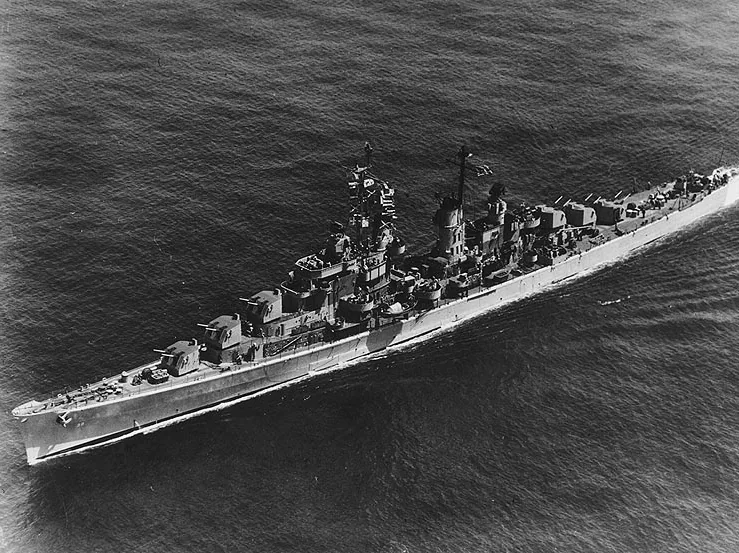
Service
- as Tucson3 February 1945 — 11 June 1949211 days of the war
- Name
- USS Tucson
- Pennant / hull number
- CL-98
- Namesake
- City of Tucson, Arizona
- Builder
- Bethlehem Shipbuilding Corporation, San Francisco, California
- Laid down
- 23 December 1942
- Launched
- 3 September 1944
- Commissioned
- 3 February 1945
- Decommissioned
- 11 June 1949
- Struck
- 1 June 1966
- Fate
- Sold for scrap on 24 February 1971 (1971)
- Status
- Scrapped
Specifications
- Displacement, standard
- 6,718 long tons (6,826 t)
- Displacement, full load
- 8,340 long tons (8,474 t)
- Length
- 164.9 m (541 ft) OA
- Beam
- 16.15 m (53 ft)
- Draught
- 6.1 m (20 ft)
- Speed
- 32.5 knots (60.2 km/h, 37.4 mph)
- Complement
- 688
- Main gun
- 127 mm (5 in)
Tucson (CL-98) was laid down on 23 December 1942 at San Francisco, Calif., by the Bethlehem Steel Co.; launched on 3 September 1944; sponsored by Mrs. Emmett S. Claunch, Sr.; and commissioned on 3 February 1945, Capt. Arthur D. Ayrault in command.
Following outfitting at San Francisco and shakedown out of San Diego, Tucson sailed for the western Pacific on 8 May. She stopped at Pearl Harbor on 13 May for three weeks of additional training before resuming her voyage west on 2 June. She stopped overnight at Ulithi on 13 and 14 June, then continued on to the Philippines, and reached Leyte on the 16th. The cruiser was assigned to the screen of the Fast Carrier Task Force, TF 38, specifically to that of Rear Admiral Gerald F. Bogan's Task Group (TG) 38.3 built around carriers Essex (CV-9), Ticonderoga (CV-14), Randolph (CV-15), Monterey (CV-26), and Bataan (CVL-29).
Tucson joined the fast carriers just in time to participate in their final rampage against the Japanese Empire and its inner defenses. On 1 July, she sortied from Leyte Gulf with TF 38 and headed north to the Japanese home islands. On the 10th, the flattops launched planes against Tokyo. On the 14th and 15th, TF 38's air groups struck Hokkaido and northern Honshu. They returned to southern Honshu on the 17th and 18th to blast Tokyo again and then left the area for almost a week. On 24 and 28 July, she appeared with the carriers south of Shikoku while their planes hit shipping in the Inland Sea. On the 30th, they zeroed in on Kobe and Nagoya. After that, they retired south to fuel and replenish before striking out northward. By the second week of August, Tucson was off northern Honshu screening the carriers while their planes pounded the island once more. She then accompanied them south to pummel Tokyo again on the 13th. Two days later, Japan capitulated.
Continue to the full service history About 788 words
From the Dictionary of American Naval Fighting Ships, compiled by the Naval History and Heritage Command (Tucson (CL-98)). A work of the United States Government, in the public domain.
Armament and machinery
Armament and machinery
- Propulsion
- 2 × geared turbines
- 2 × screws
- Power
- 4 × Steam boilers
- 75000 shp
- Armament
- 12 × 5 in/38 caliber Mark 12 guns (6×2)
- 8 × dual 40 mm Bofors anti-aircraft guns
- 16 × 20 mm Oerlikon anti-aircraft cannons
- 8 × 21 in torpedo tubes (removed before end of World War II)
- 6 × depth charge projectors
- 2 × depth charge tracks
- Armour
- Belt: 1.1 - 3+3/4 in
- Deck: 1+1/4 in
- Turrets: 1+1/4 in
- Conning Tower: 2+1/2 in
Sister ships
Sources
- Facts harvested from USS Tucson (CL-98) on Wikipedia. Figures only — no wording is taken from it.
- Service history reproduced verbatim from Tucson (CL-98) , Dictionary of American Naval Fighting Ships — public domain, a work of the United States Government.
- Photograph: Unknown author — U.S. Navy photo NH 98518 — Public domain — Wikimedia Commons