USS Tuscaloosa (CA-37)
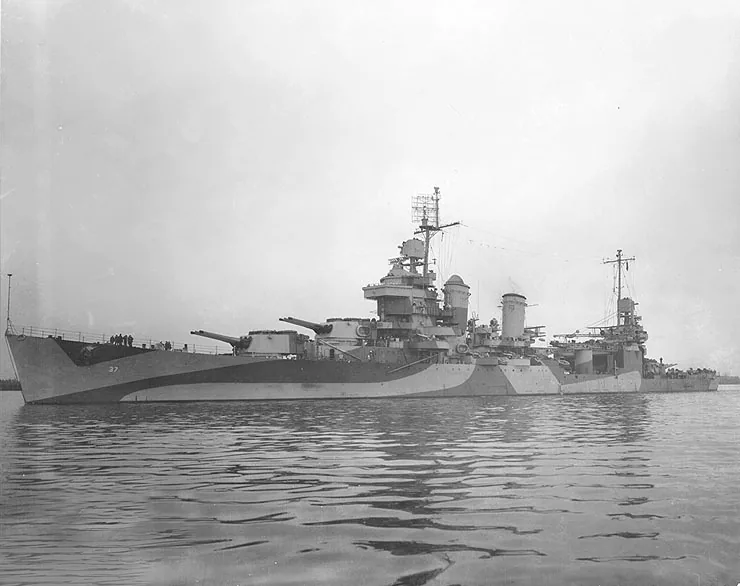
Service
- as Tuscaloosa17 August 1934 — 13 February 19462,193 days of the war
- Name
- USS Tuscaloosa
- Pennant / hull number
- CA-37
- Namesake
- City of Tuscaloosa, Alabama
- Builder
- New York Shipbuilding, Camden, New Jersey
- Ordered
- 13 February 1929
- Laid down
- 3 September 1931
- Launched
- 15 November 1933
- Commissioned
- 17 August 1934
- Decommissioned
- 13 February 1946
- Struck
- 1 March 1959
- Fate
- Sold for scrap 25 June 1959 (1959)
- Status
- Scrapped
Specifications — As built
- Displacement, standard
- 9,975 long tons (10,135 t)
- Length
- 179.22 m (588 ft) OA
- Beam
- 18.59 m (61 ft)
- Draught
- 5.79 m (19 ft)
- Speed
- 32.7 knots (60.6 km/h, 37.6 mph)
- Complement
- 866
- Main gun
- 203 mm (8 in)
Tuscaloosa (CA-37) was laid down on 3 September 1931 at Camden, N.J., by the New York Shipbuilding Co.; launched on 15 November 1933; sponsored by Mrs. Thomas Lee McCann, wife of Lt. Thomas L. McCann and the niece of the Hon. William B. Oliver, Representative of the 6th District of Alabama; and commissioned on 17 August 1934, Capt. John N. Ferguson in command.
Tuscaloosa devoted the autumn to a shakedown cruise which took her to Rio de Janeiro, Buenos Aires, and Montevideo, before she returned to the New York Navy Yard shortly before Christmas. She then underwent post-shakedown repairs which kept her in the yard into March 1935.
The heavy cruiser soon shaped a course for the west coast. After a stop at Guantanamo Bay, Cuba, she transited the Panama Canal on 7 and 8 April and then steamed north to San Diego, where she joined Cruiser Division (CruDiv) 6 in time to participate in Fleet Problem XVI staged in May in the northern Pacific off the coast of Alaska and in waters surrounding the Hawaiian Islands. This operation was divided into five distinct phases which might be aspects of some real naval campaign of the future in which the United States would take the strategic offensive.
Continue to the full service history About 5,304 words
From the Dictionary of American Naval Fighting Ships, compiled by the Naval History and Heritage Command (Tuscaloosa I (CA-37)). A work of the United States Government, in the public domain.
Armament and machinery
This vessel is recorded in 2 configurations. Wartime refits changed armament and complement substantially, so each is kept separately rather than averaged into one set of figures. The figures above are as built.
As built
- Propulsion
- 4 × Parsons reduction steam turbines
- 4 × Propellers
- Power
- 8 × Babcock & Wilcox boilers
- 107000 shp
- Armament
- 9 × 8 in/55 caliber guns (3x3)
- 8 × 5 in/25 caliber anti-aircraft guns
- 2 × 3-pounder 47 mm saluting guns
- 8 × caliber 0.50 in machine guns
- Armour
- Belt: 3-5 in
- Deck: 1+1/4 - 2+1/4 in
- Barbettes: 5 in
- Turrets: 1+1/2 - 8 in
- Conning Tower: 5 in
- Aircraft
- 4 × floatplanes
1945
- Main gun
- 203 mm (8 in)
- Armament
- 9 × 8 in/55 caliber guns (3x3)
- 8 × 5 in/25 caliber anti-aircraft guns
- 2 × 3-pounder 47 mm saluting guns
- 6 × quad 40 mm Bofors anti-aircraft guns
- 28 × single 20 mm Oerlikon anti-aircraft cannons
Sister ships
Sources
- Facts harvested from USS Tuscaloosa (CA-37) on Wikipedia. Figures only — no wording is taken from it.
- Service history reproduced verbatim from Tuscaloosa I (CA-37) , Dictionary of American Naval Fighting Ships — public domain, a work of the United States Government.
- Photograph: Unknown author — U.S. Navy photo NH 97939 — Public domain — Wikimedia Commons