HNoMS Lincoln (G42)
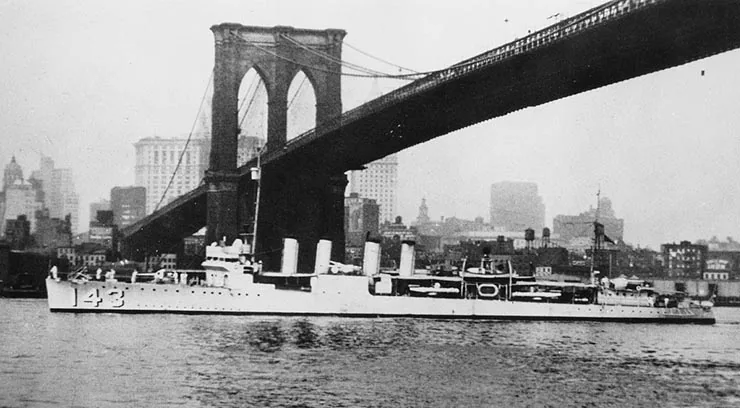
Service
- as USS Yarnall29 November 1918 — 23 October 1940418 days of the war
- as HMS Lincoln23 October 1940 — 26 August 19441,403 days of the war
- as HNoMS LincolnFebruary 1942 — 25 December 1943692 days of the war
- as Druzhny (Friendly)26 August 1944 — 23 August 1952372 days of the war
- Name
- HNoMS Lincoln
- Pennant / hull number
- G42
- Builder
- William Cramp & Sons, Philadelphia
- Laid down
- 12 February 1918
- Launched
- 19 June 1918
- Commissioned
- 29 November 1918
- Decommissioned
- 29 May 1922
- Recommissioned
- 19 April 1930
- Struck
- 8 January 1941
- Fate
- Returned to United Kingdom for scrapping, 23 August 1952 (1952)
- Status
- Unknown
Specifications
- Displacement, standard
- 1,154 long tons (1,173 t)
- Length
- 95.71 m (314 ft)
- Beam
- 9.14 m (30 ft)
- Draught
- 2.74 m (9 ft)
- Speed
- 35 knots (64.8 km/h, 40.3 mph)
- Complement
- 122
- Main gun
- 102 mm (4 in)
John Joliffe Yarnall, born in Wheeling, Va. (now W.Va.) in 1786, was appointed midshipman in the Navy on 11 January 1809. Between 1809 and 1812, Yarnall cruised the coastal waters of the United States in Chesapeake and Revenge performing duty that was tantamount to blockading his own country to enforce President Madison's embargo on trade with the European adversaries during the Napoleonic Wars. In 1813, he was transferred to Oliver Hazard Perry's command on the Great Lakes and became the first lieutenant on board Perry's flagship, Lawrence. He participated in the decisive Battle of Lake Erie on 10 September 1813, and, though wounded, refused to leave his post during the engagement. When Perry shifted his flag to Niagara during the battle, Lt. Yarnall assumed command of Lawrence. After the battle, he took the squadron's wounded on board and carried them back to Erie for medical attention. For his gallantry in the battle, Yarnall earned Perry's commendation as well as a medal expressing the gratitude of Congress and the country.
In the spring of 1815, Yarnall sailed from New York with Stephen Decatur in the frigate Guerriere for the Mediterranean Sea. On 17 June, off the Algerian coast, his ship encountered and captured Meshuda, the flagship of the Algerine "Navy." While defending his country's honor and rights during that engagement, the valiant Yarnall again suffered wounds. Probably because of his wounds, Lt. Yarnall was chosen as the bearer of dispatches from Decatur's squadron to the government in Washington. In July 1815, he embarked in the sloop-of-war Epervier for the voyage home. The warship was last seen on 14 July 1815 as she passed through the Strait of Gibraltar and into the Atlantic. Presumably, Yarnall and all others on board went down with her during the transatlantic voyage.
(Destroyer No. 143: dp. 1,154 (n.); l. 314'4- "; b. 30'11- "; dr. 9'10- " (aft) (f.); s. 35.12 k. (tl.); cpl. 122; a. 4 4", 2 3", 12 21" tt., 2 .30-cal. mg., 2 dct.; cl. Wickes )
Continue to the full service history About 1,009 words
From the Dictionary of American Naval Fighting Ships, compiled by the Naval History and Heritage Command (Yarnall I (Destroyer No. 143)). A work of the United States Government, in the public domain.
Armament and machinery
Armament and machinery
- Armament
- 4 × 4"/50 caliber guns
- 2 × 3 in/23 guns
- 12 × 21 inch (533 mm) torpedo tubes
- 2 × .30 cal (7.62 mm) machine guns
- 2 × depth charge racks
Sister ships
- HMCS Annapolis (I04)
- HMCS Caldwell (I20)
- HMCS Chelsea (I35)
- HMCS Columbia (I49)
- HMCS Georgetown (I40)
- HMCS Hamilton (I24)
- HMCS Leamington (G19)
- HMCS Lincoln (G42)
- HMCS Mansfield (G76)
- HMCS Montgomery (G95)
- HMCS Niagara (I57)
- HMCS Richmond (G88)
- HMCS Salisbury (I52)
- HMCS St. Clair (I65)
- HMS Bath (I17)
- HMS Brighton (I08)
- HMS Caldwell (I20)
- HMS Campbeltown (I42)
- HMS Castleton (I23)
- HMS Charlestown (I21)
- HMS Chelsea (I35)
- HMS Georgetown (I40)
- HMS Hamilton (I24)
- HMS Lancaster (G05)
Sources
- Facts harvested from HNoMS Lincoln (G42) on Wikipedia. Figures only — no wording is taken from it.
- Service history reproduced verbatim from Yarnall I (Destroyer No. 143) , Dictionary of American Naval Fighting Ships — public domain, a work of the United States Government.
- Photograph: Unknown author — Public domain — Wikimedia Commons