USS Badger (DD-126)
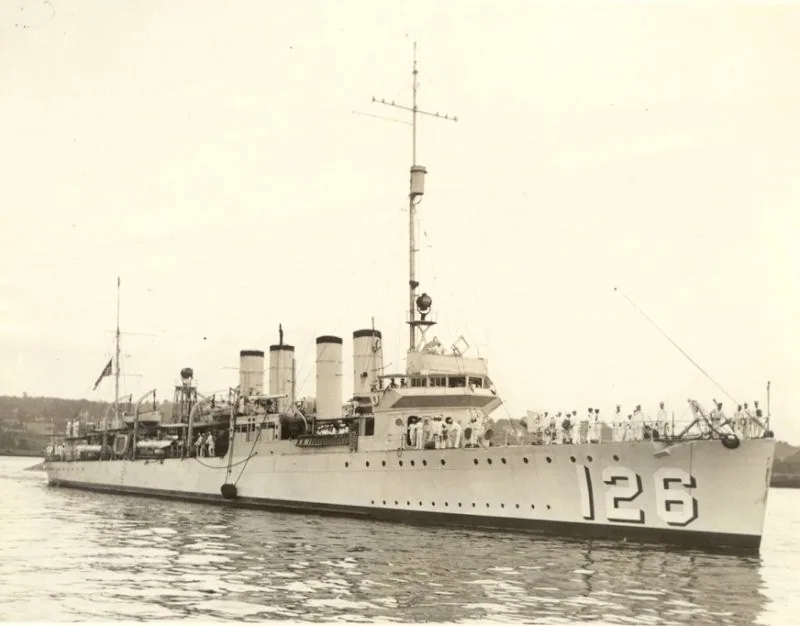
Service
- as Badger29 May 1919 — 20 July 19452,149 days of the war
- Name
- USS Badger
- Pennant / hull number
- DD-126
- Namesake
- Commodore Oscar C. Badger (1823–1899)
- Builder
- New York Shipbuilding Corporation, Camden, New Jersey
- Laid down
- 9 January 1918
- Launched
- 24 August 1918
- Commissioned
- 29 May 1919
- Decommissioned
- 27 May 1922
- Recommissioned
- 6 January 1930
- Struck
- 13 August 1945
- Fate
- Sold for scrapping 30 November 1945 (1945)
- Status
- Scrapped
Specifications
- Displacement, standard
- 1,211 long tons (1,230 t)
- Length
- 95.71 m (314 ft)
- Beam
- 9.45 m (31 ft)
- Draught
- 2.74 m (9 ft)
- Speed
- 35 knots (64.8 km/h, 40.3 mph)
- Complement
- 136
Oscar C. Badger, born on 12 August 1823 in Mansfield, Connecticut, received appointment as a midshipman in the Navy on 9 September 1841 and, after a tour of duty in Independence , served in Saratoga along the Atlantic coast of Africa. While serving in the latter ship, he saw his first action in the punitive expedition that landed on the west coast of Africa in 1843 and destroyed the Berribee villages. In the sidewheel steamer Mississippi , during the Mexican War, he participated in the expedition that captured the Mexican town of Alvarado in the spring of 1847. Badger then attended the Naval School (as the Naval Academy was then called) at Annapolis, Md.; completed his course of study there; and was warranted a passed midshipman on 10 August 1847. By 1850, he was posted to the Pacific Squadron and served successively in Supply , the frigate Savannah , and the sloop Vincennes . He returned to shore in 1853 for a tour of duty at the Naval Observatory located in Washington, D.C. In 1855, he returned to the Pacific Squadron for duty in the sloop John Adams and, that autumn, participated in an expedition to the Fiji Islands to redress wrongs suffered by members of the crews of American whalers and merchant ships at the hands of natives. The landing party destroyed the village of Vutia. To round out his pre-Civil War service, Badger was assigned in turn to Plymouth, Macedonian, Minnesota , and, lastly, to the Washington Navy Yard. He was serving in the national capital at the outbreak of the Civil War, and took command of the screw steamer Anacostia early in that conflict. In her, he participated in a series of actions against Confederate batteries along the Virginia bank of the Potomac. During the Peninsula Campaign, he took part in the siege of Yorktown, Virginia. In 1862 , he was transferred to the western theater to superintend the arming of river gunboats. In mid-1863, he was switched to the South Atlantic Blockading Squadron and participated in the attack on shore batteries on Morris Island on 11 July 1863. A week later, he commanded Patapsco in an attack on Fort Wagner and, a month after that, led the ironclad in a series of operations against Forts Wagner, Gregg, and Sumter. On the night of 22 August 1863, he took command of the ironclad Montauk for another try at Fort Sumter. Soon thereafter, Badger was appointed fleet captain, ad interim, of the South Atlantic Blockading Squadron and, in that office, took part in another attack on Fort Sumter while in the flagship Weehawken on the night of 1 September 1863. During that action, he was severely wounded in the leg by a flying metal splinter. He spent the remaining years of the Civil War ashore performing ordnance duty at the Philadelphia Navy Yard and serving as inspector of cannon at Pittsburgh. Sometime during 1866 he took command of the sidewheel steamer Peoria, a unit of the North Atlantic Squadron, and, in her, rendered assistance to the victims of a fire that destroyed Basseterre on St. Kitts in the Leeward Islands. In 1868, he came ashore for equipment duty at the Portsmouth (N.H.) Navy Yard. He returned to sea in 1871 in command of Ticonderoga of the South Atlantic Fleet. He commanded the receiving ship Ohio at Boston in 1873 and 1874 and served again at the Washington Navy Yard between 1875 and 1878. His last sea duty came in 1878 and 1879 when he commanded the frigate Constitution . During 1880, he was stationed in Washington for special duty. While serving at the Naval Asylum in Philadelphia, Badger was promoted to commodore in November 1881. After commanding the Boston Navy Yard between 1881 and 1885, Badger retired in August of 1885. He died on 20 June 1899. Oscar Charles Badger, son of Rear Admiral Charles J. Badger (q.v.) and the grandson of Commodore Oscar C. Badger, born on 26 June 1890 in Washington D.C.--entered the Naval Academy in 1907 and graduated in 1911 as a member of the last academy class to go to sea after graduation as passed midshipmen rather than as commissioned officers. He served first in Minnesota (Battleship No. 22) and then in Utah (Battleship No. 31). From the latter, he led the first landing party ashore at Veracruz, Mexico, on 21 April 1914 and was awarded the Medal of Honor for the “eminent and conspicuous ... skill and courage” with which he carried out that duty. Following successive tours in Parker (Torpedo Boat Destroyer No. 48) and in Maine (Battleship No. 10), he was transferred to Arizona (Battleship No. 39), then under construction at the New York Navy Yard, and, after she went into commission, served in her until he was transferred to the American destroyer force operating out of Queenstown, Ireland, in December 1917. He served in Allen (Torpedo Boat Destroyer No. 66) and Porter (Torpedo Boat Destroyer No. 59) and was in the latter on 28 April 1918 when she made one of the few successful American attacks on a German U-boat during World War I, severely damaging U-108 . Badger received his first command in June 1918 when he took over armed yacht Sultana (SP-134) and remained in her until he assumed command of Worden (Torpedo Boat Destroyer No. 16) in October. For his service in the grueling antisubmarine campaign in World War I, Badger received the Navy Cross. Following the war, Badger served as inspector of ordnance at Camden, N.J., and at Philadelphia from January 1919 until March 1921. He then assumed command of the destroyer Pruitt (DD-347) and remained in her until early 1922, when he became gunnery officer for an Atlantic Fleet destroyer squadron. Nine months later, he joined the staff of the Commander in Chief, Asiatic Fleet (CINCAF). In that role, he was the first American to contact Japanese authorities in Tokyo after the devastating earthquake of 1923 and directed American relief efforts at Yokohama and the evacuation of refugees. He returned to Washington in November 1923 for duty in the fire control section of the Bureau of Ordnance. Two years later, he returned to sea as first lieutenant of the battleship Maryland (BB-46), but came back to Washington in August 1928 to head the Bureau of Ordnance’s fire control section. In May 1931, Badger became the commanding officer of the destroyer Southard (DD-207) and, later, executive officer of the destroyer tender Melville (AD-2). In June 1933, he began a three-year assignment in the executive department of the Naval Academy. From June 1936 to May 1938, Badger served as executive officer of Indianapolis (CA-35) when that heavy cruiser transported President Franklin D. Roosevelt to the 1936 Pan American conference. Following study at the Naval War College in 1938 and 1939, Badger became secretary to the Navy’s General Board. In December 1940, he became chief of staff to Rear Admiral Ernest J. King, Commander, Atlantic Squadron. In October 1941, Badger assumed command of the new battleship North Carolina (BB-35). He was promoted to rear admiral to date from 24 April 1942, but he continued to serve as the battleship's commanding officer until the following September when he took command of several destroyer flotillas. Called back to Washington in December to be assistant chief of naval operations for logistics plans, he attended the conferences at Quebec and Cairo as logistics advisor to the Combined Chiefs of Staff. He received the Legion of Merit for that assignment, which lasted until February 1944 when he became Commander, Service Squadrons, South Pacific Force. As such, he supervised the logistics units that supported operations in the northern Solomon Islands and in the Bismarck Archipelago, winning a gold star in lieu of a second Legion of Merit. Sometime during the summer or early fall of 1944, he became Commander, Battleship Division 7, and his command served in the screen of the Fast Carrier Task Force in the Pacific. He held that assignment through the end of the war and participated in the three-part Battle for Leyte Gulf in late October 1944, the invasion of Luzon, and in the assault on Iwo Jima. In July 1945, he commanded a striking force that bombarded the Muroran area of the Japanese home islands. On 27 August 1945, he steamed into Tokyo Bay in his flagship, the light cruiser San Diego (CL-53), leading the first contingent of American occupation forces. Following the Japanese surrender, Rear Admiral Badger began two years as Commander, Service Force, Pacific. In that position, he supervised the return home of about four million veterans of the Pacific war. Early in 1947, he directed the disposal of the radioactive ships used in the atomic tests conducted at Bikini Atoll the previous summer. In mid-1947, he transferred to the west coast of the United States to serve as Commandant, 11th Naval District. On 19 January 1948, he was promoted to vice admiral and, the following month, became Commander, Naval Forces, Far East. In that office, he observed the gradual loss of the mainland to the Chinese communists and supervised the retirement of American forces to the port cities on the China coast.
Upon returning to Washington in September 1939, he became special advisor to the Navy Department on Far Eastern affairs. On 1 May 1950, he began his last tour of active duty as Commander, Eastern Sea Frontier, and Commander, Atlantic Reserve Fleet. He retired from the Navy in June 1952 with the rank of admiral. Following retirement, Badger continued to be active in both public and private life until he died on 30 November 1958.
Badger (Destroyer No. 126) was named for Commodore Oscar C. Badger (a cousin of Secretary of the Navy George Edmund Badger), the father of Rear Admiral Charles Johnston Badger, the son of the commodore and the father of the admiral, was also honored by the naming of the destroyer Charles J. Badger (DD-657) (q.v.), and the grandfather of Admiral Oscar C. Badger. The ocean escort Badger (DE-1071) honors all four men.
Continue to the full service history About 7,030 words
From the Dictionary of American Naval Fighting Ships, compiled by the Naval History and Heritage Command (Badger II (Destroyer No. 126)). A work of the United States Government, in the public domain.
Armament and machinery
Armament and machinery
- Armament
- As built: 4 × 4 in, 2 × 3 in, 4 × triple 21 inch (533 mm) torpedo tube mounts
- 1941: 6 × 3-inch/50-caliber guns, 2 × triple 21 inch (533 mm) torpedo tube mounts, 24 depth charges
Sister ships
- HMCS Annapolis (I04)
- HMCS Caldwell (I20)
- HMCS Chelsea (I35)
- HMCS Columbia (I49)
- HMCS Georgetown (I40)
- HMCS Hamilton (I24)
- HMCS Leamington (G19)
- HMCS Lincoln (G42)
- HMCS Mansfield (G76)
- HMCS Montgomery (G95)
- HMCS Niagara (I57)
- HMCS Richmond (G88)
- HMCS Salisbury (I52)
- HMCS St. Clair (I65)
- HMS Bath (I17)
- HMS Brighton (I08)
- HMS Caldwell (I20)
- HMS Campbeltown (I42)
- HMS Castleton (I23)
- HMS Charlestown (I21)
- HMS Chelsea (I35)
- HMS Georgetown (I40)
- HMS Hamilton (I24)
- HMS Lancaster (G05)
Sources
- Facts harvested from USS Badger (DD-126) on Wikipedia. Figures only — no wording is taken from it.
- Service history reproduced verbatim from Badger II (Destroyer No. 126) , Dictionary of American Naval Fighting Ships — public domain, a work of the United States Government.
- Photograph: U.S. Navy — U.S. Navy photo [1] from Navsource.org — Public domain — Wikimedia Commons