USS Bell (DD-587)
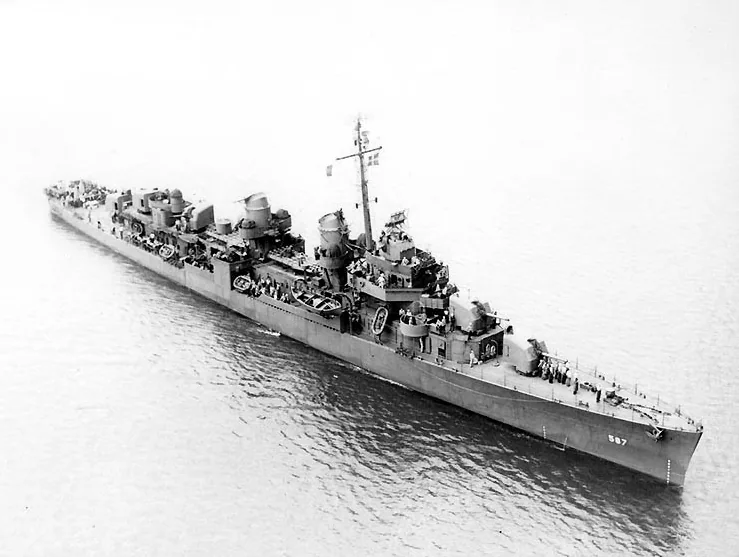
Service
- 4 March 1943 — 14 June 1946913 days of the war
- Name
- USS Bell
- Pennant / hull number
- DD-587
- Namesake
- Henry H. Bell
- Builder
- Charleston Navy Yard
- Laid down
- 30 December 1941
- Launched
- 24 June 1942
- Commissioned
- 4 March 1943
- Decommissioned
- 14 June 1946
- Struck
- 1 November 1972
- Fate
- Sunk as target, 11 May 1975 (1975)
- Status
- Wreck
Specifications
- Displacement, standard
- 2,050 long tons (2,083 t)
- Length
- 114.6 m (376 ft)
- Beam
- 11.89 m (39 ft)
- Draught
- 5.18 m (17 ft)
- Speed
- 35 knots (64.8 km/h, 40.3 mph)
- Range
- 6,479 nmi (11,999 km)
- Complement
- 329
- Main gun
- 40 mm (1.6 in)
Henry Haywood Bell, born in North Carolina in 1808, was appointed a midshipman on 4 August 1823. Highlights of his service before the Civil War were his time in Grampus as that schooner fought Caribbean pirates in the late 1820s and his command of San Jacinto during the mid 1850s. Under him, that screw frigate took the American diplomat, Townsend Harris, to Siam to establish diplomatic and economic relations between that kingdom and the United States. The ship then carried Harris to Japan where, following up Commodore Matthew C. Perry's diplomatic breakthrough, he became the first United States minister. The screw frigate subsequently participated in operations against the Chinese "Barrier Forts" between Whampoa and Canton before returning home in the summer of 1858. Following a period awaiting orders, Bell became the Navy's Assistant Inspector of Ordnance; and he held that post at the outbreak of the Civil War.
Although a Southerner, Comdr. Bell remained loyal to the Union and initially labored to arm and to outfit the merchantmen that the Navy had purchased to blockade the Confederate coast. When the West Gulf Blockading Squadron was established early in 1862, Bell became Farragut's fleet captain and, as such, assisted the flag officer in administering the squadron and in capturing New Orleans. To prepare for operations against the "Crescent City," he reconnoitered the forts and river obstructions that protected it from attack by sea; and, shortly thereafter, he led the expedition that cut the chain across the Mississippi connecting floating barriers in the river. During Farragut's famous dash past Forts Jackson and St. Philip, Bell commanded the Union force's third division. On 1 July, Bell relieved Capt. Thomas T. Craven in command of Brooklyn . About a fortnight later, the Navy recognized Bell's outstanding service by promoting him to commodore, allowing him to skip the rank of captain.
Commodore Bell was the squadron's highest ranking officer under Farragut; and he exercised immediate command of groups of Union warships in operations on the Mississippi, off Mobile Bay, and along the coast of Texas. Early in August 1863, Bell took temporary command of the squadron while Farragut returned north for a much needed rest; and, under his leadership, the squadron continued to operate effectively.
Continue to the full service history About 6,105 words
From the Dictionary of American Naval Fighting Ships, compiled by the Naval History and Heritage Command (Bell II (DD-587)). A work of the United States Government, in the public domain.
Armament and machinery
Armament and machinery
- Propulsion
- 60000 shp
- 2 propellers
- Armament
- 5 × 5-inch 38 caliber guns
- 4 × 40 mm AA guns
- 4 × 20 mm AA guns
- 10 × 21 inch (533 mm) torpedo tubes
- 6 × depth charge projectors
- 2 × depth charge tracks
Sister ships
- USS Abbot (DD-629)
- USS Abner Read (DD-526)
- USS Albert W. Grant
- USS Ammen (DD-527)
- USS Anthony (DD-515)
- USS Aulick (DD-569)
- USS Bache (DD-470)
- USS Beale (DD-471)
- USS Bearss
- USS Benham (DD-796)
- USS Bennett
- USS Bennion
- USS Black
- USS Boyd
- USS Bradford
- USS Braine
- USS Brown (DD-546)
- USS Brownson (DD-518)
- USS Bryant
- USS Bullard
- USS Burns (DD-588)
- USS Bush (DD-529)
- USS Callaghan (DD-792)
- USS Caperton
Sources
- Facts harvested from USS Bell (DD-587) on Wikipedia. Figures only — no wording is taken from it.
- Service history reproduced verbatim from Bell II (DD-587) , Dictionary of American Naval Fighting Ships — public domain, a work of the United States Government.
- Photograph: Unknown author — U.S. Navy photo NH 104659 — Public domain — Wikimedia Commons