USS Callaghan (DD-792)
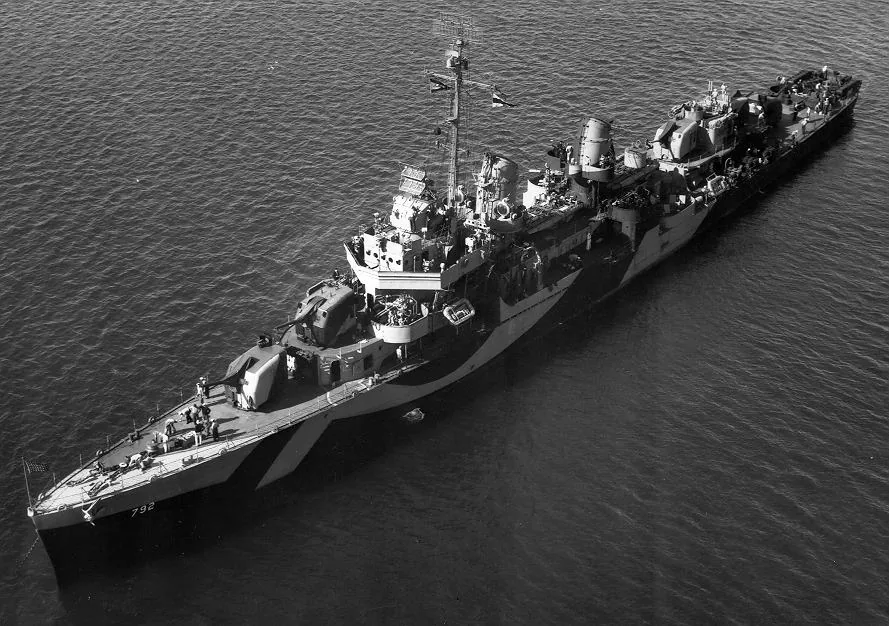
Service
- 27 November 1943 — 28 July 1945609 days of the war
- Name
- USS Callaghan
- Pennant / hull number
- DD-792
- Namesake
- Daniel J. Callaghan
- Builder
- Bethlehem Shipbuilding, San Pedro, Los Angeles
- Laid down
- 21 February 1943
- Launched
- 1 August 1943
- Commissioned
- 27 November 1943
- Fate
- Sunk by Yokosuka K5Y kamikazes off Okinawa, 28 July 1945
By aircraft (1945) - Status
- Wreck
Specifications
- Displacement, standard
- 2,050 long tons (2,083 t)
- Length
- 114.73 m (376.4 ft)
- Beam
- 12.07 m (39.6 ft)
- Draught
- 4.21 m (13.8 ft)
- Speed
- 38 knots (70.4 km/h, 43.7 mph)
- Range
- 6,500 nmi (12,038 km)
- Complement
- 329
- Main gun
- 127 mm (5 in)
Born in San Francisco, Calif., 26 July 1890, Daniel Judson Callaghan graduated from the Naval Academy in 1911. His prewar service included command of Truxtun (Destroyer No. 14), staff duty afloat and ashore, and duty as naval aide to the president. He commanded San Francisco (CA-38) from May 1941 to May 1942, then served as chief of staff to Commander, South Pacific area and South Pacific Force. Rear Admiral Callaghan was killed in action in the bitter Naval Battle of Guadalcanal 13 November 1942 while commanding forces that helped turn back a far stronger Japanese fleet. He posthumously received the Congressional Medal of Honor for extraordinary heroism during the action in which he gave his life.
Callaghan (DD-792) was launched 1 August 1943 by Bethlehem Steel Co., San Pedro, Calif.; sponsored by Mrs. D. J. Callaghan; commissioned 27 November 1943, Commander F. J. Johnson in command; and reported to the Pacific Fleet.
Callaghan sailed from the west coast 5 February 1944 to plunge into action with fast-striking 5th Fleet in smashing air raids on the Palaus, Yap, Ulithi, and Woleai from 30 March to 1 April. Based on Manus in April, Callaghan supported the Hollandia operation through important services as picket ship during air strikes, and screening the valuable tankers.
Continue to the full service history About 665 words
From the Dictionary of American Naval Fighting Ships, compiled by the Naval History and Heritage Command (Callaghan (DD-792)). A work of the United States Government, in the public domain.
Armament and machinery
Armament and machinery
- Propulsion
- 60,000 SHP (45 MW)
- 2 propellers
- Armament
- 5 × 5 in/38 guns
- 10 × 40 mm AA guns
- 7 × 20 mm AA guns
- 10 × 21 inch (533 mm) torpedo tubes
Sister ships
- USS Abbot (DD-629)
- USS Abner Read (DD-526)
- USS Albert W. Grant
- USS Ammen (DD-527)
- USS Anthony (DD-515)
- USS Aulick (DD-569)
- USS Bache (DD-470)
- USS Beale (DD-471)
- USS Bearss
- USS Bell (DD-587)
- USS Benham (DD-796)
- USS Bennett
- USS Bennion
- USS Black
- USS Boyd
- USS Bradford
- USS Braine
- USS Brown (DD-546)
- USS Brownson (DD-518)
- USS Bryant
- USS Bullard
- USS Burns (DD-588)
- USS Bush (DD-529)
- USS Caperton
Sources
- Facts harvested from USS Callaghan (DD-792) on Wikipedia. Figures only — no wording is taken from it.
- Service history reproduced verbatim from Callaghan (DD-792) , Dictionary of American Naval Fighting Ships — public domain, a work of the United States Government.
- Photograph: U.S. Navy Bureau of Ships — U.S. Navy Bureau of Ships photo BS 61307 from usndazzle.com — Public domain — Wikimedia Commons