USS Cole (DD-155)
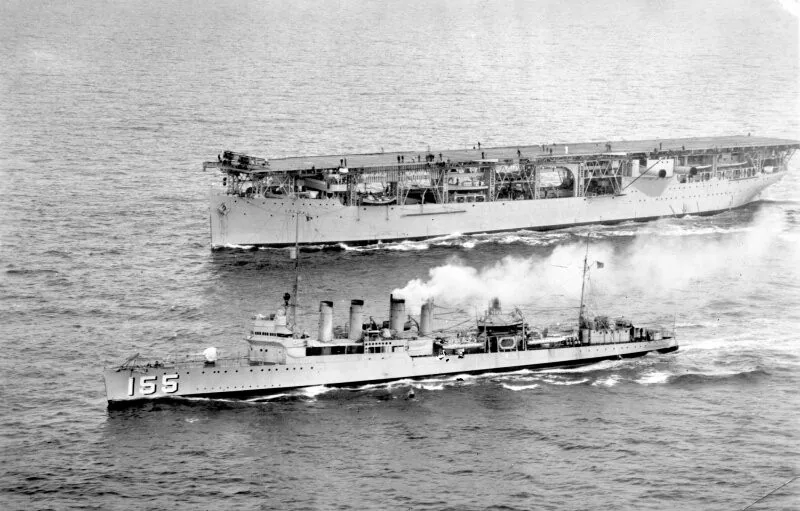
Service
- as Cole19 June 1919 — 1 November 19452,193 days of the war
- Name
- USS Cole
- Pennant / hull number
- DD-155
- Namesake
- Edward B. Cole
- Builder
- William Cramp & Sons, Philadelphia
- Laid down
- 25 June 1918
- Launched
- 11 January 1919
- Commissioned
- 19 June 1919
- Decommissioned
- 10 July 1922
- Struck
- 16 November 1945
- Fate
- Sold for scrapping, 6 October 1947 (1947)
- Status
- Scrapped
Specifications
- Displacement, standard
- 1,090 long tons (1,107 t)
- Length
- 95.71 m (314 ft)
- Beam
- 9.45 m (31 ft)
- Draught
- 2.74 m (9 ft)
- Speed
- 35 knots (64.8 km/h, 40.3 mph)
- Complement
- 122
- Main gun
- 102 mm (4 in)
Edward Ball Cole was born 23 September 1879 in Boston, Mass. One of the country's leading experts on machineguns, he received a direct commission in the Marine Corps in World War I. Major Cole received a Distinguished Service Cross for heroism during the Battle of Belleau Wood (10 June 1918) in which he was mortally wounded. He died 18 June 1918 and is buried at Mouroux Cemetery, France.
Cole (Destroyer No. 155) was launched 11 January 1919 by William Cramp and Sons Ship and Engine Building Co., Philadelphia, Pa.; sponsored by Mrs. E. B. Cole; and commissioned 19 June 1919, Commander I. F. Dortch in command.
Cole sailed from New York 30 June 1919 to join U.S. Naval Forces in Turkish waters. For the next year she aided in the evacuation of refugees fleeing turmoil and war in the Middle East and showed the flag in the eastern Mediterranean and Black Sea, returning to New York 4 June 1920. She cruised in east coast and Caribbean waters until decommissioned at Philadelphia Navy Yard 10 July 1922.
Recommissioned 1 May 1930, Cole joined the Scouting Fleet in the Atlantic. Once again she cruised along the east coast and in the Caribbean and took part in training exercises. From 22 October 1932 to 24 March 1933 and from 3 February to 14 August 1934, Cole was in reduced commission at Norfolk Navy Yard as part of a rotating reserve squadron. On 15 August 1934 Cole wasassigned to the Scouting Force in the Pacific, and following maneuvers in the Caribbean reached her new base at San Diego, Calif., 9 November. She remained in the Pacific until 24 May 1936 and then reported to New York as a Naval Reserve training ship. She arrived Philadelphia Navy Yard 25 September and was decommissioned there 7 January 1937.
Recommissioned 16 October 1939, Cole joined the neutrality patrol in the Atlantic. From 10 June 1941 she escorted convoys to Newfoundland and Iceland making five such voyages by 28 January 1942. From 14 March to 28 September, the destroyer patrolled and escorted convoys along the east coast, making one convoy run to the Virgin Islands. She put to sea from Norfolk 24 October for the invasion of North Africa on 8 November during which she landed 175 men of the 47th Infantry under fire on a pier at Safi, Morocco. Cole received the Presidential Unit Citation for her fine performance of this hazardous mission. Returning to Boston 1 December she resumed convoy duty, and between 18 December 1942 and 15 February 1943 she operated between the east coast, Newfoundland, and Nova Scotia, then made a voyage to Gibraltar in March. The destroyer returned to the Mediterranean, reaching Mers-el-Kebir, Algeria, 23 May.
Along with patrol and escort duties in the Western Mediterranean, Cole took part in the invasion of Sicily 10 July 1943, acting with a British submarine as a beach identification group, and later guarded transports during the assault on Salerno 9 September. She returned to Charleston, S.C., for overhaul 24 December, after which she resumed convoy escort duty along the east coast and in the Caribbean, making one voyage to Casablanca in March 1944. On 3 December 1944, she began duty as a plane guard for carriers conducting air operations out of Quonset Point, R.I., which continued until 31 August 1945. She was reclassified AG-116 30 June 1945. Cole was decommissioned 1 November 1945, and sold 6 October 1947.
From the Dictionary of American Naval Fighting Ships, compiled by the Naval History and Heritage Command (Cole (Destroyer No. 155)). A work of the United States Government, in the public domain.
Armament and machinery
Armament and machinery
- Propulsion
- 24200 shp
- Geared turbines
- 2 screws
- Armament
- 4 × 4 in guns
- 2 × 3 in guns
- 12 × 21 in torpedo tubes
Sister ships
- HMCS Annapolis (I04)
- HMCS Caldwell (I20)
- HMCS Chelsea (I35)
- HMCS Columbia (I49)
- HMCS Georgetown (I40)
- HMCS Hamilton (I24)
- HMCS Leamington (G19)
- HMCS Lincoln (G42)
- HMCS Mansfield (G76)
- HMCS Montgomery (G95)
- HMCS Niagara (I57)
- HMCS Richmond (G88)
- HMCS Salisbury (I52)
- HMCS St. Clair (I65)
- HMS Bath (I17)
- HMS Brighton (I08)
- HMS Caldwell (I20)
- HMS Campbeltown (I42)
- HMS Castleton (I23)
- HMS Charlestown (I21)
- HMS Chelsea (I35)
- HMS Georgetown (I40)
- HMS Hamilton (I24)
- HMS Lancaster (G05)
Sources
- Facts harvested from USS Cole (DD-155) on Wikipedia. Figures only — no wording is taken from it.
- Service history reproduced verbatim from Cole (Destroyer No. 155) , Dictionary of American Naval Fighting Ships — public domain, a work of the United States Government.
- Photograph: U.S. Navy — U.S. Navy photo [1] from Navsource.org — Public domain — Wikimedia Commons