USS Foote (DD-169)
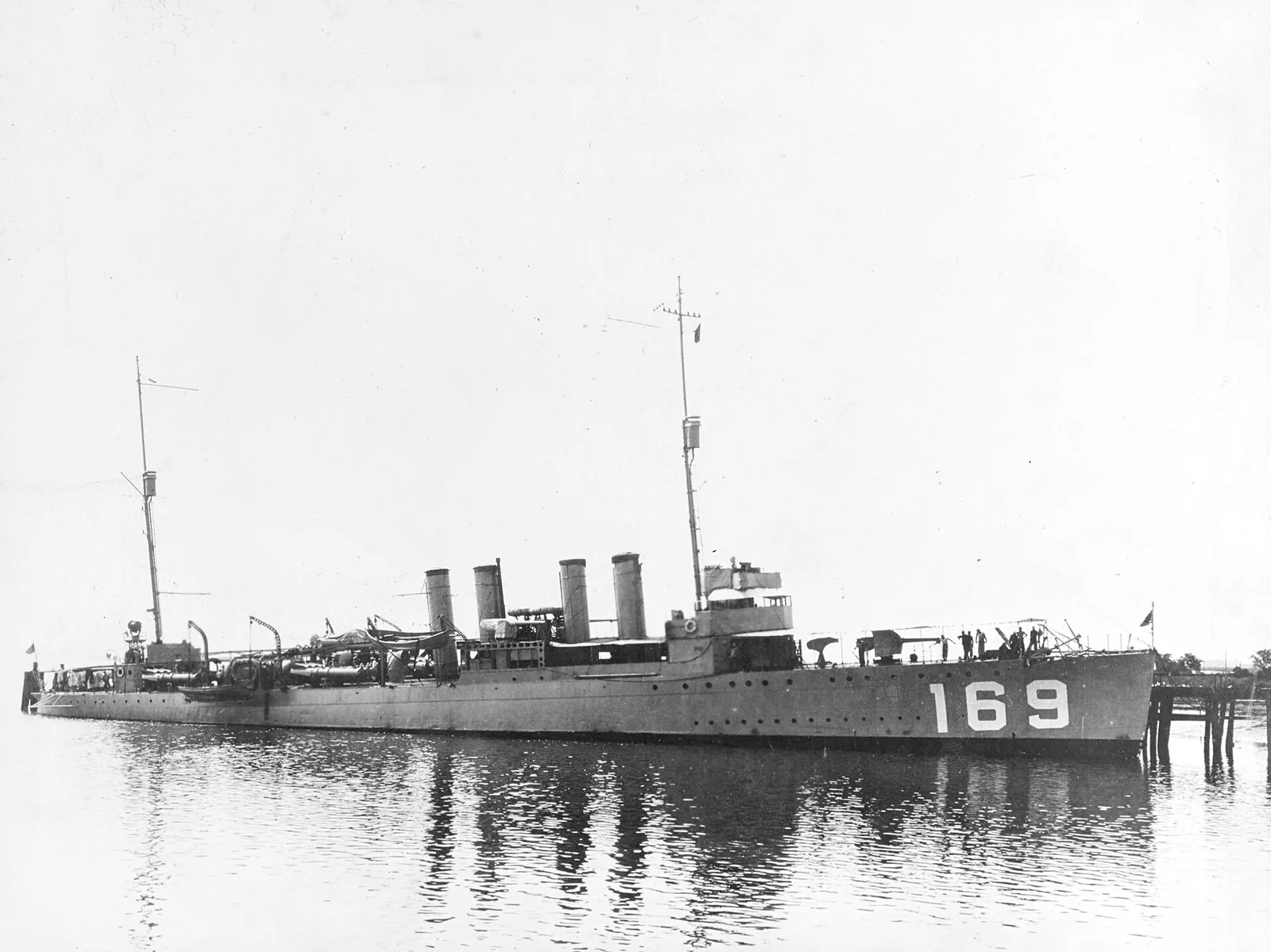
Service
- as Foote21 March 1919 — 23 September 1940388 days of the war
- as HMS Roxborough23 September 1940 — 1 August 19441,408 days of the war
- as Zhyostky ("Rigid")1 August 1944 — 7 February 1949397 days of the war
- Name
- USS Foote
- Pennant / hull number
- DD-169
- Namesake
- Andrew Hull Foote
- Builder
- Fore River Shipbuilding Company, Quincy, Massachusetts
- Laid down
- 7 August 1918
- Launched
- 14 December 1918
- Commissioned
- 21 March 1919
- Decommissioned
- 6 July 1922
- Recommissioned
- 2 July 1940
- Struck
- 8 January 1941
- Fate
- Returned to UK, 7 February 1949 for scrapping, 14 May 1949 (1949)
- Status
- Unknown
Specifications
- Displacement, standard
- 1,060 long tons (1,077 t)
- Length
- 95.71 m (314 ft)
- Beam
- 9.45 m (31 ft)
- Draught
- 2.74 m (9 ft)
- Speed
- 35 knots (64.8 km/h, 40.3 mph)
- Complement
- 101
- Main gun
- 102 mm (4 in)
Andrew Hull Foote, born 12 September 1806 at New Haven, Conn., entered the Navy 4 December 1822 as a midshipman. Commanding Portsmouth in the East India Squadron on 20 and 21 November 1856, Foote led a landing party which seized the barrier forts at Canton, China, in reprisal for attacks on American ships. From 30 August 1861 to 9 May 1862, Foote commanded the Naval Forces on Western Rivers with distinction, organizing and leading the gunboat flotilla in the capture of Forts Henry and Donelson and Island No. 10. Wounded in action at Fort Donelson, Foote was commissioned Rear Admiral 16 July 1862, and was on his way to take command of the South Atlantic Blockading Squadron when he died at New York 26 June 1863.
The second Foote (Destroyer No. 169) was launched 14 December 1918 by Fore River Shipbuilding Co., Quincy, Mass.; sponsored by Mrs. Lelia F. Cady, daughter of Admiral Foote; and commissioned 21 March 1919, Lieutenant Commander D. H. Stuart in command.
Foote sailed from Boston 3 May 1919 to take up an observation station off Newfoundland for the historic first aerial crossing of the Atlantic, made later that month by Navy seaplanes. She returned to Boston 22 May to complete her interrupted fitting out, then took part in training operations until sailing from Newport 27 August bound for a tour of duty with Naval Forces European Waters. From September through December, she served in the Adriatic, then called at Italian and French ports homeward bound. Arriving at Boston 12 February 1920, she was placed in reserve 24 February for repairs there and at Charleston.
In the summer of 1921, Foote operated with 50 percent of her complement during summer target practice in Narragansett Bay, and returning to Charleston, she lay there and at Boston for alterations and repairs until decommissioned at Philadelphia 6 July 1922. Recommissioned 2 July 1940, Foote operated on patrol out of Charleston, S.C., until sailing 7 September for Halifax, Nova Scotia. There, on 23 September 1940, she was decommissioned and transferred to the Royal Navy in the destroyers for land bases exchange. Commissioned as HMS Roxborough 23 September 1940, the destroyer crossed the Atlantic to join the Western Approaches Command, guarding convoys during the dangerous last leg of their voyages into British ports. In March 1942, Roxborough took up western Atlantic escort duty out of Halifax, Nova Scotia. Returning to the Tyne 10 January 1944, Roxborough lay in reserve there until transferred to Russia 1 August 1944. She was returned to Great Britian 7 February 1949 after her Russian service as Zhostkyi.
From the Dictionary of American Naval Fighting Ships, compiled by the Naval History and Heritage Command (Foote II (Destroyer No. 169)). A work of the United States Government, in the public domain.
Armament and machinery
Armament and machinery
- Armament
- 4 × 4 in/50 guns
- 12 × 21 inch (533 mm) torpedo tubes
- 1 × Depth charge projector
Sister ships
- HMCS Annapolis (I04)
- HMCS Caldwell (I20)
- HMCS Chelsea (I35)
- HMCS Columbia (I49)
- HMCS Georgetown (I40)
- HMCS Hamilton (I24)
- HMCS Leamington (G19)
- HMCS Lincoln (G42)
- HMCS Mansfield (G76)
- HMCS Montgomery (G95)
- HMCS Niagara (I57)
- HMCS Richmond (G88)
- HMCS Salisbury (I52)
- HMCS St. Clair (I65)
- HMS Bath (I17)
- HMS Brighton (I08)
- HMS Caldwell (I20)
- HMS Campbeltown (I42)
- HMS Castleton (I23)
- HMS Charlestown (I21)
- HMS Chelsea (I35)
- HMS Georgetown (I40)
- HMS Hamilton (I24)
- HMS Lancaster (G05)
Sources
- Facts harvested from USS Foote (DD-169) on Wikipedia. Figures only — no wording is taken from it.
- Service history reproduced verbatim from Foote II (Destroyer No. 169) , Dictionary of American Naval Fighting Ships — public domain, a work of the United States Government.
- Photograph: U.S. Navy — Official U.S. Navy photo NH 53932 from the U.S. Navy Naval History and Heritage Command — Public domain — Wikimedia Commons