USS Guardfish (SS-217)
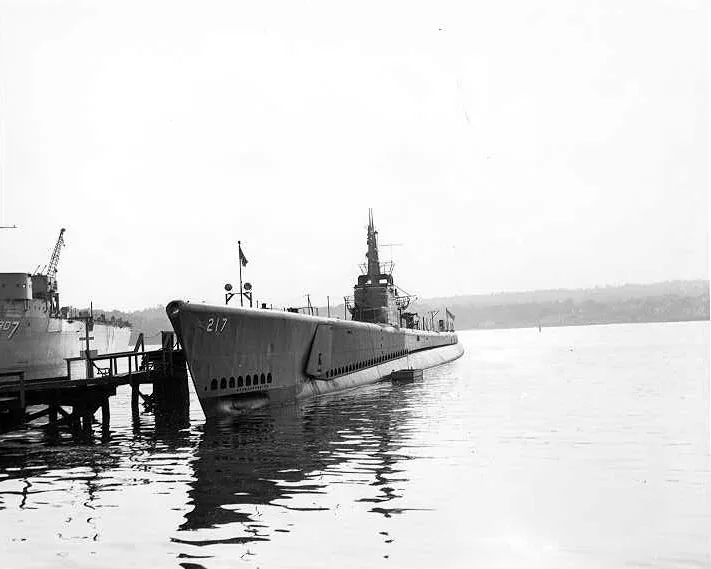
Service
- 8 May 1942 — 25 May 19461,213 days of the war
- Name
- USS Guardfish
- Pennant / hull number
- SS-217
- Builder
- Electric Boat Company, Groton, Connecticut
- Laid down
- 1 April 1941
- Launched
- 20 January 1942
- Commissioned
- 8 May 1942
- Decommissioned
- 25 May 1946
- Struck
- 1 June 1960
- Fate
- Sunk as a target off Block Island, 10 October 1961 (1961)
- Status
- Wreck
Specifications
- Displacement, surfaced
- 1,525 long tons (1,549 t)
- Displacement, submerged
- 2,424 long tons (2,463 t)
- Length
- 94.79 m (311 ft)
- Beam
- 8.23 m (27 ft)
- Draught
- 5.18 m (17 ft)
- Speed
- 21 knots (38.9 km/h, 24.2 mph)
- Range
- 11,000 nmi (20,372 km)
- Complement
- 60
- Main gun
- 76 mm (3 in)
The first Guardfish, a fleet submarine, was launched by the Electric Boat Co. of Groton, Conn., 20 January 1942, sponsored by Mrs. Edward J. Marquart. She commissioned at New London, Conn., 8 May 1942, Lt. Comdr. T. B. Klakring in command.
After conducting shakedown out of New London, Guardfish departed that base 28 June 1942 for Pearl Harbor via the Panama Canal, and arrived there 25 July to prepare for her first cruise. Her first war patrol was in the hitherto unpatrolled waters off northeast Honshu. Guardfish departed Pearl Harbor 6 August 1942, sank a trawler 22 August, and 24 August sank 3,114-ton cargo ship Seikai Maru off Kinkasan Harbor. Eva'ding escort vessels, she proceeded up the coast and found a convoy 2 September. Guardfish attacked the next day, sinking 5,253-ton Kaimei Maru and 1,118-ton cargo ship Tenyu Maru. Chita Maru, a 2,376-ton freighter, retreated into the harbor and anchored, but a remarkable long-range shot from Guardfish left her resting in the mud. Guardfish returned to Midway from her spectacularly successful first patrol for refit 15 September 1942.
Guardfish departed Midway on her second war patrol 30 September and headed for the East China Sea. Surviving a violent attack by patrolling aircraft 19 October, Guardfish closed a seven-ship convoy 21 October, sinking a 4,000-ton freighter and 6,362-ton Nichiho Maru north of Formosa as the convoy scattered. After evading pursuing aircraft and surface ships, Guardfish returned to Pearl Harbor 28 November 1942. For her outstanding success on war patrols 1 and 2 Guardfish received a Presidential Unit Citation.
Continue to the full service history About 1,036 words
From the Dictionary of American Naval Fighting Ships, compiled by the Naval History and Heritage Command (Guardfish I (SS-217)). A work of the United States Government, in the public domain.
Armament and machinery
Armament and machinery
- Propulsion
- 4 × General Motors Model 16-248 V16 Diesel engines driving electric generators
- 2 × 126-cell Sargo batteries
- 4 × high-speed General Electric electric motors with reduction gears
- two propellers
- 5,400 shp (4.0 MW) surfaced
- 2,740 shp (2.0 MW) submerged
- Armament
- 10 × 21-inch (533 mm) torpedo tubes
- 6 forward, 4 aft
- 24 torpedoes
- 1 × 3-inch (76 mm) / 50 caliber deck gun
- Bofors 40 mm and Oerlikon 20 mm cannon
Sister ships
- USS Albacore (SS-218)
- USS Amberjack (SS-219)
- USS Angler
- USS Barb (SS-220)
- USS Bashaw
- USS Blackfish
- USS Bluefish (SS-222)
- USS Bluegill
- USS Bonefish (SS-223)
- USS Bream
- USS Cavalla (SS-244)
- USS Cero (SS-225)
- USS Cobia
- USS Cod
- USS Corvina
- USS Croaker
- USS Dace (SS-247)
- USS Darter (SS-227)
- USS Dorado (SS-248)
- USS Drum (SS-228)
- USS Finback (SS-230)
- USS Flasher (SS-249)
- USS Flier
- USS Flounder
Sources
- Facts harvested from USS Guardfish (SS-217) on Wikipedia. Figures only — no wording is taken from it.
- Service history reproduced verbatim from Guardfish I (SS-217) , Dictionary of American Naval Fighting Ships — public domain, a work of the United States Government.
- Photograph: Unknown author — Unknown source — Public domain — Wikimedia Commons