USS Herndon (DD-638)
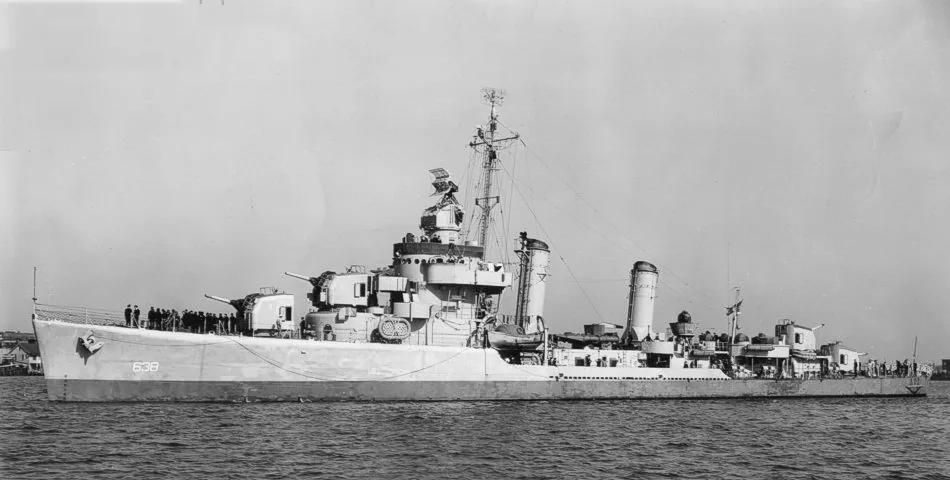
Service
- as Herndon20 December 1942 — 28 January 1946987 days of the war
- Name
- USS Herndon
- Pennant / hull number
- DD-638
- Namesake
- William Lewis Herndon
- Builder
- Norfolk Navy Yard
- Laid down
- 26 August 1941
- Launched
- 2 February 1942
- Commissioned
- 20 December 1942
- Decommissioned
- 28 January 1946
- Struck
- 1 June 1971
- Fate
- Sunk as target off Florida, 24 May 1973 (1973)
- Status
- Wreck
Specifications
- Displacement, standard
- 1,630 long tons (1,656 t)
- Length
- 106.07 m (348 ft)
- Beam
- 10.97 m (36 ft)
- Draught
- 3.35 m (11 ft)
- Speed
- 37.4 knots (69.3 km/h, 43 mph)
- Range
- 6,500 nmi (12,038 km)
- Complement
- 276
- Main gun
- 127 mm (5 in)
William Lewis Herndon, one of the Navy's outstanding explorers and seamen, was born 15 October 1813 in Fredericksburg, Va. Appointed Midshipman 1 November 1828, he cruised in Pacific, South American, Mediterranean, and Gulf waters from then until 1842. From 1842 to 1846 Herndon served in the Depot of Charts and Instruments (to become the U.S. Naval Observatory) with his cousin and brother-in-law, Matthew Fontaine Maury, preparing oceanographic charts and performing other scientific work invaluable to the safe and accurate navigation of the seas. During the Mexican War, Herndon commanded brig Iris with distinction.
In 1851 Herndon headed an expedition exploring the Valley of the Amazon, a vast area as uncharted as the wildest part of central Africa. Departing Lima, Peru, 21 May 1851, Herndon and his small party of six men pressed into the wild and treacherously beautiful jungles. After a remarkable journey of 4,366 dangerous miles, which took him through wilderness from sea level to heights of 16,199 feet, Herndon reached the city of Para 11 April 1852. On 26 January 1853 Herndon submitted an encyclopedic and profusely illustrated 414-page report to Secretary of the Navy, John P. Kennedy.
After 2 years of active service in Potomac and San Jacinto, Herndon, now a commander, was given leave in 1855 to command the Pacific Mail steamer George Law, renamed Central America, 20 June 1857, on the New York to Aspinwall run. Making his way up the coast from Aspinwall with $2,000,000 in gold and 474 passengers, as well as 101 crew members, Herndon encountered a heavy gale off Cape Hatteras 7 September 1857. The gale steadily increased in savagery until the 12th, and Central America was shipping water through several leaks. As the ship pitched and rolled through the pounding seas, water in her hold put out her boiler fires. Commander Herndon reluctantly admitted that, despite the valiant efforts of crew and passengers alike, his ship was doomed and summoned aid by firing the ship's minute guns. At 2 p.m., West Indian brig Marine arrived to aid the stricken steamer. Disregarding his own life, Commander Herndon supervised the loading of women and children into lifeboats and watched them pull to safety in Marine. Herndon's bravery and his concern for his passengers and crew helped save 152 of the 575 people on board. Commander Herndon was last seen in full uniform, standing by the wheelhouse with his hand on the rail, as the ship gave a lurch and went down. A monument at Annapolis commemorates this intrepid explorer and gallant seaman.
Continue to the full service history About 981 words
From the Dictionary of American Naval Fighting Ships, compiled by the Naval History and Heritage Command (Herndon II (DD-638)). A work of the United States Government, in the public domain.
Armament and machinery
Armament and machinery
- Propulsion
- 50000 shp
- 4 boilers
- 2 propellers
- Armament
- 4 × 5 in/38 caliber DP guns
- 4 × 40 mm guns
- 4 × 20 mm AA guns
- 5 × 21 in torpedo tubes (5 Mark 15 torpedoes)
- 6 × depth charge projectors
- 2 × depth charge tracks
Sister ships
- USS Aaron Ward (DD-483)
- USS Baldwin
- USS Beatty (DD-640)
- USS Bristol (DD-453)
- USS Buchanan (DD-484)
- USS Butler
- USS Carmick
- USS Corry (DD-463)
- USS Cowie
- USS Davison
- USS Doran (DD-634)
- USS Doyle (DMS-34)
- USS Duncan (DD-485)
- USS Earle
- USS Eberle
- USS Edison (DD-439)
- USS Edwards (DD-619)
- USS Ellyson
- USS Emmons
- USS Endicott
- USS Ericsson (DD-440)
- USS Fitch
- USS Forrest
- USS Frankford
Sources
- Facts harvested from USS Herndon (DD-638) on Wikipedia. Figures only — no wording is taken from it.
- Service history reproduced verbatim from Herndon II (DD-638) , Dictionary of American Naval Fighting Ships — public domain, a work of the United States Government.
- Photograph: USN — Official U.S. Navy Bureau of Ships photo 19-N-45762 from the U.S. Navy Norfolk Naval Shipyard — Public domain — Wikimedia Commons