USS Ingraham (DD-444)
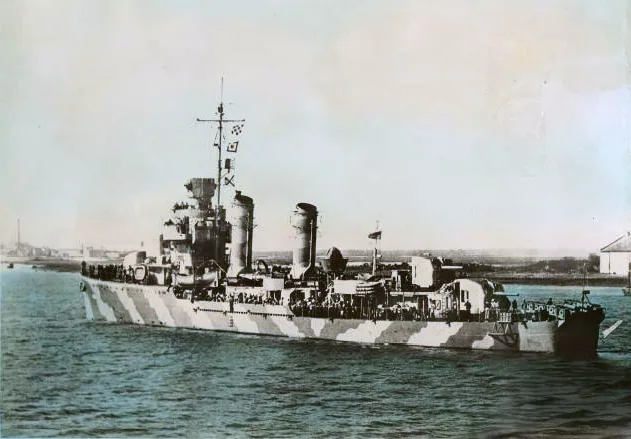
Service
- as USS Ingraham19 July 1941 — 11 September 1942419 days of the war
- Name
- USS Ingraham
- Pennant / hull number
- DD-444
- Namesake
- Duncan Ingraham
- Builder
- Charleston Navy Yard
- Laid down
- 15 November 1939
- Launched
- 15 February 1941
- Commissioned
- 19 July 1941
- Struck
- 11 September 1942
- Fate
- Sunk in collision, 22 August 1942
By collision (1942) - Status
- Wreck
Specifications
- Displacement, standard
- 1,600 long tons (1,626 t)
- Length
- 105.77 m (347 ft)
- Beam
- 10.97 m (36 ft)
- Draught
- 3.35 m (11 ft)
- Speed
- 33 knots (61.1 km/h, 38 mph)
- Range
- 6,500 nmi (12,038 km)
- Complement
- 208
- Main gun
- 127 mm (5 in)
Captain Duncan Nathaniel Ingraham was born in Charleston, S.C., 6 December 1802. He was appointed Midshipman 18 June 1812 at the age of 10 and, after distinguished service, was commissioned Captain 14 September 1855. While in command of the sloop-of-war St. Louis in the Mediterranean, in July 1853, he interfered at Smyrna with the detention by the Austrian consul of Martin Koszta, a Hungarian who had declared in New York his intention of becoming an America citizen, and, who had been seized and confined in the Austrian ship Hussar. For his conduct in this matter he was voted thanks and a medal by Congress. Captain Ingraham served as Chief of the Bureau of Ordnance and Hydrographer of the Navy from 1856 until 1860. He resigned from the Navy 4 February 1861 to enter the Confederate States Navy with the rank of captain. He was commandant of the Charleston station 1862 to 1865. He died at Charleston 16 October 1891.
The second Ingraham (DD-444) was launched 15 February 1941 by the Charleston Navy Yard; sponsored by Mrs. George Ingraham Hutchinson, granddaughter of Captain Ingraham; and commissioned 17 July 1941, LT . Comdr. W. M. Haynsworth, Jr., in command.
After shakedown and local operations along the East Coast, Ingraham commenced duties as convoy escort December 1941 as the Japanese surprise attack drew America into the fight for freedom. During 1942 she escorted convoys between the United States, Iceland, and the United Kingdom, bringing supplies desperately needed by the Allies to stem Hitler's advance and to take the offensive. Under constant threat from German U-boats, Ingraham continued her escort duty to Europe and as far south as the Panama Canal.
On the night of 22 August as she was investigating a collision between U.S. destroyer Buck and a merchant vessel, Ingraham collided with tanker Chemung in heavy fog off the coast of Nova Scotia and Ingraham sank almost immediately. Depth charges on her stern exploded. Only 11 men survived the collision. She was struck from the Navy Register 11 September 1942.
From the Dictionary of American Naval Fighting Ships, compiled by the Naval History and Heritage Command (Ingraham II (DD-444)). A work of the United States Government, in the public domain.
Armament and machinery
Armament and machinery
- Propulsion
- 2 × steam turbines
- 4 × boilers
- 2 × shafts
- Power
- 50000 shp
- Armament
- 5 × 5 in dual purpose guns
- 12 × 0.5 in machine guns
- 10 × 21 in torpedo tubes
- 1 × Y-gun depth charge projector
- 2 × depth charge tracks
Sister ships
- USS Aaron Ward (DD-483)
- USS Baldwin
- USS Beatty (DD-640)
- USS Bristol (DD-453)
- USS Buchanan (DD-484)
- USS Butler
- USS Carmick
- USS Corry (DD-463)
- USS Cowie
- USS Davison
- USS Doran (DD-634)
- USS Doyle (DMS-34)
- USS Duncan (DD-485)
- USS Earle
- USS Eberle
- USS Edison (DD-439)
- USS Edwards (DD-619)
- USS Ellyson
- USS Emmons
- USS Endicott
- USS Ericsson (DD-440)
- USS Fitch
- USS Forrest
- USS Frankford
Sources
- Facts harvested from USS Ingraham (DD-444) on Wikipedia. Figures only — no wording is taken from it.
- Service history reproduced verbatim from Ingraham II (DD-444) , Dictionary of American Naval Fighting Ships — public domain, a work of the United States Government.
- Photograph: United States Navy — Wikipedia:Contact us/Photo submission Sent in via OTRS ticket # 2009061010062191 — Public domain — Wikimedia Commons