USS Jack (SS-259)
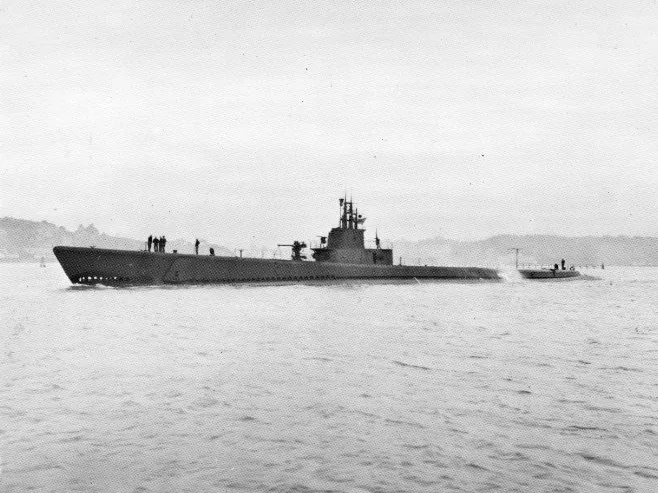
Service
- as USS Jack6 January 1943 — 21 April 1958970 days of the war
- as Amfitriti21 April 1958 — 5 September 1967
- Name
- USS Jack
- Pennant / hull number
- SS-259
- Builder
- Electric Boat Company, Groton, Connecticut
- Laid down
- 2 February 1942
- Launched
- 16 October 1942
- Commissioned
- 6 January 1943
- Decommissioned
- 8 June 1946
- Recommissioned
- 20 December 1957
- Struck
- 1 September 1967
- Fate
- Returned to the U.S. Navy, 1967 and sunk as a target 5 September 1967 (1967)
- Status
- Wreck
Specifications
- Displacement, surfaced
- 1,525 long tons (1,549 t)
- Displacement, submerged
- 2,424 long tons (2,463 t)
- Length
- 94.79 m (311 ft)
- Beam
- 8.23 m (27 ft)
- Draught
- 5.18 m (17 ft)
- Speed
- 21 knots (38.9 km/h, 24.2 mph)
- Range
- 11,000 nmi (20,372 km)
- Complement
- 60
- Main gun
- 76 mm (3 in)
The first Jack (SS-259) was launched by Electric Boat Co., Groton, Conn., 16 October 1942; sponsored by Mrs. Frances Seely; and commissioned at New London, Conn., 6 January 1943, Comdr. T. M. Dykers in command.
Jack underwent shakedown training along the New England coast, sailing from New London 26 April 1943 for service in the Pacific. Reaching Pearl Harbor 21 May, the submarine took on supplies and departed on her first offensive war patrol 5 June 1943. Taking part in a submarine offensive against Japan, she patrolled off Honshu. Jack came upon a five-ship convoy 26 June and in a series of five well-executed attacks sank 4,000-ton passenger-cargo ship Toyo Maru and 6,000-ton cargo ship Shozan Maru. In attempting to torpedo a third ship, the submarine was shaken by an aerial torpedo, but the alert crew corrected her dangerous diving angle and effected repairs. On Independence Day 1943, Jack began to track smoke on the horizon and soon detected Nikkyo Maru with an escort. The submarine sent the cargo ship under with three torpedoes and returned to Pearl Harbor for repairs 19 July 1943.
Jack's second war patrol (5 September-10 October) brought no opportunities for attack as engineering difficulties forced her to return prematurely to Pearl Harbor.
Continue to the full service history About 842 words
From the Dictionary of American Naval Fighting Ships, compiled by the Naval History and Heritage Command (Jack I (SS-259)). A work of the United States Government, in the public domain.
Armament and machinery
Armament and machinery
- Propulsion
- 4 × Hooven-Owens-Rentschler (H.O.R.) diesel engines driving electrical generators
- 2 × 126-cell Sargo batteries
- 4 × high-speed Allis-Chalmers electric motors with reduction gears
- two propellers
- 5,400 shp (4.0 MW) surfaced
- 2,740 shp (2.0 MW) submerged
- Armament
- 10 × 21-inch (533 mm) torpedo tubes
- 6 forward, 4 aft
- 24 torpedoes
- 1 × 3-inch (76 mm) / 50 caliber deck gun
- Bofors 40 mm and Oerlikon 20 mm cannon
Sister ships
- USS Albacore (SS-218)
- USS Amberjack (SS-219)
- USS Angler
- USS Barb (SS-220)
- USS Bashaw
- USS Blackfish
- USS Bluefish (SS-222)
- USS Bluegill
- USS Bonefish (SS-223)
- USS Bream
- USS Cavalla (SS-244)
- USS Cero (SS-225)
- USS Cobia
- USS Cod
- USS Corvina
- USS Croaker
- USS Dace (SS-247)
- USS Darter (SS-227)
- USS Dorado (SS-248)
- USS Drum (SS-228)
- USS Finback (SS-230)
- USS Flasher (SS-249)
- USS Flier
- USS Flounder
Sources
- Facts harvested from USS Jack (SS-259) on Wikipedia. Figures only — no wording is taken from it.
- Service history reproduced verbatim from Jack I (SS-259) , Dictionary of American Naval Fighting Ships — public domain, a work of the United States Government.
- Photograph: Unknown author — Unknown source — Public domain — Wikimedia Commons