USS Livermore (DD-429)
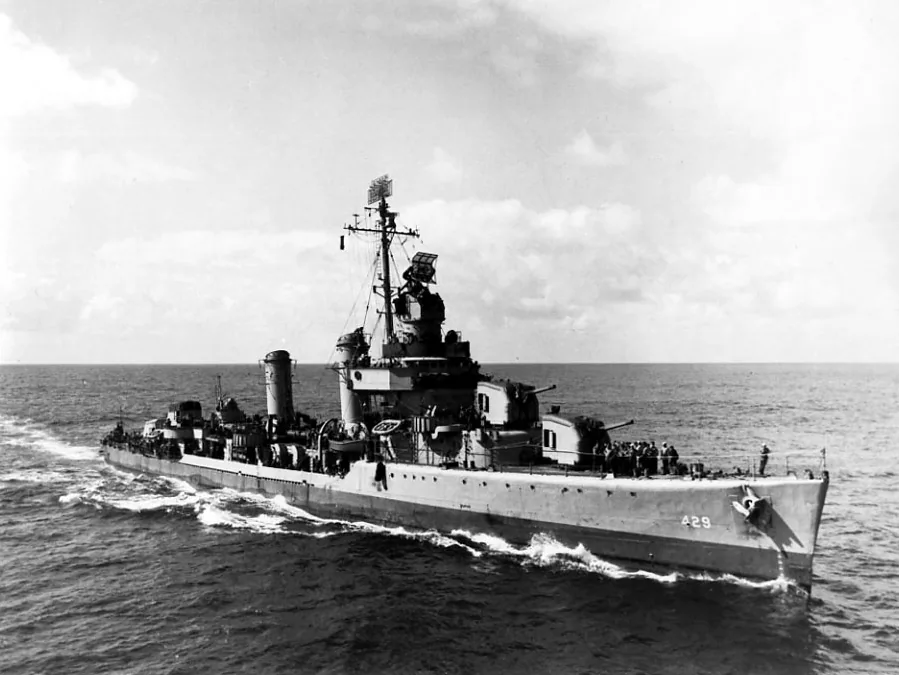
Service
- as Livermore7 October 1940 — 24 January 19471,791 days of the war
- Name
- USS Livermore
- Pennant / hull number
- DD-429
- Namesake
- Samuel Livermore
- Builder
- Bath Iron Works
- Laid down
- 6 March 1939
- Launched
- 3 August 1940
- Commissioned
- 7 October 1940
- Decommissioned
- 24 January 1947
- Struck
- 19 July 1956
- Fate
- Sold 3 March 1961 for scrapping (1961)
- Status
- Scrapped
Specifications — As built
- Displacement, standard
- 1,630 long tons (1,656 t)
- Length
- 106.07 m (348 ft) OA
- Beam
- 10.97 m (36 ft)
- Draught
- 3.35 m (11 ft)
- Speed
- 37.5 knots (69.5 km/h, 43.2 mph)
- Range
- 6,000 nmi (11,112 km)
Samuel Livermore was born in Concord, N.H., on 26 August 1786, the son of Edward St. Loe Livermore and Mehitable (Harris) Livermore. Samuel’s mother, Methtiable, died in 1793 at the age of 28, leaving behind five children; Samuel was only seven years old at the time of her death. His father, Edward, practiced law in Concord and upon reaching adulthood, Samuel followed in his father’s footsteps and pursued the law, attending Harvard College, Mass. He graduated from Harvard in 1804, and shortly thereafter passed the Massachusetts bar, whereupon, he began to practice law in Boston. It was in that place in 1811 that he published A Treatise on the Law Relative to Principles, Agents, Factors, Auctioneers, and Brokers , which, according to Charles Warren’s 1911 A History of the American Bar , was a first of its kind in American legal writing.
On 18 June 1812, the U.S. Congress declared war on Great Britain, beginning a conflict that would be known as the War of 1812 (1812–1815). A year into the war, on 21 May 1813, Livermore joined the U.S. naval service having been appointed the acting chaplain on board the frigate Chesapeake by the authority of Capt. James Lawrence, the frigate’s commanding officer. Livermore and Lawrence were friends and as was sometimes the custom during that time a commanding officer possessed the authority to appoint one of their friends to such a position with little inconvenience.
By the time Livermore began his service on board Chesapeake the Royal Navy’s presence along the U.S. coast had increased to 129 warships. Despite the British numerical superiority, U.S. naval vessels triumphed in a number of one-on-one duels, such as Constitution and HMS Guerriere (19 August 1812), Wasp and HMS Frolic (18 October 1812), United States and HMS Macedonian (25 October 1812), Constitution and HMS Java (29 December 1812). Thus, despite the British blockade and the general belief in the Royal Navy’s invincibility, confidence in their ability to tame the unruly Yankees started to wane.
Continue to the full service history About 6,818 words
From the Dictionary of American Naval Fighting Ships, compiled by the Naval History and Heritage Command (Livermore I (DD-429)). A work of the United States Government, in the public domain.
Armament and machinery
This vessel is recorded in 2 configurations. Wartime refits changed armament and complement substantially, so each is kept separately rather than averaged into one set of figures. The figures above are as built.
As built
- Propulsion
- Four Babcock & Wilcox boilers; General Electric SR geared turbines; 2 shafts
- 50000 shp
Fit 2
- Complement
- 276
- Main gun
- 127 mm (5 in)
- Armament
- 5 × 5 in DP guns
- 6 × .50 cal (12.7 mm) guns
- 6 × 20 mm AA guns
- 10 × 21 in torpedo tubes
- 1 × depth charge projector
- 2 × depth charge tracks
Sister ships
- USS Aaron Ward (DD-483)
- USS Baldwin
- USS Beatty (DD-640)
- USS Bristol (DD-453)
- USS Buchanan (DD-484)
- USS Butler
- USS Carmick
- USS Corry (DD-463)
- USS Cowie
- USS Davison
- USS Doran (DD-634)
- USS Doyle (DMS-34)
- USS Duncan (DD-485)
- USS Earle
- USS Eberle
- USS Edison (DD-439)
- USS Edwards (DD-619)
- USS Ellyson
- USS Emmons
- USS Endicott
- USS Ericsson (DD-440)
- USS Fitch
- USS Forrest
- USS Frankford
Sources
- Facts harvested from USS Livermore (DD-429) on Wikipedia. Figures only — no wording is taken from it.
- Service history reproduced verbatim from Livermore I (DD-429) , Dictionary of American Naval Fighting Ships — public domain, a work of the United States Government.
- Photograph: U.S. Navy — Official U.S. Navy photo 80-G-218107 from the U.S. Navy Naval History and Heritage Command — Public domain — Wikimedia Commons