USS Plunkett
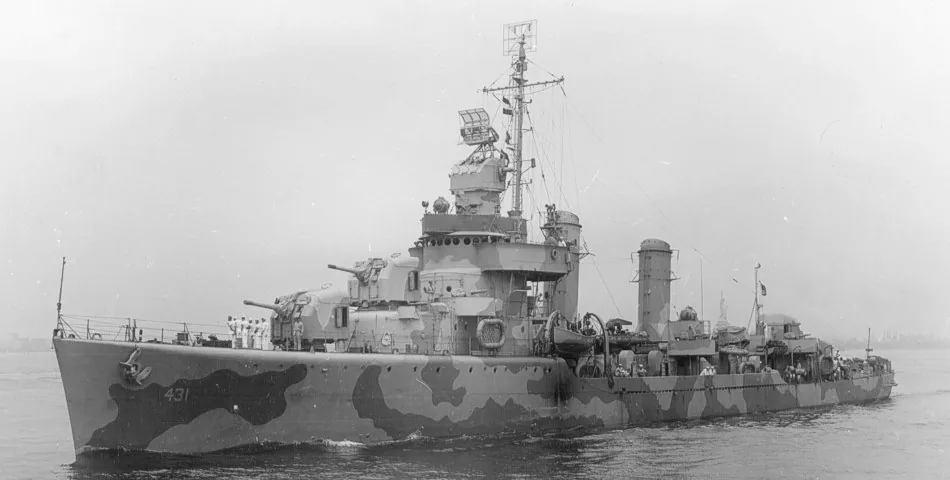
Service
- as USS Plunkett17 July 1940 — 1 November 19721,873 days of the war
- as ROCS Nan Yang16 February 1959 — 1975
- Name
- USS Plunkett
- Pennant / hull number
- DD-431
- Namesake
- Charles Peshall Plunkett
- Builder
- Federal Shipbuilding and Drydock Company
- Laid down
- 1 March 1939
- Launched
- 7 March 1940
- Commissioned
- 17 July 1940
- Decommissioned
- 3 May 1946
- Struck
- 1 November 1972
- Fate
- Scrapped in 1975 (1975)
- Status
- Scrapped
Specifications
- Displacement, standard
- 1,630 long tons (1,656 t)
- Length
- 106.07 m (348 ft)
- Beam
- 10.97 m (36 ft)
- Draught
- 3.35 m (11 ft)
- Speed
- 37.4 knots (69.3 km/h, 43 mph)
- Range
- 6,500 nmi (12,038 km)
- Complement
- 276
- Main gun
- 127 mm (5 in)
Charles Peshall Plunkett, born in Washington, D.C., 15 February 1864, was appointed to the Naval Academy in 1879. A veteran of the Spanish-American War, during which he served in Adm. Dewey-s Squadron at Manila Bay, he had commanded both North Dakota and South Dakota and had served as Director, Target Practice and Engineering Competitions for the Navy Department before the United States entered World War I. In July, 1918, he assumed command of the 5 Naval Railway Batteries in France. Under his direction those mobile units of 14- battleship guns supported French and American armies from 6 September until the Armistice. Awarded the Distinguished Service Medal for his service during the war, he later commanded Destroyers, US Atlantic Fleet, and served as Chief of Staff, Naval War College; President, Board of Inspection and Survey; and as Commandant, New York Navy Yard and the 3d Naval District. Retiring in 1928, Rear Admiral Plunkett died, in Washington, D.C., 24 March 1931.
Plunkett (DD-431) was laid down 1 March 1939 by the Federal Shipbuilding and Dry Dock Co., Kearny, N.J.; launched 7 March 1940; sponsored by Mrs. Charles P. Plunkett, widow of Rear Admiral Plunkett; and commissioned 17 July 1940, Lt. Comdr. P. G. Hale in command.
Prior to 7 December 1941, Plunkett operated in the Western Atlantic and in the Gulf-Caribbean area on Neutrality Patrol. Initially in the latter area, she joined other Neutrality Patrol vessels off Tampico to prevent the departure of several German steamers, then cruised off Martinique, French Antilles to prevent the dispatching of warships, equipment, and gold to the Vichy government. Patrol and convoy missions in the North Atlantic followed, and, on 7 December 1941, she was enroute from Reykjavik to Argentia.
Continue to the full service history About 1,129 words
From the Dictionary of American Naval Fighting Ships, compiled by the Naval History and Heritage Command (Plunkett (DD-431)). A work of the United States Government, in the public domain.
Armament and machinery
Armament and machinery
- Propulsion
- 50000 shp
- 4 boilers
- 2 propellers
- Armament
- 5 × 5 in DP guns
- 6 × .50 cal (12.7 mm) guns
- 6 × 20 mm AA guns
- 10 × 21 in torpedo tubes
- 2 × depth charge tracks
Sister ships
- USS Aaron Ward (DD-483)
- USS Baldwin
- USS Beatty (DD-640)
- USS Bristol (DD-453)
- USS Buchanan (DD-484)
- USS Butler
- USS Carmick
- USS Corry (DD-463)
- USS Cowie
- USS Davison
- USS Doran (DD-634)
- USS Doyle (DMS-34)
- USS Duncan (DD-485)
- USS Earle
- USS Eberle
- USS Edison (DD-439)
- USS Edwards (DD-619)
- USS Ellyson
- USS Emmons
- USS Endicott
- USS Ericsson (DD-440)
- USS Fitch
- USS Forrest
- USS Frankford
Sources
- Facts harvested from USS Plunkett on Wikipedia. Figures only — no wording is taken from it.
- Service history reproduced verbatim from Plunkett (DD-431) , Dictionary of American Naval Fighting Ships — public domain, a work of the United States Government.
- Photograph: Unknown author — Public domain — Wikimedia Commons