USS Puffer (SS-268)
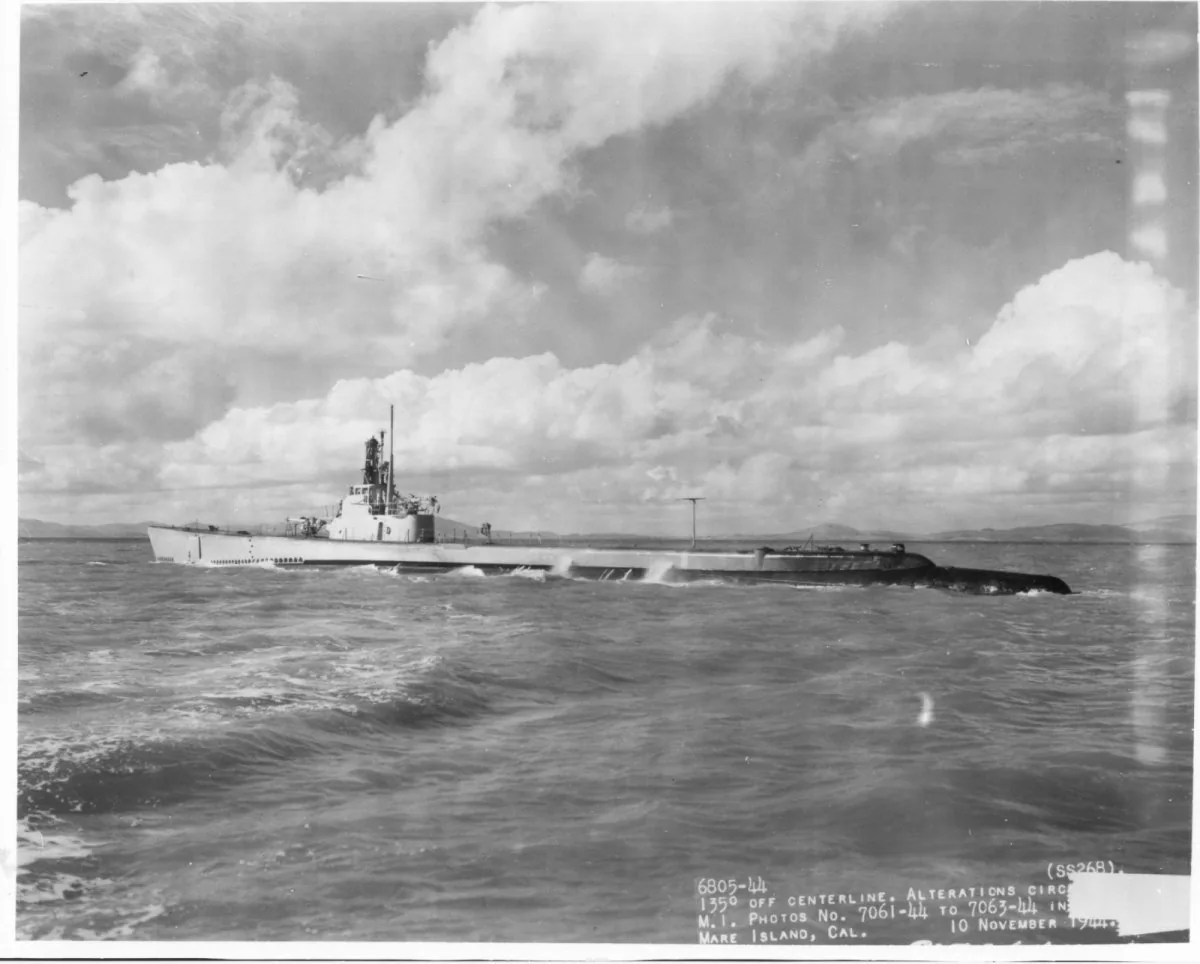
Service
- 27 April 1943 — 28 June 1946859 days of the war
- Name
- USS Puffer
- Pennant / hull number
- SS-268
- Builder
- Manitowoc Shipbuilding Company, Manitowoc, Wisconsin
- Laid down
- 16 February 1942
- Launched
- 21 November 1942
- Commissioned
- 27 April 1943
- Decommissioned
- 28 June 1946
- Struck
- 1 July 1960
- Fate
- Sold for scrap 3 December 1960 (1960)
- Status
- Scrapped
Specifications
- Displacement, surfaced
- 1,525 long tons (1,549 t)
- Displacement, submerged
- 2,424 long tons (2,463 t)
- Length
- 94.79 m (311 ft)
- Beam
- 8.23 m (27 ft)
- Draught
- 5.18 m (17 ft)
- Speed
- 21 knots (38.9 km/h, 24.2 mph)
- Range
- 10,799 nmi (20,000 km)
- Complement
- 60
- Main gun
- 76 mm (3 in)
Puffer (SS-268) was laid down by the Manitowoc Shipbuilding Co., Manitowoc, Wis., 16 February 1942; launched 22 November 1942; sponsored by Mrs. Ruth B. Lyons; and commissioned 27 April 1943, Lt. Comdr. M. J. Jensen in command.
Puffer was transported down the Mississippi to New Orleans on a special floating drydock, having periscopes installed enroute after receiving torpedoes and ammunition. She exercised off Panama for a month, then headed across the Pacific to Australia, arriving in early September 1943. Her first war patrol, to intercept Japanese commerce in the Makassar Strait-Celebes Sea area, 7 September to 17 October, resulted in several damaged ships but no sinkings. On 24 November Puffer sailed on her 2nd patrol, in the Sulu Sea and the approaches to Manila. On 20 December she sank 820-ton destroyer Fujo, and on 1 January 1944, 6,707-ton freighter Ryuyo Maru, before putting in to Fremantle for refit 12 January.
Puffer departed for her 3rd war patrol, in the South China Sea, 4 February. On 22 February, she sank the 15,105-ton transport Teikyo Maru. Returning to Fremantle 4 April, she sailed again 30 April for Madoera Straits, Makassar Straits and the Sulu Sea. She acted as life guard for the first Allied carrier strike on Soerabaia, sank 3,181-ton freighter Shinryu Maru 18 May, then on 5 June, attacked three tankers, sinking 2,166-ton Ashizuri and 2,500-ton Takasaki. She ended this most successful patrol, for which she received the Navy Unit Commendation, at Fremantle 21 June.
Continue to the full service history About 531 words
From the Dictionary of American Naval Fighting Ships, compiled by the Naval History and Heritage Command (Puffer I (SS-268)). A work of the United States Government, in the public domain.
Armament and machinery
Armament and machinery
- Propulsion
- 4 × General Motors Model 16-248 V16 Diesel engines driving electric generators
- 2 × 126-cell Sargo batteries
- 4 × high-speed General Electric electric motors with reduction gears
- two propellers
- 5,400 shp (4.0 MW) surfaced
- 2,740 shp (2.0 MW) submerged
- Armament
- 10 × 21-inch (533 mm) torpedo tubes
- 6 forward, 4 aft
- 24 torpedoes
- 1 × 3-inch (76 mm) / 50 caliber deck gun
- Bofors 40 mm and Oerlikon 20 mm cannon
Sister ships
- USS Albacore (SS-218)
- USS Amberjack (SS-219)
- USS Angler
- USS Barb (SS-220)
- USS Bashaw
- USS Blackfish
- USS Bluefish (SS-222)
- USS Bluegill
- USS Bonefish (SS-223)
- USS Bream
- USS Cavalla (SS-244)
- USS Cero (SS-225)
- USS Cobia
- USS Cod
- USS Corvina
- USS Croaker
- USS Dace (SS-247)
- USS Darter (SS-227)
- USS Dorado (SS-248)
- USS Drum (SS-228)
- USS Finback (SS-230)
- USS Flasher (SS-249)
- USS Flier
- USS Flounder
Sources
- Facts harvested from USS Puffer (SS-268) on Wikipedia. Figures only — no wording is taken from it.
- Service history reproduced verbatim from Puffer I (SS-268) , Dictionary of American Naval Fighting Ships — public domain, a work of the United States Government.
- Photograph: Unknown author — Unknown source — Public domain — Wikimedia Commons