USS Rathburne (DD-113)
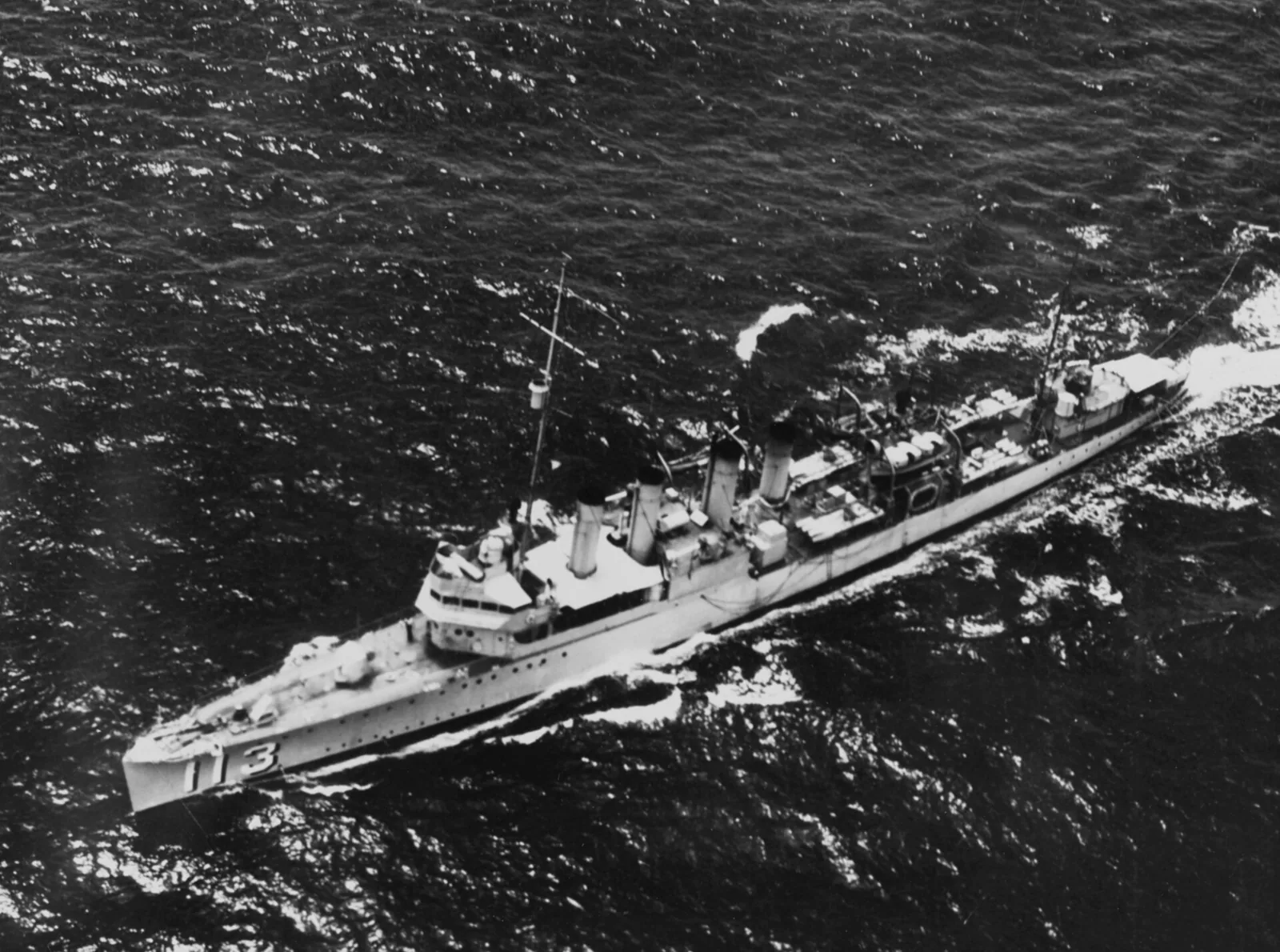
Service
- as Rathburne24 June 1918 — 2 November 19452,193 days of the war
- Name
- USS Rathburne
- Pennant / hull number
- DD-113
- Namesake
- John Peck Rathbun
- Builder
- William Cramp & Sons, Philadelphia
- Laid down
- 12 July 1917
- Launched
- 27 December 1917
- Commissioned
- 24 June 1918
- Decommissioned
- 12 February 1923
- Recommissioned
- 8 February 1930
- Struck
- 28 November 1946
- Fate
- Sold for scrapping, November 1946 (1946)
- Status
- Scrapped
Specifications
- Displacement, standard
- 1,060 long tons (1,077 t)
- Length
- 95.71 m (314 ft)
- Beam
- 9.45 m (31 ft)
- Draught
- 3.66 m (12 ft)
- Speed
- 35 knots (64.8 km/h, 40.3 mph)
- Complement
- 133
- Main gun
- 102 mm (4 in)
John Peck Rathbun served in the Continental Navy from its beginning. As a lieutenant in Providence , he participated in an attack on New Providence in 1776. When John Paul Jones took command, he remained in Providence , then went with Jones to Alfred . Promoted to captain of the sloop Providence in April 1777, he took his ship back to the Bahamas, and on the night of 27 January 1778, sent a small landing party of Marines ashore at New Providence. They captured Forts Nassau and Montague without bloodshed. On the 28th, Rathbun brought Providence into Nassau harbor. Before departing on the morning of the 30th, he and his crew had taken two sloops and a brig, Mary ; released American prisoners; dismantled the fortifications; and acquired badly needed small arms, ammunition, and powder.
In 1779 he assumed command of the frigate Queen of France and in July cruised off Newfoundland with Providence and Ranger . On the 16th the ships sighted a convoy bound for Britain. Fog closed in, but when it lifted, Queen of France was next to a merchantman whose crew mistook the American for a British escort vessel. Rathbun took advantage of the situation, exploited the mistake in identity, and captured the ship. Ranger and Providence followed suit. Ten more ships were cut out of the convoy, their total value approaching $1 million.
In 1780 Rathbun took Queen of France south in Commodore Whipple's force to bolster the defenses of Charleston, S.C. There, with smaller ships, she was stationed in the Ashley River to prevent British forces under Cornwallis from crossing and attacking the city. As the American position weakened, Queen of France's guns were removed and she was sunk as a block ship. Her crew then went ashore and Rathbun served as an artilleryman until the city fell in May 1781.
Continue to the full service history About 1,502 words
From the Dictionary of American Naval Fighting Ships, compiled by the Naval History and Heritage Command (Rathburne I (Destroyer No. 113)). A work of the United States Government, in the public domain.
Armament and machinery
Armament and machinery
- Armament
- 4 × 4 in/50 guns
- 2 × 3 in/23 guns
- 12 × 21 in torpedo tubes
Sister ships
- HMCS Annapolis (I04)
- HMCS Caldwell (I20)
- HMCS Chelsea (I35)
- HMCS Columbia (I49)
- HMCS Georgetown (I40)
- HMCS Hamilton (I24)
- HMCS Leamington (G19)
- HMCS Lincoln (G42)
- HMCS Mansfield (G76)
- HMCS Montgomery (G95)
- HMCS Niagara (I57)
- HMCS Richmond (G88)
- HMCS Salisbury (I52)
- HMCS St. Clair (I65)
- HMS Bath (I17)
- HMS Brighton (I08)
- HMS Caldwell (I20)
- HMS Campbeltown (I42)
- HMS Castleton (I23)
- HMS Charlestown (I21)
- HMS Chelsea (I35)
- HMS Georgetown (I40)
- HMS Hamilton (I24)
- HMS Lancaster (G05)
Sources
- Facts harvested from USS Rathburne (DD-113) on Wikipedia. Figures only — no wording is taken from it.
- Service history reproduced verbatim from Rathburne I (Destroyer No. 113) , Dictionary of American Naval Fighting Ships — public domain, a work of the United States Government.
- Photograph: Chief Photographer's Mate John Highfill, U.S. Navy — Official U.S. Navy photo NH 94845 from the U.S. Navy Naval History and Heritage Command — Public domain — Wikimedia Commons