USS Runner (SS-275)
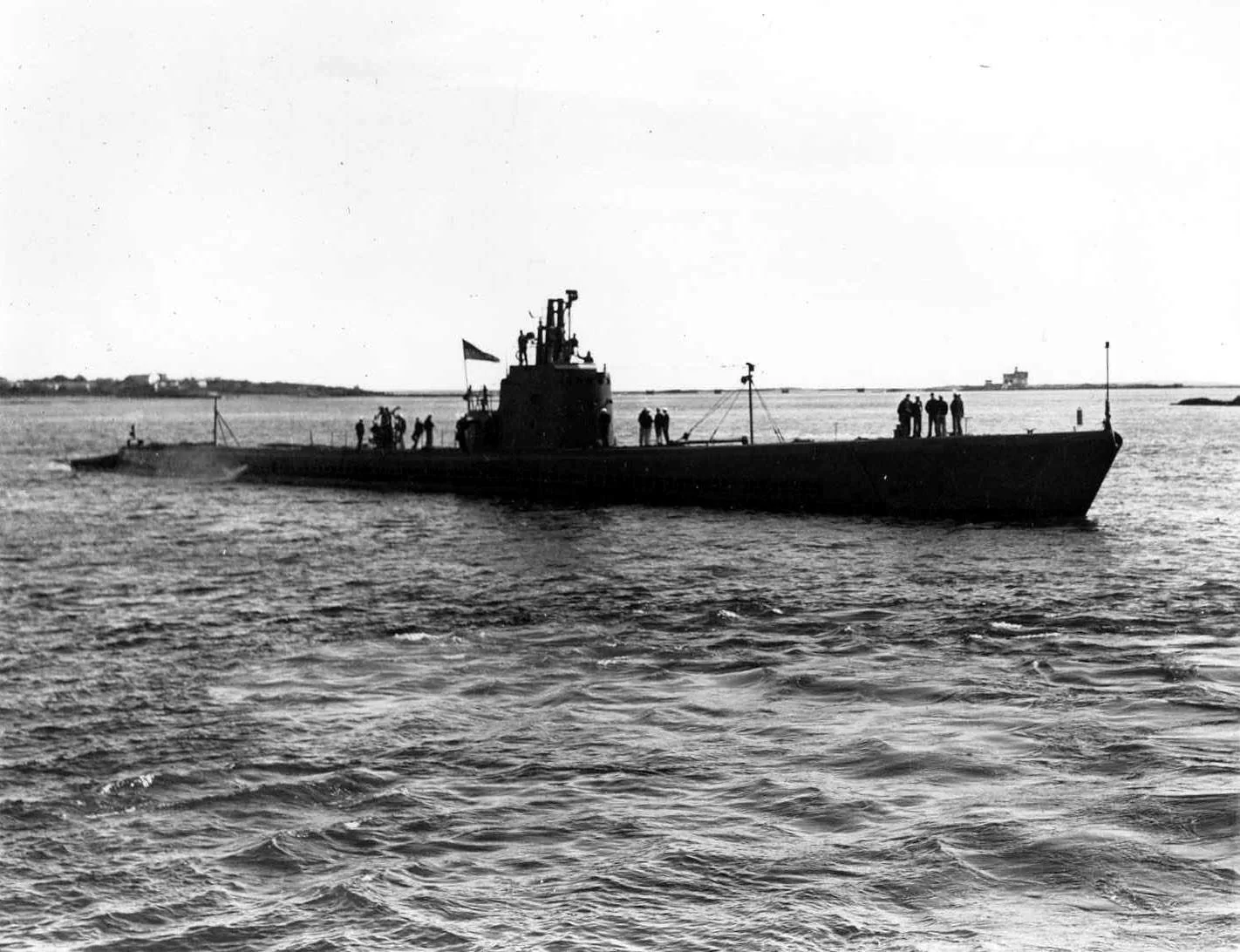
Service
- as Runner30 July 1942 — 30 October 1943457 days of the war
- Name
- USS Runner
- Pennant / hull number
- SS-275
- Namesake
- Runner
- Builder
- Portsmouth Naval Shipyard, Kittery, Maine
- Laid down
- 8 December 1941
- Launched
- 30 May 1942
- Commissioned
- 30 July 1942
- Struck
- 30 October 1943
- Fate
- Missing June 1943 (1943)
- Status
- Unknown
Specifications
- Displacement, surfaced
- 1,525 long tons (1,549 t)
- Displacement, submerged
- 2,424 long tons (2,463 t)
- Length
- 94.79 m (311 ft)
- Beam
- 8.23 m (27 ft)
- Draught
- 5.18 m (17 ft)
- Speed
- 21 knots (38.9 km/h, 24.2 mph)
- Range
- 10,799 nmi (20,000 km)
- Complement
- 60
- Main gun
- 76 mm (3 in)
The first Runner (SS-275), a diesel-powered attack submarine, was laid down 8 December 1941 by the Portsmouth Navy Yard, Portsmouth, N.H.; launched 30 May 1942; sponsored by Mrs. John H. Newton; commissioned 30 July 1942, Comdr. F. W. Fenno, Jr., in command.
Following shakedown out of New London, Runner departed the east coast in late 1942, and arrived at Pearl Harbor via the Panama Canal on 10 January 1943. Her first patrol, 18 January to 7 March, was conducted in the area between Midway and the Palau Islands. Five Japanese cargo ships were torpedoed on this patrol, but none was confirmed as being sunk. In making the last attack of the patrol on a freighter off Peleliu, she was damaged by a near miss from a bomb dropped from a patrol bomber. The concussion knocked out her sound gear and the power supply for both periscope hoists. Runner made her escape by a deep dive, the crew made emergency repairs, and the ship returned to Pearl Harbor for overhaul.
On her second patrol, 1 April to 6 May, Runner's primary mission was to lay a minefield off Pedro Blanco Rock. Successful in this mission, Runner proceeded to Hainan Straits, off the Chinese mainland. One freighter was torpedoed, and the sound of a ship breaking up was heard over Runner's sound gear, but the kill could not be confirmed. The submarine returned to Midway 6 May 1943.
On 27 May, she departed Midway for the Kurile Island chain and waters off northern Japan. No report was heard from her again. Captured Japanese records indicated that she sank the cargo ship Seinan Maru on 11 June in Tsugaru Strait off Hokkaido, and the passenger-cargo ship Shinryu Maru on 26 June off the Kurile Islands. Japanese records also suggest a submarine was lost either by striking a mine or a combination air and sea attack. In any case, Runner was declared overdue and presumed lost in July 1943 and struck from the Navy list on 30 October 1943.
From the Dictionary of American Naval Fighting Ships, compiled by the Naval History and Heritage Command (Runner I (SS-275)). A work of the United States Government, in the public domain.
Armament and machinery
Armament and machinery
- Propulsion
- 4 × General Motors Model 16-248 V16 Diesel engines driving electric generators
- 2 × 126-cell Sargo batteries
- 4 × high-speed General Electric electric motors with reduction gears
- two propellers
- 5,400 shp (4.0 MW) surfaced
- 2,740 shp (2.0 MW) submerged
- Armament
- 10 × 21-inch (533 mm) torpedo tubes
- 6 forward, 4 aft
- 24 torpedoes
- 1 × 3-inch (76 mm) / 50 caliber deck gun
- Bofors 40 mm and Oerlikon 20 mm cannon
Sister ships
- USS Albacore (SS-218)
- USS Amberjack (SS-219)
- USS Angler
- USS Barb (SS-220)
- USS Bashaw
- USS Blackfish
- USS Bluefish (SS-222)
- USS Bluegill
- USS Bonefish (SS-223)
- USS Bream
- USS Cavalla (SS-244)
- USS Cero (SS-225)
- USS Cobia
- USS Cod
- USS Corvina
- USS Croaker
- USS Dace (SS-247)
- USS Darter (SS-227)
- USS Dorado (SS-248)
- USS Drum (SS-228)
- USS Finback (SS-230)
- USS Flasher (SS-249)
- USS Flier
- USS Flounder
Sources
- Facts harvested from USS Runner (SS-275) on Wikipedia. Figures only — no wording is taken from it.
- Service history reproduced verbatim from Runner I (SS-275) , Dictionary of American Naval Fighting Ships — public domain, a work of the United States Government.
- Photograph: Unknown author — Public domain — Wikimedia Commons